
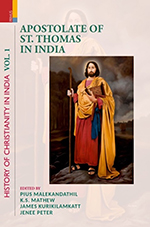
Apostolate of St. Thomas in India, the first volume in the History of Christianity in India series commissioned by the Syro-Malabar Church, examines the tradition of St. Thomas’s mission to India from a historical perspective rather than treating it simply as an article of faith. Bringing together historians, archaeologists, theologians and scholars from related disciplines, it argues that the apostolic tradition gains credibility when different forms of evidence are viewed collectively. Literary sources, archaeological discoveries, inscriptions, coins, oral traditions, liturgical texts, ecclesiastical records, Indo-Roman trade networks and cultural memory are all woven into the discussion. The long-standing debate between the Apostolic theory and the Migration theory maintains that the earliest community understood itself as Mar Thoma Christianikal, whereas the title ‘Syrian Christians’ reflected liturgical and ecclesiastical connections rather than ethnic identity. In doing so, the volume questions earlier Eurocentric approaches that tended to privilege written documents over indigenous historical traditions.
The historical analysis is enriched by insights from Church History, Archaeology, Anthropology, Geography, Trade History, Numismatics, Epigraphy, Literary Criticism, Cultural Studies and Ethnohistory. Influenced by Ranajit Guha and the Subaltern Studies tradition, the contributors argue that oral narratives, ritual practices, pilgrimage customs, songs, and collective memory can serve as legitimate historical sources when supported by independent evidence. The chapters move logically from the political and cultural settings of first-century North-West India and South India to discussions of the Acts of Thomas, the Seven Churches, Mylapore Archaeology and Syriac, Arabic, Patristic, Portuguese and Papal sources. The loss of Syriac and Malayalam manuscripts destroyed by Portuguese colonizers during the Synod of Diamper (1599) is also highlighted as an important reason for the limited documentary evidence available today.
The volume presents a persuasive case by identifying King Gondophares through numismatic evidence and the Takht-i-Bahi inscription, lending historical support to the Acts of Thomas. It proposes two phases of St. Thomas’s mission: the First Apostolate (AD 44–50) in North-West India and the Second Apostolate (AD 52–72) in Kerala and Mylapore, and relates both to the Indo-Roman maritime trade network. The strategic placement of the Seven Churches along major trade routes and the concept of a ‘historical nucleus’ further strengthen its argument that traditions preserved across Syriac, Arabic, Greek, Latin, Portuguese and Indian sources reflect a shared historical memory. Drawing on textual, archaeological, and visual evidence, including the Acts of Thomas, Patristic writings, Syriac manuscripts, Papal Bulls, inscriptions, coins, St. Thomas Crosses, the Flos D. Thomae, Margamkali and Parichamuttukali, the volume makes a significant contribution to the historiography of Indian Christianity. The book undoubtedly offers a strong foundation for future research.
Diana Agnes is Assistant Professor, PG and Research Department of English, Auxilium College (Autonomous), Vellore.