
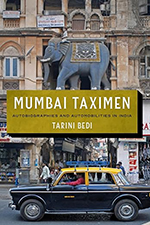
Over the past decade or so, ethnographic work on Mumbai has taken a pronounced infrastructural turn. Jonathan Shapiro Anjaria, Lisa Björkman and Nikhil Anand, among others, have investigated the making and maintenance of the city’s material fabric, from contested streets to the politics of piped water. Tarini Bedi’s Mumbai Taximen is an impressive, if differently inflected, addition to this growing literature. Originally conceived as an exploration of Bombay’s transport infrastructure, the study morphed into a thick description of the Chillia, hereditary Sunni Muslim drivers of Mumbai’s once ubiquitous black-and-yellow Premier Padmini taxis. Residing predominantly in the northern Mumbai suburb of Pathanwadi, these migrants from Palanpur in Gujarat claim a history of taxi driving in the metropolis dating back to the early twentieth century. Using the lens of ‘sensuous scholarship’ (p. 6), Bedi unpacks how these men and their families built meaningful lives, kinship networks, and political claims to the city through the daily labour of driving, repairing and caring for their cars.
Bedi frames this sensory universe through concepts drawn from the vocabulary of her interlocutors. A key idea is joona (original or old), a term that suffuses Chillia narratives in two ways. First, it is a claim to belonging and pedigree: the Chillia assert their status as the city’s original taxi drivers, implicitly countering the idea that they are either recent or transient migrants. Second, joona also signifies mastery, a testimony to the skills acquired over time and passed down from one generation to another. Importantly, in the early twenty-first century, the word was also applied to the Premier Padmini, a car whose struggles to stay on the road (until it ceased to ply in 2023) mirrored the battles against obsolescence waged by its ageing drivers.
Bedi also interprets the domestic and social economy of the Chillias through their jaalu, a term denoting the web of kinship ties that stretches across sexes and generations alike within this community. She shows how relations of jaalu are multi-stranded, combining kinship with the practical business of keeping a household afloat. This involves pooling funds, advancing informal loans, and adhering to social expectations and religious norms. Although driving is an overwhelmingly male occupation, Chillia women in Pathanwadi undertake maal, small-scale piecework for sale that is conducted from the confines of the home. Some women also serve as religious teachers in the community. Bedi highlights the centrality of women’s work to the family economy, sustaining households in the face of constant precarity. Where taxi driving serves as the outward-facing dimension of the Chillia’s jaalu, maal functions in an intimate register, ensuring the fulfilment of familial obligations.
Dekh-bhal denotes the sensory care through which drivers sustain their vehicles, their livelihoods, and one another. Bedi interprets a driver’s skill as a recursively honed instinct, shaped through long years of tactile engagement with the feel, rhythm, smell, and sound of the car. Her narrative fleshes out how this accumulated history of care, rather than abstract measures of value, underpinned a car’s worth. Dekh-bhal, in its broadest sense, structures Chillia perceptions of their relationships with their machines and with each other.
In the final chapter, Bedi shifts the focus from the internal social world of her subjects to the external institutional contexts that structure their lives, in particular the spheres of official bureaucratic procedures and labour politics as these play out in union and government offices. She argues that in these domains, ‘it is competition between the legal, bureaucratic, and institutional aspects of knowledge that shapes relations rather than the sensory knowledge of the drivers’ jaalu’ (p. 168). In turn, ‘These different worlds and their different configurations of knowledge and regulation are vital to how tensions over driving work and rights to contemporary Mumbai’s roads play out’ (p. 169).
Bedi’s sensory approach yields a larger argument about the study of automobility as a global technology and practice. Her focus on the collective structures that frame the Chillia’s relationship with their taxis stands in contrast to dominant approaches within Western scholarship that privilege the individual, usually male, driver. Bedi reveals instead how an ostensibly atomized form of livelihood fashioned a community. For the Chillia, driving is an activity sustained collectively, through kin ties and sensory knowledge passed down across generations. Importantly, however, Bedi does not construe this as a vernacular tradition sitting outside global car culture. The kaali-peeli trade grew out of the same worldwide spread of cars and roads in the twentieth century. ‘Indian automobility’, Bedi concludes, ‘is both a universal experience of automobilization and a specific sensory, embodied, and political domain where people who drive for a living collectively cultivate relationships to cars, technology, repair, the material and ecological environment, and the road’ (p. 200).
Mumbai Taximen shows how the Chillia built a knowing and knowledgeable life, marked by the quest for dignity and honour, within a trade whose terms—economic, political, and technological—were set by others. The deep and often moving engagement with her protagonists’ lives allows her to construct a sensitive and culturally nuanced account of Indian automobility as a practice. But because the book stays so close to one hereditary community, a reader is left wanting to know more about how other taxi drivers, standing outside the Chillia network and lacking their carefully nurtured claims to pedigree and provenance, might complicate the sensory and kin-based model Bedi presents in this finely crafted book.
Prashant Kidambi is Professor of Colonial Urban History at the University of Leicester, UK. He has written extensively on the history of Mumbai.