
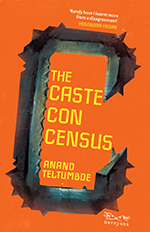
The Reservation policies for the subaltern castes, which were first institutionalized by the British Indian Government through the Government of India Act of 1935, Anand Teltumbde argues, had two sequels: they became the cornerstone of a postcolonial welfarist affirmative action agenda on the one hand, and, on the other hand, fuelled the agenda, in more recent times, that the Government conduct an updated caste census, a systematic recording of individuals’ caste identities during a nationwide population survey. This contemporary demand from several opposition parties has now been finally accepted by the political class across the entire spectrum of ideologies. The context of Teltumbde’s study is, specifically, the sudden and unexpected turnaround by the Hindu Right Government, headed by the Bharatiya Janata Party (BJP), in agreeing to a move which, not too long ago, Prime Minister Narendra Modi and his cohorts had decried as an ‘urban Naxal thought’ and branded as a divisive agenda. The BJP’s suspicion of and resistance to any attempt to fragment the Hindus along caste lines was, in fact, predictable, and made evident as early as the 1990s in its protest against the decision of the government led by VP Singh to implement caste-based reservations (on the same lines as those for the Scheduled Castes and Scheduled Tribes) for the so-called Other Backward Classes (OBCs).
In The Caste Con Census, Teltumbde tries to excavate the several foundational layers on which the caste system in its current incarnation has been constructed. He tracks the emergence of the system from the point of the gradual over-determination of the several autonomous, indigenous communities settled in the Indian subcontinent by the steady influx of migrant populations, especially the Steppe pastoralists, from the north. Over time, the general trend of genetic admixture declined, and traces of endogamy (the core feature of caste society) became more and more evident. It was the Steppe settlers, largely, who seemed to be the source of early Vedic rituals and the gradual crystallization of Brahminical Hinduism through the merger of their own traditions, with certain indigenous practices. The regimentation of the structure happened despite, or perhaps because of, the challenge posed to Brahminism by the shramanic religions of Buddhism and Jainism. Nor did the extended rule of several Muslim dynasties during the medieval era of Indian history, unhampered by any reformist aspirations, disturb the, by then, indisputably Brahminical, religious hegemony among the Hindus.
For Teltumbde, the defining moment for the inauguration of caste in its modern avatar was the colonial period, following the Mutiny of 1857, during which the British Indian Government realized that in order to govern the Indian colony more effectively, it must have a comprehensive knowledge about native life. To this end, ‘the government undertook systematic efforts to collect, codify and institutionalize knowledge about native customs, communities and hierarchies to better administer and control them.’ A key purpose of this strategy was to divide and rule a subject race which had managed to consolidate itself by uniting its constituents across regions and religions. By the 1881 census, caste (along with religion) had officially become central to the colonial categorizing procedure and attempts were made to fit all jatis into a pan-Indian fourfold varna system, irrespective of regional variations. This ‘totalizing epistemology’, as Teltumbde describes it, transformed the heterogeneous Indian society into an inert object of administration and domination. While not agreeing with the contentions of some scholars that the British ‘invented’ caste, Teltumbde does hold that the British reconstructed it, making it bureaucratic and documented. Colonial power, in his words, ‘not only produced a taxonomy of caste, but also installed into it the grammar of governance’.
The segregation of the lowermost castes under different heads in the colonial censuses proved to be a model for the creation of demographic brackets called ‘scheduled’ (protected) castes (Dalits) and tribes (Adivasis) in the Government of India Act, 1935. These became a blueprint of sorts for the Constitution of postcolonial India. Coining a term which is replete with irony, Teltumbde calls these the ‘constitutional castes’, meaning thereby that they, along with the later addition called ‘Other Backward Classes’ (OBCs), are castes which have been legally accorded the right to reservation. Once caste had been legally ‘entrenched’, with minimum objection from within the Constituent Assembly, the radical Ambedkarite discourse of caste annihilation was marginalized by the pragmatic discourse of state-administered justice via caste-based reservations. Thus, instead of being used as a contingent fire-fighting mechanism to narrow down caste disparities, reservations, with no timeline and no yardstick to measure the degree of their success or failure, have, over time, been installed as the ultimate panacea for the redressal of a caste-riven social order. Meanwhile, there are hardly any universalist programmes for the empowerment of the deprived people in general, such as long-term, state-mandated provision for quality affordable housing, healthcare and education, these having been deferred, seemingly forever, by a policy of ‘affirmative tokenism’, as Teltumbde designates it. His own position is that, historically, reservations have only benefitted a small upper crust among the constituencies of the downtrodden, while the overwhelming majority among them continue to endure caste stigma and humiliation.
Not unexpectedly, in recent years, an unseemly race has begun among some of the beneficiaries of reservations, ironically the relatively prosperous OBCs, the constituency of land-owning, intermediary caste farmers—to claim the spoils of ‘backwardness’. This manifests itself in the creation of several splinter groups of ‘backwards’, such as the Extremely Backwards Castes (EBCs) and the Most Backward Castes (MBCs), each aiming to bag for itself as large a share of the compensatory cake as possible. But the last laugh for those who have always been sceptical about the direction in which the reservation bandwagon has been travelling is the admission into this compartment of the non-caste related Economically Weaker Sections (EWS) of the population. The move for this additional quota of 10 per cent for the EWS was, not surprisingly, initiated by the BJP, which has a support base largely among the upper castes, Brahmins and Banias primarily. However, equally predictably, the move won consent from almost all political parties in Parliament, not one of which wanted to be branded anti-reservation.
The Caste Con Census, therefore, is a compact, yet comprehensive, study of the now impending caste census, which, according to Teltumbde, will be no more than an extension of the logic of reservations. Its findings, even if they are arrived at most meticulously, with utmost concern for accuracy and authenticity of data, will be of little help to a majority of the reserved category populations who, in a day and age of shrinking government sector openings in education and employment, will not qualify for government doles through reservation anyway. A conclusion with which many, even from among the liberal Left, might not be too comfortable.
Tapan Basu is former Professor, Department of English, University of Delhi, Delhi.