

Dibyajyoti Sarna’s Red River, an independent not-for-profit organization, has been publishing books, mostly poetry collections, since 2017. Sarna’s book design and Semeen Ali’s editing bring together well-chiselled poetry books where poems read like art installations; the intricate art design on the cover and inside adds a unique intensity to the books. Interestingly, in the books under review are voices from different parts of South Asia: Aziz is from Pakistan, Islam is from Bangladesh, and Wahie and Sivakumar are from India.
Ammar Aziz’s debut poetry book, The Missing Prayer is a layered emotional and spiritual journey coursing through life’s many experiences. Deeply autobiographical, the poems delineate with empathy the lives of his grandparents and parents, and the pain experienced by them due to the Partition. Aziz’s grandfather, an unpublished poet, lost his life’s work in India as he waited for the family to move to Lahore in 1947. His grandmother narrated stories of mango orchards in Hoshiarpur— ‘She spoke of her home, of the land,/of the walls, which must have absorbed her shadows,/ her calls.’ In poetry he meets his father; in music his mother. In ‘Puriya Kalyan’, ‘Mother is a minor raga/ melded with a major scale./ I chase her on keys/ and strings of love/ from one octave to another.’ The ethereal and the material blend in a poem on Urdu, the ‘language of revered forms’— ‘You want me to talk dirty/ but how does one do that/ in Urdu?…The language, which has/ the expression to praise/ the mysterious sensations of your body….’ An acute awareness of a world increasingly Islamophobic is seen in poems like ‘When They Spot a Muslim’. At the core of this book lie reminiscences of the poet’s childhood and it is from this well of memories that Ammar Aziz draws his poems.
Mohammad Shafiqul Islam’s On the Other Side of Silence is his third poetry collection. The poems are thought-provoking meditations on silence. 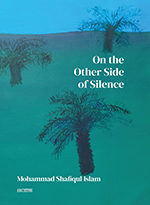

 The poems become an immersive experience in the elegiac mode and ‘there is rhythm in grave-digging’— ‘How many graves, then, turn a country into a graveyard?’ In the poem ‘Cartography’, the poet expresses his love for his beloved Bangladesh. He dreams of a land ‘where both city and country had bonds, connecting the populace with a lisle of amity and empathy, with no sign of bigotry and injustice’. Even though the present is a far cry from his imagined world, the poet continues to dream and hopes— ‘One bright morn the birds will sing again.’
Sarvesh Wahie, doctoral research scholar from Jena, Germany, has brought out his second book titled Mussoorie Daze. Wahie grew up in Mussoorie, Uttarakhand and writes as an insider to reflect critically on the state of one of India’s most popular hill stations. The poet reminisces about the Mussoorie that was, with its dense deodars, pine trees and oaks. Intense lines in prose and verse course through iconic places such as Picture Palace, Library Chowk, Clock Tower, Kempty Falls, as also other lesser-known ones such as village Kotli. Wahie marks how tourist invasion has transformed the hill station into a place ‘flooded with garbage’, with ‘intolerable whiffs of burnt clutch plates’. Wahie delves beneath the ostensible colonial history of Mussoorie which has rendered places like Landour ‘the theatre of nostalgia industry’. He asks poignantly, ‘But does Mussoorie not have a history of its own, that the nostalgia industry has won itself a monopoly in literature and otherwise?’ In the chapters that follow, Wahie’s prose focuses on the individual in space and time, the process of writing and its impact on the self. The poet seeks solace in the recovery of silence: ‘Let the voices now be gone, disperse into silence, and let the forest speak.’ The long poem titled ‘Daze 2’ reinforces this idea and silence emerges as a precious but sadly a forgotten entity in the present: ‘Night oh Night!/ Swollen from a sepia diffuse,/ This town is miniscule/ on a moonless high./ Sunken in a contagious cold./ Even the streets do not comply/ to the silence, once a birthright,/ seldom do waters blemish the eyes.’
The dogs on the streets of Mussoorie are important inhabitants of the hill station, savouring silence at midnight: ‘Let these echoes of the midnight be the terrain of dogs alone, for they have mastered the art of blending their voices into silence.’
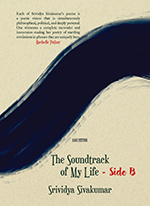
Srividya Sivakumar’s third poetry collection, The Soundtrack of My Life—Side B, takes us through the many notes of life both consonant and discordant. The dominant note, in this book, is that of desire. Sivakumar’s ability to view different facets of life through desire makes her poems an engaging read. She remains ever conscious of an absent lover or one that leaves, but in the many relationships she charts, there is an assertion of the body. Silence manifests in an entirely different way in Sivakumar’s world as the poet makes a pitch for expression: ‘Turn your back to this beast of silence./ Let averted eyes strengthen you./ Let a shift in stance guide you./ May you always be (silence) free.’ Sivakumar’s poems defy the traditional mould of passivity for women and immerse whole-heartedly into the language of the body; this is both response and resistance.
Using Subramania Bharati’s phrase ‘Rowthiram Pazhagu’ in the Tamil script as the title of her poem, Sivakumar, like the celebrated Tamil poet, urges women: ‘You do not have to be on your best behaviour at all times./ What you do need/ is to be your authentic self.’ A striking aspect of this book is the subtle but seamless blend of Tamil words with English: ‘I tell my students the rain smells better as mannvasanai or mitti,/ not petrichor.’
The voices of Aziz, Islam, Wahie and Sivakumar from different parts of the Indian subcontinent indicate interesting stylistic and thematic trends. The wide range charted by these poets provides multiple standpoints to understand the conflictual context of the individual in today’s world.
Payal Nagpal is Professor, Department of English, Janki Devi Memorial College, University of Delhi, Delhi.