
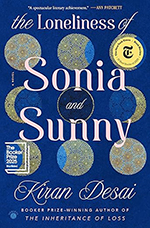
There must have been more unlikely foundations for a romance than a shared inability to finish a book, but to suggest that one cannot read Yasunari Kawabata’s Snow Country because one loves it too much is, on the implausible face of it, rather like leaving a tin of Beluga unopened out of a sheer reverence for caviar. Whoever frowned more scornfully against such romantic cant than the average reader? Yet when Sunny and Sonia first encounter each other in Kiran Desai’s The Loneliness of Sonia and Sunny, it is this conversational gambit that passes between them. I must confess to having subjected Desai’s own meticulously upholstered saga to much the same Tantalus-like treatment, picking it up and dropping it until its prose began to sound in my mind like Komako’s samisen—vibrant, crystalline, and echoing off some distant, snowy peak. Its pages pull us through a tunnel of their own until, as if from behind a steamed-over train window, the outer world is blotted out and only Desai’s white wilderness remains.
And what a rewarding wilderness it is: dizzyingly vast, shape-shifting like Badal Baba himself. Desai sweeps us from the dust-scalloped guava orchards and murky dawns of Allahabad to the deodar-dark slopes of Landour, where ghost snows hover silently in the ether. We are carried down to Goan shores, where crumbling, oyster-shell-shuttered mansions sit among python-like rivers, the evening air redolent of salty mud, woodsmoke, and frying prawn croquettes. From there, she plunges us into the transparent turquoise lagoons of Venice, past gloomy palazzos, before depositing us in Mexico, where volcanic-stone haciendas smell of copal and squeezed morning oranges, and plundered clay creatures stare blankly from bookshelves.
Which writer could escape the charge of banality if their plot were reduced to its bare bones? Stripped so bare, the narrative reads suspiciously like a turn-of-the-millennium Bombay melodrama: a lonely phoren-studying girl’s grandparents scheme to match her with a phoren-settled boy, both resist, a fortuitous tragedy throws them together, a sun-drenched romantic interlude in Goa, and the inevitable Venetian rupture that scatters them back to their respective exiles, which eventually accomplish what the families could not. But plots, of course, do not make a novel; such reductive exercises only serve to prove how literature completely relies upon its execution.
Where Desai’s execution triumphs is in its dialectical tension. She sets the suffocating intimacy of home against the anonymity of exile, in which her characters are permitted to dissolve into ghosts. Sonia’s displacement in Vermont is not merely a consequence of bad weather, but a deliberate erasure orchestrated by an older lover. The artist Ilan de Toorjen Foss is a predatory aesthete who might have been sired by Robert Browning’s Duke of Ferrara out of Henry James’s Gilbert Osmond. Like Osmond, he treats a living woman less as a companion than as an exquisite acquisition to be curated, going so far as to command her to hide under his bed when a guest intrudes. He prefers the absolute control of a captured image to a breathing woman, converting his subject into a canvas where, we are told, ‘everyone he painted turned into him’.
Sunny’s parallel disquiet in New York does not elicit equal sympathy, if only because his isolation is so entirely self-inflicted. Fleeing the claustrophobia of home, he traps himself in a performative masquerade, hiding his past from his American girlfriend while wandering a city that makes him feel like an impostor. Desai knows very well that the immigrant dream is rarely as liberating as its proponents assume. She has a sharp eye for the unique humiliations of the uprooted: the lonely Indian in New York who avoids his countrymen on the assumption that multiple brown bodies invite suspicion, or the wretched aunt dying of shame at the sight of Punjabi toilet cleaners in London. This internalized prejudice corrupts even intimacy; Sunny belatedly realizes that his initial pride in a white partner was merely a shallow assimilation that has curdled into ‘inherited racial rage’.
Across all these spaces, caste, class, religion, and race remain inescapable prisons, compounded by the ferment of sectarian hyper-nationalism. The violence of the present, Desai reminds us with grim cyclicality, is built securely upon the blood of the past.
The most striking thing about the novel’s structure is how earnestly it operates as an intricate game of the gaze. The journalist, the writer, the painter, and even the state are all implicated in this hierarchy of looking. Desai lends Ilan’s artistic tyranny a literal, rather gothic extension: the artist’s gaze manifests as a spectral hound stalking the Indian hills. Even absolute absences possess eyes. A faceless silver amulet is left to stalk dreams, and the weight of ancestral watchfulness peers through an attic window. The characters attempt to master their displacement by documenting others, only to find the lens turned back ruthlessly upon themselves.
The book, sedimented by these themes, runs like a great river, inconsistent in its speed, pooling in dark, unexpected eddies but ever flowing. It pulls us in a singular, haunting current, whose true momentum is driven by the subterranean tetrad of human experience: love, loneliness, absence, and abandonment. Indeed, the consistency with which the novel enwraps us in the mist of its world lies, paradoxically, in its very inconsistency. Not all sentences march to the same rhythm; paragraphs and thoughts wander, and characters do not inevitably resolve along expected trajectories. Yet everyone, in their varied way, carries a shimmering knowledge of life; everyone is granted something sharp, something infused with mysticism, to say. A melancholic patriarch, Manav, touches upon the core of the matter when he advises Sunny to abandon the certainties of the West and go straight to the mystics to understand ‘who you should have become instead of the person that you are’. Invoking Rumi’s banishment from Balkh and his devotion to Shams of Tabriz, he reminds us that exile and love—while they violently undo the sense of self—are the forces that shake the soul and form the kernel of any true spiritual quest.
To enter this river is to accept that you may not return intact, for at the heart of this current is a paradox: to love another is to risk losing the right to exist. This psychological non-existence operates as a structural principle across the novel’s broader canvas. We see it in the bureaucratic erasure of the rapist, Madan, who, because he does not legally exist on paper, becomes a dangerous, untraceable shadow. We see it in Sonia, who, when subjected to the predatory Ilan, feels she has been entirely erased. Standing on the threshold of a new life, she points out to Darius the impossibility of writing her own story: ‘How to write about myself during the time I was missing? My thoughts were Ilan’s thoughts. Then if a woman has become a mirror, if art is a mirror, how can a mirror create a mirror?’
One sees in these sentences not only beauty, but a sense of psychological depth—an eagle-eyed understanding of how humans observe, what their interior lives are made of, and how those observations slowly evolve them into who they are.
Desai was never a minimalist, and the sheer fecundity of this book is, quite simply, an unbodied joy. One sits back constantly to marvel at her sentences and the dappled beauty they evoke. In a literary landscape that often demands fiction to perform immediate, utilitarian work, her novel invites a luxurious, total surrender to the imagination. Rather than being encumbered by restraint, the pages are generously adorned with sensory delights: delicate chrysanthemum custards, vermilion lacquer sewing-boxes, and pistachio-green refrigerators running on kerosene. Even minor passers-by leave a permanent imprint on the reader. The bandy-legged milkman of Jabarkhet instantly summons the ghost of Dil Das, and with him, a Mussoorie now past, while old Moolchand’s bright red shirt—worn only for market days—stirs thoughts that lie too deep for tears.
Is The Loneliness of Sonia and Sunny a flawless work? Perhaps Desai never set out to craft something of the sort; a novel evoking such profuse-splendoured feelings must naturally accommodate a harmonious madness. Its vast landscape requires a degree of fortitude to traverse, but it stands as a robust defence of what the old-style novel once offered. Like Sonia’s mother hiding in the deodars with David Copperfield, Desai reminds us that retreating into a great book is not an evasion of life, but a necessary way to endure it.
Nikhil Kumar is an independent writer.