
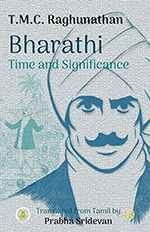
‘Vande mataram enbom’ and ‘Nenjukkum neethium’ were among the songs that I grew up hearing my mother sing. These were written by the great poet Bharati, I was told, who wrote passionate songs about freedom. As someone growing up in distant Andhra, and with only textbook learning about the Independence movement largely dominated by Mahatma Gandhi and Jawaharlal Nehru, I really did not know much about what had happened in other States on the ground. Yes, there are famous names such as VOC, but how about the many others who were part of the freedom movement?
Hence it was an excellent learning experience to read Bharathi: Time and Significance, an eye-opener of sorts to some of the events that happened, especially between 1905 and 1911, in Tamil Nadu, my own home State. How could I have ever thought Bharati was just a poet who wrote fiery songs on the thirst for freedom!
This is Raghunathan’s fourth book on Bharati and begins with how the seeds of patriotism were sown in him, and ends with a conclusion that he was the first socialist thinker in Tamil Nadu. He takes us through this period between 1905 and 1911 in ten chapters. The first chapter opens with identification of Sister Nivedita as Bharati’s spiritual guru, to whom he dedicated all his poems as long as she lived. There is a discussion about when Bharati actually met Sister Nivedita based on different accounts; here we learn about Benares and Calcutta Congress meetings and the forceful declaration that Bharati was already infused with patriotism before he met his spiritual guru because of events in his life, specifically the reason for his wealthy father becoming a pauper literally overnight. We also learn about how the British ensured that local industry was not allowed to develop, rather how best it could be exploited using monopolies.
We move on to Bharati’s journalistic activities. He joined Swadesamitran as a sub-editor in November 1904 and was with them for eleven months during which time he was apparently also the editor of Chakravartini, a magazine to promote the education of women, though it appears that it was men who mostly wrote the content! With the help of two issues in hand, and references in other places, Raghunathan fills an entire chapter about this magazine. It is striking to note that even in those days, there was talk about women’s education and emancipation. In 1906, Bharati seems to have suddenly resigned—soon after the journal India was launched.
The chapter ‘Gurumani’s Advice’ is interesting because Raghunathan goes beyond Chellammal Bharati writing that it was Sister Nivedita who had told Bharati off for not bringing his wife and because he said that ‘we do not have the custom of bringing our wives to public places’. Raghunathan, while delving deeper into Sister Nivedita’s advice to Bharati, also brings out the fact that Swami Vivekananda was ‘the patriot of all patriots and the father of Indian nationalism’ whose impact was felt not only in Bengal but in far-away Tamil Nadu too: on VOC, Bharati and Subramania Siva, among others. A chunk of this chapter also deals with Sister Nivedita’s role in the Indian struggle for Independence. When Bharati met Sister Nivedita, they were all dejected after the Partition of Bengal. And then her fiery speech to him was the ‘sun that dispelled the darkness of his soul’. Raghunathan goes on to the role played by the Bhagavad Gita in the freedom struggle, especially in rousing active resistance and referring to Tilak’s interpretation that the Gita calls on ‘one to be conscious of one’s duty’. He also says that ‘so precious was the Gita to the Bengal rebels that they took an oath to give up their lives, holding the Gita in one hand before Mother Kali.’
Tilak’s role in the freedom struggle is dealt with in detail in the chapter on fierce nationalism: it was only active struggle that would let the revolt succeed. They had to learn how to make bombs—enthused by the Russians revolting against the tsar. The chapter also shows how the nationalist movement in Tamil Nadu was a youth movement. Young Bharati was not yet twenty-five, and was very popular and influential among college students. He made speeches and recited his poems; wrote for India, the primary source of Bharati’s political outlook at that time. We learn not only about his views on violence but that of others of that time; what the moderates felt about the British and the importance of physical fitness among the youth, something that Swami Vivekananda had also emphasized. There is quite a bit on secret societies too, especially those set up by Siva—and other societies including those set up by VOC as a prelude. And a detailed section on how it was the arrest of VOC that triggered a chain of events.
Thus, the last few chapters are densely packed with information about the freedom struggle on the ground, not just in Tamil Nadu but elsewhere in India as well such as in Punjab and Bengal. Like Sri Aurobindo and others who urged people to offer their services to visualizing our motherland as Kali—the destroyer of foreign rule, Bharati too wrote about Bharata Mata, addressing her as Bhavani, Kali, etc. Raghunathan also describes the influence of Mazzini, the Italian nationalist. The book concludes saying that while Bharati did believe in armed struggle for a while, perhaps he also saw the danger in promoting violence; he certainly believed it was important to have economic and social freedom along with political freedom.
Prabha Sridevan has done a meticulous job of translating the book so that it reads easily, even though it is an intense book. Just a point of note: why is Sister Nivedita’s name spelt throughout as ‘Niveditha’ when there is no ‘h’ in the spelling that is used universally by Ramakrishna Mission and even Swami Vivekananda in a handwritten note; nor is there an ‘h’ in Bharati’s name, as used by his granddaughter S. Vijaya Bharati who has written his biography for the National Book Trust. But these are minor complaints. Definitely, the book will serve those not so familiar with Tamil to learn and understand the life and times of Bharati for those half a dozen years which the book covers.
Ahana Lakshmi holds a Ph.D. in Environmental Science and has been writing from a young age. Her volumes of translation include From the Inner Palace (Kumudini) and Election Fever and Other Stories (Prema Nandakumar). Her latest is a translation of stories by Dalit women writers titled The Stomach that Chewed Hunger and Other Stories published by Zubaan with TNTB.