
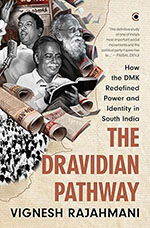
Vignesh Rajahmani in The Dravidian Pathway has attempted a comprehensive account of Dravidian Politics after examining an exhaustive list of literature on the Justice Party, Self-respect Movement, Dravidar Kazhagam (DK) and Dravida Munnetra Kazhagam (DMK). The book has four chapters, apart from the Introduction and Conclusion. The Epilogue draws the attention of the readers to side-lined issues as well as the challenges posed to Dravidian politics from the Right-Wing religion-based identity politics.
In the Introduction, the author focuses on the transition of the Dravidian movement into party politics. It is argued that while the DK was dogmatic in its approach, the DMK was pragmatic and ideologically resilient. He refers to two phases in the evolution of Dravidian-Tamil identity, one with the emergence of the Neo-Saivite Movement epitomized by Maraimalai Adigal through Thani Tamil Iyakkam (1916), and the other by Periyar through the Self-respect Movement (1925). He argues that Periyar in his self-respect concept expanded the Tamil identity framework to subsume a wide range of marginalized groups, with unprecedented focus on gender inequality. But the view of the author—that the term ‘Dravidian’ emerged in the political realm thanks to Iyothee Thass—is problematic. Even before Iyothee Thass founded the Dravida Mahajana Sangam in 1891, Bishop Robert Caldwell had laid the foundations for the later day anti-Brahmanical political movement spearheaded by the non-Brahman Justice Party. The term ‘Dravidian’ until then had been used more as a linguistic and geographical expression. Caldwell’s assertion, as a linguist, that Tamil belonged to the Dravidian family of languages suited the developing political processes in Dravidian Land (Tamil Nadu).
After parting company with Periyar, as Vignesh observes, Annadurai made it a point to keep the Dravidian-Tamil identity intact. At the same time he clearly distinguished between Brahmans and Brahmanism. According to him, Aryanism was not confined to the Aryan alone; it also manifested among Dravidians. His efforts thereby to bring Tamil Brahmins into the fold of Dravidian politics facilitated C Rajagopalachari’s (Rajaji) support to DMK later in the 1967 elections. Moreover, the DMK’s ‘cross-religious inclusivity with the Tamil language as its central feature’ sustained its alliance with the All India Muslim League.
The author highlights the role of reading rooms (padippakam/vaasakasalai) in spreading the ideology of self-respect in southern districts. He cites a reading room (padippakam) functioning in Virudhunagar built by MS Periasamy Nadar and VV Vanniaperumal Nadar to illustrate his point. His own reference to a reading room in Porayar named after Rao Bahadur T Rathinasamy Nadar, a Congressman, as early as 1918, serves to show that the importance of reading rooms is overstated.
The Nadars emerging as an assertive social group is first due to European missionaries in southern parts of the then Tirunelveli district, and later to the economic impact north of Tirunelveli. Emulating the examples of their counterparts who took to Christianity and progressed educationally, the Nadars in the north of Tirunelveli having flourished as stock brokers and traders started schools even as early as 1880s in Virudhunagar and Aruppukottai.
The political career of Annadurai and Karunanidhi after their break away from Periyar’s Dravidar Kazhagam (1949) is highlighted by Rajahmani. Annadurai and Karunanidhi, both scriptwriters, could propagate the Party’s ideology effectively through Tamil cinema. Annadurai’s letters to his Party ranks in Dravida Nadu (1955-1963) titled Thampikku Annaavin Kadithangal (Elder Brother’s Letters to Younger Brother) had a decisive influence on them. Annadurai in these series touched upon a wide range of subjects that included history, politics, economics, and later dealt with issues relating to State politics. These letters numbering about 171 along with 119 letters he subsequently wrote in Kanji (1964-1969) and the ideas articulated in public platforms (now compiled into Annavin Peruraikal [Speeches of Anna] kept the concepts of the Self-respect movement alive. I wish Vignesh had looked through these writings to provide more fascinating accounts.
In Chapter three, Vignesh enumerates and explains six different causes for the decline of the Congress and the rising popularity of the DMK. ‘The Constitution Amendment Act, 1951’: The Madras High Court set aside the communal reservation systems in a case filed by Champakam Dorairajan. Periyar undertook a vigorous campaign and his Party Dravida Kazhagam observed 14 August 1950 as ‘Communal G.O. Day’, with strikes by students, hartal by merchants, processions and rallies by the Party ranks. For fear of social unrest, the Madras Assembly carried a resolution in April 1951 authorizing the government ‘to adopt such measures as are necessary for admission to the Government professional colleges and appointments in Government services as will conduce to the welfare of all classes of citizens.’ Armed with this resolution, the Chief Minister and other ministers rushed to Delhi seeking an amendment to the Constitution. Prime Minister Jawaharlal Nehru amended Articles 15 and 29 to allow quotas for the socially and educationally backward classes, Scheduled Castes and Scheduled Tribes. This was the first victory scored by the DK rather than DMK over the concept of social justice.
‘The Modified Scheme of Elementary Education, 1953’: Dubbing it as Kulakalvi thittam (caste avocation), the DK and the DMK jointly announced mummunai poraattam (three-cornered protest–opposition to change the name of Kallakudi as Dalmiapuram, kulakalvi thittam and removal of Rajaji from Chief Ministership) led by EVK Sampath representing the DK and M Karunanidhi representing the DMK. The call evoked response from teachers and students who actively took part in the agitations. A large number of DMK cadres suffered imprisonment. Rajaji had to finally step down (13 April 1954) and the popularity of the DMK shot up.
‘The Passage of the States Reorganization Act, 1956’: Nehru in the wake of the tragic fallout of Partition was reluctant to reorganize the Indian States on a linguistic basis, fearing it would threaten national unity. However, yielding to the mounting pressure after Potti Sriramulu’s death over a separate State for Andhraites, he appointed the States Reorganization Commission which submitted its report in September, 1955. The Kamaraj Government earned discredit for ordering police firing in Thammapatti (Athur taluk in Salem district) and Kallakudi during the agitations. About 13 non-Congress parties joined together to plan a hartal on 20 February 1956. In the all-Party meet held on 27 January to press inclusion of Devikulam and Peermedu in Tamil Nadu in the charter of demands, Periyar as a supporter of the Kamaraj Government now, did not take part, as geographical borders hardly mattered to him. Annadurai proved his political sagacity by playing a leading role in this people’s movement
In the changed political context, sensing the mood of the people, the DMK, took a decision at the Tiruchi Conference held in 1956, to enter electoral politics. The manifesto-like list prepared by the DMK included land reforms with ceiling on land holdings, limiting the Union Government’s power to tax the States, nationalization of industries, health care benefits for the working class, a casteless and classless society, promotion of the Tamil language and renaming the State as Tamil Nadu. Though the Kamaraj Congress won a decisive victory in the 1957 elections, the DMK’s fight for linguistic reorganization of States and its alliance with the CPI worked to its advantage. The DMK won 50 out of 142 seats it contested to the Legislative Assembly.
‘The Constitution Amendment Act, 1963’: The DMK’s success in the elections frightened the Congress to the extent of passing the Sixteenth Constitutional Amendment Act in 1963.
‘The Anti-Hindi Protests of 1965’: Despite Nehru’s assurance in Parliament on 7 August 1959 that English would continue as long as non-Hindi speaking people wanted it, the Official Languages Act of 1963 came into force. A committee headed by M Karunanidhi conducted public meetings and conferences in Tirunelveli, Thanjavur and finally in Madras. But the disastrous announcement that Hindi would be the official language from 26 January 1965 led to violent demonstrations and arson resulting in 70 deaths according to the official version.
1965 and the following year being a severe drought-hit period, the escalating price rise of food grains in the open market, and poor quality of rice supplied through the State’s fair-price shops caused public unrest. The 1967 election manifesto drafted by Annadurai included 15 standard acres as a land ceiling limit, nationalization of banks and transport services and movie theatres that targeted a wider section of people. The slogan Annadurai coined—Moontrupadi latchiyam (3 Madras Measure desired), oru padi nichayam (one Madras measure certain)—caught the imagination of the people. The police repression unleashed on DMK cadres when they agitated against the rising price of food grains in the State worked against the Congress.
Notwithstanding the Congress’s good performance with focus on long term developments during 1952-1967, food shortage pinched the poor masses who had to stand in queues under the scorching sun to get poor quality rice and kerosene from State-controlled fair price shops. The other factors which favoured the DMK against the Congress were: the Congress split before the 1957 elections with Rajaji forming the Congress Reform Committee and later founding the Swatantra Party (1959). Brahman elites, landlords, rich traders and merchants who backed Rajaji distanced themselves from the Congress. This class of people financed the elections in 1967 when Rajaji allied with the DMK.
With Kamaraj moving to Delhi under the Kamaraj Plan in 1963, followed by the death of Nehru in 1964, the Congress had become organizationally weak. The teachers who felt aggrieved by Rajaji’s ‘Modified Education Scheme’ and students who had been politicized after the 1965 anti-Hindi agitations as first time voters, spiritedly campaigned for DMK in the 1967 elections. In the list of successful candidates fielded by the DMK, a vast majority were school teachers. It was a decisive victory for the DMK that won 173 seats with its allies securing 138. The Congress won 51 seats with Kamaraj being defeated in his own home constituency.
In the Epilogue, the author gives credit to Dravidian politics in general and Karunanidhi in particular for successfully carrying on the legacies of Periyar and Annadurai. He has not, however, failed to pinpoint the areas of shortcomings, especially in addressing the issues of caste and gender. The other issues that pose challenges to Dravidian politics highlighted here are: the unequal distribution of power and resources in the State, the domination of a few families within the DMK making the entry of new candidates from humble backgrounds impossible, the recent trend of politicians becoming businessmen and educational entrepreneurs and their growing influence on State policy, entrenchment of certain caste groups in legislature and other decision-making bodies, the challenge to Dravidian Tamil identity by religion-based identity politics, the onslaught of neo-liberal policy pursued at the Centre and the State and the impending threat of delimitation.
The Dravidian Pathway is a must read to understand Dravidian Politics in Tamil Nadu.
KA Manikumar is former Professor of History, Manonmaniam Sundaranar University, Tirunelveli, Tamil Nadu.