
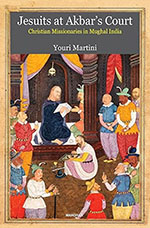
Youri Martini had previously published this monograph in Italian under the title, Akbar e i Gesuiti: Missionari cristiani alla corte del Gran Moghul in 2018. It has recently been published in English by Manohar Publishers & Distributors in order to facilitate the wider dissemination of his work. Martini, who holds a degree in History and Religious Studies and teaches in the Italian secondary school system, has shown a sustained interest in the study of Jesuit missions in Mughal India and the religious policies of Akbar. He situates this study within the broader context of Akbar’s reign, during which Jesuit missionaries visited the Mughal court at the Emperor’s invitation. The monograph examines these encounters, which the author characterizes as a ‘double orientation’ (p. 20), directed toward the imperial court and the local population. However, the primary focus of the work remains on the imperial interactions, particularly those involving the three Jesuit missions at Akbar’s court. These interactions unfolded through diplomacy, theological debates, translation projects, liturgical practices, and instruments of conversion, and also included the composition of Persian polemical works on Islam and Prophet Muhammad.
The author draws on a wide range of primary and secondary sources to substantiate his arguments. Much of his interpretation relies on Jesuit letters, memoirs, and treatises, supplemented by a substantial body of secondary scholarship on Jesuit missions, particularly works written in Italian and French. The monograph consists of a brief introduction and six chapters, including the conclusion, and is accompanied by a detailed index and illustrations. It opens with an examination of the background to the Jesuits’ presence at Akbar’s court, which Martini describes as a ‘surprising initiative’ (p. 25). Unlike the usual pattern, in which missionaries required permission from local authorities to operate in Asian regions, this instance was marked by imperial initiative. Akbar himself invited the Jesuits and requested that they bring their religious texts, writing to the Lusitania authorities in Goa and to the Jesuits of the College of St Paul, Goa. He further situates these developments within the broader political context of the period. As Akbar expanded his territorial domains, particularly following the conquest of Gujarat, the Mughal Empire came into closer contact with the Portuguese, opening new avenues for diplomatic exchange. As part of this engagement, Akbar agreed not to attack Portuguese territories, while the Portuguese, in turn, assured protection for the annual Hajj pilgrimage by sea without the imposition of taxes and tolls. However, as Martini demonstrates in the later part of his monograph, this arrangement was not consistently adhered to in practice.
Martini also emphasizes Akbar’s initiatives such as the establishment of the Ibadat Khana (House of Prayers) and the Maktab Khana (Imperial translation bureau), which were intended to bring together individuals and texts from different religious traditions. He further discusses the promulgation of the Mahzar (infallibility decree) as a political strategy, particularly having ‘international implication’ which enabled Akbar not only to assert authority independent of the constraints of the ulema but also to claim absolute independence from the authority of the Ottomans. Within this framework, Martini argues that the invitation to the Jesuits was motivated by two primary considerations: first, Akbar’s desire to challenge Sunni hermeneutic traditions in the Ibadat Khana, and second, his interest in securing support for the activities of the Maktab Khana.
Martini then goes on to discuss the arrival and outcomes of the first two Jesuit missions at Akbar’s Court. He elaborates on the selection of the missionaries, their journeys to the imperial court, the initial theological debates held at the Ibadat Khana, and their interactions with the Emperor and his courtiers, particularly Abul Fazl, with whom they were involved in the translation of and commentary on the Gospels at the Maktab Khana. He argues that despite the scepticism of the Portuguese authorities in Goa regarding the dispatch of the first mission, ecclesiastical councils favoured the initiative, viewing it as an opportunity to convert a powerful ruler and, by extension, a large number of his subjects (p. 49). Accordingly, the first mission was entrusted to two Jesuits, Rudolph Acquaviva and Antonio de Monserrate, who reached Akbar’s court at Fatehpur Sikri.
At the Ibadat Khana, the Jesuits challenged the doctrine of tahrif (the alleged alteration of earlier divine scriptures) and criticized Islamic interpretations of the Bible, even alleging that the Quran contained historical inconsistencies. These arguments provoked strong reactions from Muslim scholars. Martini examines these debates in detail, noting that the principal topics of discussion included the Trinity, the divine sonship of Christ, the incarnation, the passion, the status of Muhammad as the seal of Prophecy, and the question of true word of God (the Bible or the Quran), as well as the doctrine concerning the Day of Judgement and the Resurrection (p. 58). He argues that Akbar and Abul Fazl were, at times, supportive of Jesuit positions. However, Martini also suggests that Akbar’s attitude later shifted. He notes that the Emperor cautioned the Jesuits against speaking offensively about the Prophet of Islam and gradually became less engaged in theological debates (p. 59).
Martini attributes this change to two main factors: first, Akbar’s growing concern over rebellions in various parts of the empire, and second, the persistent opposition of the ulema, who enjoyed the support of influential figures within the imperial harem. Despite the shift, the Jesuits continued to carry out their duties and were able to translate further portions of the Gospel into Persian. By 1582, however, the debates at the Ibadat Khana had been suspended. In the same year, hostilities between the Mughal and Portuguese further complicated the situation, leading the Jesuits Provincial in Goa to consider recalling the missionaries. The missionaries themselves, still hopeful of converting Akbar, sought to delay their departure. However, as Martini notes, when Akbar proclaimed himself the leader of a ‘new faith’ Din-i-Ilahi, the missionaries came to realize that there was little possibility of converting the Emperor. Consequently, after repeated requests and upon receiving assurances that other missionaries would be sent in their place, they were allowed to return to Goa.
Martini also briefly discusses the second mission, which was facilitated by Leo Grimon, a Greek Orthodox sub-deacon who visited Akbar’s court around 1590. Grimon impressed the Emperor with his linguistic skills by translating Greek texts into Persian and was subsequently considered a suitable envoy to be sent to Goa to request the dispatch of another Jesuit mission. After the failure of the first mission, the Jesuits were reluctant to undertake another, but Grimon persuaded them by raising the possibility of Akbar’s conversion. Consequently, two Jesuits, Duarte Leitao and Christoval de Vega, along with Esteban Ribeiro, accompanied Grimon to Lahore. They were received cordially, participated in theological debates, and devoted themselves to teaching members of the royal family and the children of nobles, while awaiting opportunities to engage the Emperor in religious discussions. However, like the previous one, the mission ultimately proved unsuccessful. Akbar was preoccupied with military campaigns in Sindh, Kashmir, and Orissa, which limited sustained engagement. Moreover, the missionaries encountered strong opposition from factions at court and gradually realized that the Emperor had no intention of converting, prompting their eventual return to Goa.
In the third chapter, Martini explores Akbar’s religious policies, arguing that the Emperor, as the head of a Sunni Muslim polity, initiated reforms to ensure opportunities for religious practice not only for non-Sunni Islamic communities but also for non-Muslims (p. 83). He underscores that these ideas were informed by the Sufi principle of sulh-i-kul (Universal Peace), which aimed to mitigate conflicts among communities with diverse religious and cultural traditions, and were further grounded in Ibn Arabi’s doctrine of wahdat-ul-wujud (Unity of Being). This intellectual influence was mediated, in part, through Abul Fazl, who was deeply immersed in Ibn Arabi’s works and exercised significant influence on Mughal religious policies. Martini cites Akbarnama and Akbar’s letter to King Philip II of Spain to demonstrate how Akbar extolled the use of aql) (reason) in religious inquiry, giving prominence to ijtihad in contrast to taqlid (imitation) associated with the ulema. Martini argues that the presence of Jesuits provided Akbar with a set of sophisticated argumentative tools to challenge established Islamic hermeneutics (p. 91). This claim appears exaggerated, given that other religious and intellectual currents were also influencing the Emperor’s religious convictions.
Martini also expounds in detail on the third Jesuit mission, which began with a renewed request for missionaries from Goa. Despite the scepticism of the Jesuit Provincial Francisco Cabral, the Viceroy, Dom Matias de Albuquerque, was inclined to maintain the mission for political reasons. Martini notes this inclination but does not clearly specify what these considerations entailed. The third mission consisted of Jerome Xavier, Manoel Pinheiro and Bento de Góis, who served as a Persian interpreter, and reached Lahore on 5 May 1595. During the initial two years of the mission, Xavier devoted himself to studying Persian, while Pinheiro and Góis began to organize the religious life of the small Christian community. Unlike Pinheiro and Góis, Martini depicts Xavier as a courtier who not only became a regular presence at the Court but was also appreciated for his intellectual qualities. However, in the later part of his narrative, Góis is presented as playing a more integral role, as he, along with Xavier, accompanied the Emperor during his movements across regions such as Kashmir and, notably, the Deccan during military campaigns.
Meanwhile, Xavier had several opportunities to converse with the Emperor, during which he presented letters from the Provincial father and showed him two Japanese-style paintings. He also participated in theological debates, which Martini notes closely resembled those held at the Ibadat Khana, even though the forum itself was no longer active. These exchanges generated extended and often unresolved discussions on a wide range of theological issues. Martini also highlights the impact of ‘Christian Art’ on Mughal paintings, suggesting that it functioned as a source of imperial legitimacy, particularly under Akbar and Jahangir. Furthermore, he argues that Xavier not only devoted himself to the translation of several biblical texts but also composed polemical works of an anti-Islamic nature, which he considers among the earliest examples of Christian literature in the Persian language.
Martini’s work offers a detailed account of Jesuit-Mughal encounters, grounded primarily in extensive missionary sources and related secondary literature. However, at several points, his engagement with Persian sources appears limited or insufficiently critical. For instance, in his discussion of the debates at the Ibadat Khana, Martini, relying on secondary sources, suggests that an agitated alim proposed a trial by fire to Acquaviva. Yet, in the Akbarnama, the initiative for such a test is attributed to the Jesuit in his exchange with a Muslim cleric, whereas in Muntakhab-ut-Tawarikh, it is the cleric who challenges the Jesuits. These divergent accounts, preserved in the works of Abul Fazl and Abd-ul-Qadir Badauni, are not adequately reconciled in Martini’s narrative. Martini’s focus on intellectual and theological exchanges provides important insights into early modern cross-cultural interactions through debates, illustrations, and the translations of religious texts. However, the work tends to privilege Jesuit perspectives and at times overstates their influence on Akbar’s religious thought, without sufficiently engaging with the diverse intellectual traditions present at the Ibadat Khana. Nevertheless, despite these limitations, the monograph remains a valuable contribution to the study of early modern religious encounters.
Anas Zaman is a Ph.D. candidate, Department of History, University of Delhi, Delhi. His research focuses on the political culture of the Mughal Empire in the latter half of the seventeenth century. He is also one of the recipients of the prestigious Inlaks Research and Travel Grant (2025) by Inlaks Shivdasani Foundation.