
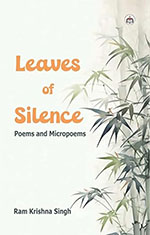
Professor Ram Krishna Singh is a distinguished poet, translator, and academic, renowned for his extensive contributions to Indian Writing in English and his mastery of the haiku and tanka. His Leaves of Silence is a contemplative and intellectually layered poetry collection that interrogates the fractured condition of modern existence through a deeply personal yet socially engaged poetic voice. The collection traverses a wide spectrum of themes—alienation, political disillusionment, spiritual quest, ecological anxiety, and the erosion of human relationships—while experimenting with diverse poetic forms.
The opening poems establish a pervasive sense of disconnection that characterizes modern society. The poet foregrounds the difficulty of forging meaningful human connections in an increasingly fragmented world. This alienation is accompanied by profound uncertainty, where emotional states are suspended in a liminal condition—waiting, searching, and anticipating resolution that never fully arrives. The recurring motif of ‘waiting’ becomes emblematic of existential inertia, as the speaker oscillates between hope and despair. Even attempts to invoke fortune or divine intervention, symbolized through talismanic imagery, culminate not in revelation but in silence, suggesting the futility of relying on external forces for meaning.
A significant thematic strand in the collection is the poet’s engagement with mortality and the transient nature of life. The anticipation of death is not merely a biological inevitability but an existential horizon that shapes reflections on memory, aging, and loss. The poems evoke a poignant sense of temporal fragility, where love fades, relationships disintegrate, and individuals are left with haunting remnants of emotional attachments. The notion of ‘emotional divorce’ becomes particularly striking, encapsulating the quiet dissolution of intimacy in loveless relationships. This emotional desolation is further intensified by a creeping loneliness that is both unsettling and inescapable.
The collection also contains strong autobiographical undertones in poems such as ‘Lasting Marks’, ‘Life Unlived’, ‘In Patna’, and ‘Sleep Divorce’, wherein the poet articulates a deeply personal sense of abandonment and unfulfillment. The voice that emerges is unapologetically candid, exposing vulnerabilities without succumbing to self-pity. Parallel to its introspective concerns, Leaves of Silence is sharply attuned to socio-political realities. In poems such as ‘General Election’, ‘Abandoned’, ‘Systematic Romance’, ‘Heritage’, ‘Absurd Maze’, and ‘Freedom’, the poet employs satire and biting imagery to critique contemporary political culture, exposing what he perceives as the moral bankruptcy of political leadership. The depiction of politicians as a ‘valueless generation’ underscores a deep-seated disillusionment with governance and public life.
The collection addresses the corrosive impact of modernity on human consciousness. The striking comparison of television screens to ‘dragon fire that swallows bloom’ encapsulates the destructive influence of media and technology, which consume creativity and diminish authentic human experience. The poet laments the loss of ancient wisdom, which has been supplanted by fear, anxiety, and an unrelenting ‘rat race’. In a world devoid of inherent purpose, the act of seeking itself becomes a form of resistance.
Environmental concerns also find expression in the collection, reflecting awareness of the ecological crisis. The imagery of a ‘toxic’ poetic mind serves as a metaphor for the pervasive contamination of both the natural world and human consciousness. The ongoing ‘assault on earth’ underscores the urgency of addressing climate change, suggesting that even the imaginative realm is not immune to environmental degradation.
The collection’s exploration of love and relationships is marked by a sense of disillusionment and longing. The poems depict a world in which loyalty has eroded and emotional connections have become tenuous. Yet, amidst this bleakness, there remains a persistent yearning for love and intimacy. The poem ‘Body’s No Picnic’ exemplifies the poet’s respect for women and his ability to portray sensuality with sensitivity and depth. The interplay between desire and loneliness creates a complex emotional landscape, where the search for connection is both necessary and fraught with disappointment.
Leaves of Silence is notable for its experimentation with multiple poetic traditions. The inclusion of haiku and tanka reflects an engagement with Japanese aesthetics, characterized by brevity, precision, and evocative imagery. These shorter forms distill philosophical insights and sensuous experiences into compact expressions, offering moments of clarity within the broader thematic density of the collection. The four-liners, too, function as aphoristic reflections, encapsulating the poet’s worldview.
The poet’s use of cultural and religious references further enriches the text. Allusions to biblical narratives coexist with references to Indian cultural sites such as the ghats of Banaras and the Mahakumbh, creating a syncretic framework that reflects a pluralistic vision. These references not only ground the poems in specific cultural contexts but also underscore the universality of the themes they address.
Ultimately, Leaves of Silence is a meditation on the paradoxes of contemporary existence. It captures the tension between hope and despair, connection and isolation, faith and scepticism. While the collection is imbued with a sense of melancholy, it is not devoid of hope. The poet’s recognition of the power of his own pen suggests a belief in the enduring significance of artistic expression in poems such as ‘I’m a Poet’ and ‘Intermission’. The desire to be remembered—to be read and known even after death—transforms poetry into a means of transcending mortality.
In conclusion, Leaves of Silence challenges readers to confront the silences that pervade their own lives, urging them to seek meaning in a world that often appears indifferent.
Tabinda Shamim is Assistant Professor in the Department of English at Karamat Husain Muslim Girls’ P.G. College, Lucknow, Uttar Pradesh. She specializes in Indian writing in English, poetry, popular literature, English language teaching, stylistics, and discourse analysis. She has published in several academic journals.