
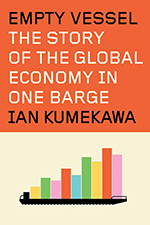
Ian Kumekawa’s new book, Empty Vessel: The Story of the Global Economy in One Barge, best illustrates global Capitalism as an abstraction of convenience. Global Capitalism, as it developed in the past few decades, was spearheaded by ‘the offshore’—an economic arena where businesses operate, service, and conduct financial transactions, often at lower costs, favourable regulations, significant tax benefits, and above all, at convenience.
In Empty Vessel, Kumekawa’s hero is an empty barge, made out of steel, and weighing 9,500 deadweight tons. It has no engine, no national allegiance, no legal or jurisdictional obligations, and no outright explicit purpose. In some sense, the vessel (and its sister ship) is an expression of convenience and the changing globalized economy. It was the ‘creation of a supernational, offshore global order: registered in the Bahamas or St. Vincent and the Grenadines, owned by international consortia, leveraged by financiers in London, Oslo, and Lagos’. The vessel, quite literally, represented the offshore.
In Kumekawa’s story, the vessel would document the offshore Capitalism unleashed by globalization since the late 1970s. It serves as an anchor for understanding how Capitalism developed across diverse contexts.
Kumekawa calls the book a global microhistory of Capitalism. Unlike the French Annales school, spearheaded by Fernand Braudel, which focused on macroscopic, quantitative, and long durée international history, the Italian school of microhistorians, such as Giovanni Levi, Carlo Poni, Carlo Ginzburg, and others, has focused on micro-ness. In some sense, for these historians, it is the little things, people, and places that tell stories of global historical transformations. To Kumekawa’s credit, a simple barge serves as an analytical unit that best represents how microhistorical narratives provide alternative logics to global Capitalism. Here, Kumekawa does not just stop at telling us about the people and places the barge surrounded itself with; he gives us a barge’s eye view: ‘Imagine the Vessel’s story if it were told using a frame of reference that focused solely on the barge itself. It would feature a ship at rest with the world spinning madly around it, with people rushing into the Vessel and out of it again.’
The novelty of Kumekawa’s book lies in how the story of the vessel itself remains static, even as the places it is moved to and the people who hop on and off begin to tell stories. The stories that follow tell how the vessel housed factory workers, soldiers, incarcerated prisoners, oil field workers, and seafarers over roughly half a century. By placing the vessel in distinct locations, Kumekawa carefully documents the economic policies of governments, the regulatory frameworks that define them, crime statistics that enabled floating jails, and political and social changes that drew people and places close to the barge and away from it.
Built near Stockholm in 1979, the vessel, known as a ‘hotel ship’, a ‘coastel’ or a ‘floatel’, would work as an accommodation ship for oilmen off the coast of the North Sea and Nigeria at different times, would serve as barracks for British troops after the Falkland War, would work as temporary housing for assembly line workers in West Germany, and would serve as a jail in New York and Portland. Over the years, just as it huddled between ports and cities, the vessel would change owners, and with it, the names it held, the flags it carried, and above all, the global trajectory of Capitalism.
The vessel and its sister ship first came into the possession of a Swedish company, Consafe, which named it Safe Esperia and housed it with hundreds of offshore oil workers. Thereafter came the Falkland War in 1982, when Argentina’s military junta invaded Britain’s Falkland Islands. The bloody conflict lasted for a little over a month and ended with the garrison’s surrender of Argentine troops. Over 255 British and 649 Argentine troops were killed in total. However, with no permanent accommodations on the Island to house the troops, the Thatcher Government had to rely on the vessel to accommodate the soldiers. The vessel was moored in Stanley Harbour, as Coastel 3, along with its sister ship, to house British troops.
Kumekawa writes that even though Thatcher had won the Falkland War which rightly aroused nationalist sentiment in Britain, the Government had to rely on a foreign shipping firm to transport the troops.
Years later, after the successful mission in the Falklands, the Bibby Line would fully acquire the vessel and name it Bibby Resolution. Soon, the Bibby Line would exploit the changes the global financial system had unleashed: flag-of-convenience and open offshore registries. To avoid tax and regulatory burdens in their home countries, several shipping firms would register their companies in Panama, Liberia, Hong Kong, the Bahamas, and other Caribbean imperial outposts. These registries became offshore tax havens. With a new flag-of-convenience registered in the Bahamas in the late 1980s, the vessel would travel to West Germany, where it would house assembly-line workers at Volkswagen factories in Emden.
Thereafter, increased mass incarceration and gentrification in New York, and later in the UK, would require the vessel to become a jail ship: ‘a temporary quick fix for which increasingly desperate municipal administrators were willing to pay top dollar.’ As Her Majesty’s prison, The Weare, near Portland Harbour, the vessel would become, as one prison inmate noted, ‘the Good Ship Lollipop’ that had its own cabins, a window, and computers. Carceral Capitalism, too, is a glaring outcome of the advent of the globalized economy.
After spending years housing prisoners, enabling gentrification, and servicing increased incarcerations, the vessel would be sold to a Nigerian company, Sea Trucks Group. It was tasked with accommodating oilmen once again in the late 2000s. In West African societies, such as Nigeria, which are rich in oil reserves, prosperity hasn’t emerged from plenty. In fact, oil has intensified existing inequalities. Some historians have even associated the Nigerian oil trade with the Atlantic slave trade. With both the slave trade and the oil trade, profits have only flowed to the political classes. However, starkly even, ‘oil and slavery both depended on the offshore’—on empty vessels.
The offshore, in Kumekawa’s book, is a bleak one: ‘a place with shadowy rules.’ There is very little accountability. While open registries and flags of convenience help shipowners cut costs, they also bypass legal protections for seafarers. It captures a sense of precarity, vulnerability, and abandonment. When things get tough at sea, and when there are very few legal compliances in place, the shipowners resort to abandoning the ship and its crew. In such grave circumstances, as was the case with Halini, a group that came to own the sister vessel, seafarers were left without assistance, without pay, and without means to return home for months in 2018. The Indian crew on board could only eat lentils with plain rice, without onions or tomatoes.
In this sense, even as Empty Vessel offers an exquisite parable of global Capitalism—as an abstraction of convenience—Kumekawa reminds us of the people it carried and of those who go unnoticed in the processes of globalization or as a result of it.
Adarsh Badri is a doctoral candidate, School of Political Science and International Studies, University of Queensland, Australia. His peer-reviewed essays have appeared in International Affairs, New Media & Society, Australian Journal of International Affairs, and Strategic Analysis. He also writes commentary in the World Politics Review, Lowy Institute’s Interpreter, Australian Outlook, and the Economic & Political Weekly, among others.