
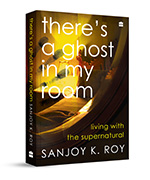
The book’s fantastic cover, with its overt reference to the supernatural and a mysterious, waxy handprint, promises a thrilling account of the author’s encounters with the occult. Situated somewhere between a memoir, travelogue and ghost story compendium, it resists sensationalism and definitiveness. The book opens with an Author’s Note where Roy makes no claims to provide answers and insists that the reader draw their own conclusions. He toes the line, attempting to keep the sceptics reading and the believers enthralled. It is easy to mistake this as Roy shying away from stating his belief in a spiritual world. As the narrative progresses, however, it becomes clear that this ambiguity is a deliberate construction. Roy may offer the reader uncertainty, often ending these stories on a question or a note of curiosity. But as the narrative advances, his faith in his explanations of events becomes unmistakable.
The language in this book is a treat. This is his debut, but he is a talented writer and possesses an extensive vocabulary which he employs liberally. ‘Nature, which forms the basis of all worship, had reclaimed ground, a final conquest against man who, spurred on by greed and ego, possession and power, practised destruction as the path to glory, forgetting that long before we walked the earth, nature alone had prevailed, and it would continue to do so long after we bombed ourselves to extinction’, he writes. There’s a friendly quality to his narrative style, lending it the warmth of exchanging stories around a bonfire, reminiscent of Henry James’s ‘Turn of the Screw’. Written as an anthology of sixteen stories, nearly each entry transports the reader to a new city, and often a new country altogether. Roy’s ability to evoke places is among his most effective tools. His description of Jerusalem in ‘Jahannam: A Visit to Hell’ stands out in particular. His grief is palpable as you witness the city through his eyes, viewing the segregation and the vestiges of violence laid in the very foundations of the city. It is evident that it is not only literary skill behind the writing, but a genuine love for history and culture. His appreciation for the creative arts, especially Indian culture and his effort to showcase the best of it all over the world, is in fact one of the primary drivers of the book.
Often in relation to this mission, Roy travels to, or sometimes lives in, some city. At the beginning of each story, he offers an exposition on the history, the food, as well as the often-illustrious people he is travelling or residing with. He is a man with many friends, for the lists and lists of names sometimes begin to blur and your eyes cross as they scan these proper nouns. Once the scene is set, often against a backdrop of prodigious drinking, daredevil travel, and a life lived with abandon, something strange invariably occurs. An accident, a moment of paralysis, an inexplicable sensation, or a vision that interrupts the flow of events. There is a liberal use of the ‘somehow’ method: somehow he snaps out of possession, somehow he moves after feeling paralysed, somehow the danger passes. This ‘somehow’ method often involves his wife, Puneeta, who seems to hold some sway with these mysterious spirits. While this slipperiness preserves the book’s refusal to claim answers, it also becomes a narrative habit. These episodes are subsequently subjected to interpretation, either through the interventions of his ever-mysterious Gurudev or through retrospectively aligning his vision with a historical incident associated with the place itself. For the sceptics, it is confirmation bias in action: coincidence and lore are marshalled in support of a supernatural explanation that is left formally unresolved, even as the author’s own conviction remains evident.
Roy comes from an immensely privileged background, and it is made excessively and repeatedly clear. No detail is spared; the reader must know about the diamonds and the Rolex in his grandfather’s portrait at their lavish ancestral home. He lives a grand life and writes about it unapologetically. He has travelled widely, cavorted with celebrities, vacationed frequently and consumed copious quantities of vodka. The text makes little attempt to temper this presentation, leaning into the spectacle of a life lived large. But it unfortunately becomes the most glaring issue in the book—the repetitive references to luxurious hotels and expensive food and brands. It is tiring and begins to feel shallow rather quickly. In ‘An Accident Foretold: Goa’, their hotel’s name—Taj Holiday Village—is cited so frequently that it begins to feel less like a setting and more like a refrain. While this insistence on specificity may be intended to anchor the narrative in lived experience, it reinforces his privilege and distracts from the stories.
Roy renders himself with consistency, and comes across as principled, if privileged, and very curious, indeed. His abiding love for his animals, which peppers the narrative, is endearing, and his love and loyalty to his family, unyielding. The stories are undeniably entertaining, but the very casual affectation that lends the narrative its warmth, also sometimes takes away from it, some factors remaining curiously underexplained. Gurudev, despite his central role in interpreting and predicting many of the book’s episodes, is left largely undefined, and key individuals are at times introduced without exposition. Initially, one had to check who Puneeta was, because she is so casually introduced, but inferred her to be his wife from the dedication. This withholding appears to be an intentional choice, and for those in Roy’s circles, it must enhance the familiarity, but for those of us meeting Sanjoy Roy, the author, it can feel alienating.
Ultimately, the book’s open-endedness is both its defining feature and its central limitation. Its refusal to settle questions of belief, genre, or interpretation allows it to maintain an atmosphere of mystery and invitation. Yet that same refusal, reinforced by privilege and repetition, also insulates the narrative from interrogation and functions as a protective posture. What remains is a work that is confident, entertaining and vivid, but one with carefully maintained ambiguity asks to be admired more than it asks to be questioned.
Alizia Kumail is a Software Developer who studied Computer Science and Engineering.