
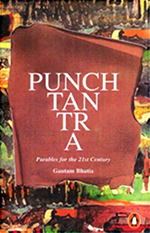
When an architect and sculptor refashions the moralistic tales of the classical Panchatantra, one eagerly looks for new building blocks. Punchtantra is a rollicking ramble through animal fables where human conduct in our confused modern society is inducted and critiqued. The book is innovatively structured, each unit beginning with a brief summary of an original tale, followed by Gautam Bhatia’s delightful elaboration in a materialistic, tech savvy, naval-gazing new world, and ending with a boldly highlighted ‘moral’. Every story begins with a charming illustration around its initial alphabet. The twenty-six stories are arranged with A to Z as the first alphabet—architectural precision perhaps. Quirks of human behaviour traverse eras from the ancient Panchatantra to the world around us, underscoring the paradox that nothing has changed, but everything is different. Jealousy, stealth, love, betrayals, illusions of success, pursuit of wealth—such intense emotions and experiences can be couched in the timeless zone of folklore. ‘Once upon a time’ animals, human beings and plants shared a common ground of tragicomedies—and they do so now in the digital world. The book with the subtitle Folk Tales for the 21st Century reminds us of such a truth. I’ve smiled my way through stories after a long time. This nowhere implies that Bhatia trivializes either the original text or our troubled times; it’s simply a rare blend of ironic humour and unexpected collocations.
A delightful example is the story ‘The Lion and the Art Critic’. The original Panchatantra story has the typical lion waiting to devour a jackal. It’s a play of wit between the King of the Forest and the most wily creature in the jungle. In Bhatia’s modern version, the lion does not enter the fragile cave of the jackal because he may simply bring down the structure, so he devices a ‘plan’. Since he is the chief of the ‘Jungle Planning Commission recently renamed Neeti Vanyog’, the members of the King’s Cabinet round up a random bunch of painters, art collectors, print makers, and start an Art Camp. Convoluted discussions ensue on the purpose of art, multiple, contradictory views surface in the bellicose arguments among the participants. Some claim that ‘art is really an orchestrated confrontation of reality’, others say it ‘illuminates the pleasures of material denial’ (p. 93). Such boring, meaningless, lengthy talk is bound to make anyone drowsy and King Lion is very sure that the jackal would have fallen asleep by now and easy to grab. The ‘moral’ is boldly written as ‘Some patrons of the arts have their stomachs at heart’ (p. 93). The amusing satire on the endless workshops, seminars and conferences promoted by the urban elite demonstrates Bhatia’s ability to correlate present foibles with the past fables.
Gautam Bhatia says in his Introduction that his inspiration for the book was James Finn Garner’s bestseller Politically Correct Bedtime Stories (p. ix). The key strategy for Bhatia is to introduce within a Panchatantra storyline today’s vocabulary and language, e.g., multicultural, nuclear plant, minority groups, Airbnbs and suchlike. My comments on another story show his elaboration on the icon of the clever Brahmin. The book’s opening story is called ‘The Defloured Brahmin’, alerting us to the duplicitous meanings that Bhatia plays with. A Brahmin and his successful lawyer wife live in an air-conditioned house and order food on Zomato, read The Financial Times, and generally don’t interfere with each other’s lives.
The Brahmin, in keeping with his inherited vocation, goes begging daily for wheat flour. In the evening, he sifts the different qualities of rice and flour received and stores them carefully in vats. He is prone to daydreaming—how he will lure busloads of foreign tourists, build an ashram on his real estate acquisitions, profit by food processing plants, a Multiplex and an Employment Exchange, etc. ‘The gluttonous brahmin was getting such a thrill out of his range of anti-ecclesiastical images that his whole body shook in a spasm of pleasure’ (p. 9). Inadvertently, he kicks out at the pot of flour and the powdery whiteness covers him entirely. The story ends on a note of calm, legal resolution. The wife refuses to ‘deflour’ the Brahmin. ‘The couple separated as two mature adult human beings and lived happily ever after’ (p. 9).
Some conclusions may be drawn from the above samples. Bhatia is returning to the world of the Panchatantra where environmental sustenance depended on correlating human lives with animals and plants, the earth and sky, the seasons with their varying moods. Though not an ideal world, it was, nevertheless, one of interaction and interdependence. By contrast, today the human-animal conflict, environmental degradation, internecine warfare have led to fragmentation and schisms. In the 21st century for which Bhatia’s fables are written, one kind of solution is offered. To bring any semblance of sanity, we can perhaps turn, temporarily, to the balm of storytelling. If one could laugh a little, dream a little, and trust a little, our millennial lives may become bearable. The solace of the Panchatantra is recast as the modernist Punchtantra.
Malashri Lal, author of twenty-six books, retired as Professor, English Department, University of Delhi, Delhi. Publications include Tagore and the Feminine, and The Law of the Threshold. Co-edited with Namita Gokhale is the ‘goddess trilogy’ on Sita, Radha, Lakshmi, and also Betrayed by Hope which received the Kalinga Fiction Award. Lal’s poetry collections are Mandalas of Time, shortlisted for the Tagore Literary Prize, and the recent book, Signing in the Air. Honours include the prestigious Maharani Gayatri Devi Award for Women’s Excellence and the SETU award of Excellence.