
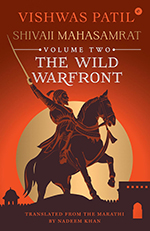
Like the political discourse in Maharashtra, Marathi literature has constantly engaged with Shivaji, not merely as a historical figure but as a contested symbol of community, identity, power and nationalism. This began with the seventeenth-century powada tradition, where poets such as Sahir Agnidas and later folk performers celebrated him as a warrior of the people and a figure of resistance. With the rise of print culture, writers like Mahadev Govind Ranade and Vishnushastri Chiplunkar recast him as a proto-national hero, a spirit of defiance against colonial rule. In the twentieth century, Ranjit Desai’s Shriman Yogi (1984) monumentalized him in the historical novel, and Babasaheb Purandare’s pageant Jaanta Raja (1985) brought him into mass theatre, though in hagiographic form. Radical thinkers, however, offered counter-readings: Jotiba Phule in Kulwadi Bhusan (date uncertain) and Chhatrapati Shivaji Raje Bhosale Yancha Powada (1869) depicted him as a liberator of peasants from caste and feudal oppression, while Govind Pansare’s Shivaji Kaun Hota? (1987) reclaimed him as a secular, anti-caste, and pro-peasant leader, directly challenging Brahminical and communalist appropriations. Across these shifting representations—powadas, nationalist allegories, historical novels, mass theatre, and radical reinterpretations—Marathi literary imagination persistently returns to Shivaji as a figure through whom it debates and redefines the very meaning of justice, identity, and sovereignty.
Vishwas Patil is a writer who thrives on dramatizing historical figures for popular consumption: Sambhaji, Netaji Subhas Chandra Bose, Anna Bhau Sathe, and now Shivaji. His strength lies in producing vivid, accessible portraits that can capture/consolidate public imagination. Yet his historical imagination is often very selective. He tends to privilege the heroic agency of individuals over the structural complexities of caste, class, and ideology. In The Wild Warfront, Shivaji is unmistakably the axis of the story, and while social forces—peasant discontent, caste contradictions, political factionalism—appear in the narrative, they mostly serve as pressures against which Shivaji acts, rather than autonomous forces with their own contradictions. Patil therefore presents less of the ideological contestation that thinkers like Phule or Pansare foregrounded, and more of a hero-centred narrative in which moral choices and strategic acumen take centerstage.
Nevertheless, rather than monumentalizing Shivaji, Patil presents Shivaji’s world as a lived historical reality. He has chosen the form of an epic cycle, each volume dramatizing a distinct stage of Shivaji’s becoming. Volume I of Shivaji Mahasamrat titled The Whirlwind (2022) concentrated on apprenticeship and vision: Shivaji’s political formation under the Bijapur Sultanate, his cautious encounters with Mughal power, and his early experiments in capturing forts as an act of asserting and establishing sovereignty. The mode was intimate and preparatory, focusing on alliances, betrayals, and the slow manifestation of political imagination. Volume II: The Wild Warfront, by contrast, plunges into the theatre of war. If the first volume narrated becoming, the second dramatizes validation. It asks questions though not limited to: can the vision endure exhaustion, betrayal, and the ceaseless pressures of campaigning? Patil’s narrative strategy reveals a shift from the romance of initiation to the struggle of endurance, marking a deeper reconfiguration of historical experience.
Patil’s strength lies in his refusal to portray war as mere spectacle. For him, the battlefield becomes a moral and ethical stage, a crucible where choices expose character. Commanders waver between mercy and necessity, foot-soldiers endure endless marches, and Shivaji himself moves between human doubt and ruthless pragmatism. Heroism here is not utopian grandeur but improvisation under constraint.
Equally compelling is Patil’s command of military realism. He spent nearly seven years preparing The Wild Warfront, combining archival research with extensive fieldwork across more than 250 of Shivaji’s forts and Sahyadri routes (New Indian Express, 2025). By walking the terrain Shivaji once traversed and studying both chronicles and modern historians, Patil has sought to recover not just events but their felt reality. Fort sieges, cavalry raids, logistics and intelligence networks are integrated seamlessly into the narrative. Technical details are offered without didacticism; instead, they are folded into lived experience, so that the reader senses how material conditions shape psychological states.
The portrayal of Shivaji himself is layered and complex. Unlike in nationalist hagiography, Shivaji here is charismatic yet humanly vulnerable, ruthless to his enemies yet calculating, aware of legitimacy even as he embraces brutality when necessary. The novel situates him in a dense web of shifting alliances—with Bijapur, the Mughals, local chieftains, and coastal powers—thereby emphasizing that sovereignty is relational, contingent, and a constantly negotiated project. Yet, the novel has limitations. The relentless detail of campaigns sometimes slows pacing, with siege-after-siege producing a sense of repetition. The supporting cast, while functionally necessary, often remains predictable: they embody loyalty or betrayal without being granted the textured interiority. The ethical consequences of Shivaji’s hard decisions are hinted at but not deeply interrogated.
I have not thoroughly compared the translation with the original considering that a separate and necessary enquiry. Within what is available in the English version and its meta-text, Khan’s translation appears competent but cautious, privileging accessibility over linguistic richness—a compromise perhaps inevitable in bringing Shivaji to a new readership.
The Wild Warfront is a demanding but rewarding novel. Its strengths lie in its realism, its nuanced portrayal of Shivaji, and its refusal of hagiography. Its weaknesses are repetitions of detail, thinness of supporting characters, and an underdeveloped engagement with the social consequences of war. Nevertheless, the work deserves recognition as a significant intervention in Marathi historical fiction and as essential reading for anyone interested in the literary representation of seventeenth-century India. By dramatizing Shivaji’s world as lived endurance rather than a historical and mythical triumph, Patil offers a historical novel in the richest sense: not a monument to legend but an epic of process. In the end, Patil remains faithful to his signature mode: dramatizing history not for the archives, but for popular memory.
Umesh Kumar is a literary translator and critic. He is currently a Visiting Scholar at the School of Literatures, Languages and Cultures and a Nominated Fellow at the Institute for Advanced Studies in the Humanities, University of Edinburgh, UK.