

Ira Saxena
My tiny friends, if you remember, I had mentioned in the Nov/Dec. ’87 issue of The Book Review that a wagon full of new books written by Indian authors had arrived in our book market. I wonder if you had the time to read some of them what with examinations on your head, but I delved into the wagon and guess what I found—two exciting books published recently by CBT.
Iqbal Narain & Lothar Lutze
The India-culture boom of post ’84 years has almost bypassed vernacular literature, the Spic Macayian increase in the tribe of Hindustani/Carnatic music and dance lovers notwithstanding. All to the credit then of editors Iqbal Narain and Lothar Lutze to take on the com¬pilation of seven papers presented at the VIII European Conference on Modern South Asian Studies (held in Sweden in 1983).

Anindyo J. Mazumdar
The subject dealt with in Lethal Games is of considerable contemporary concern. It is important enough for a leisurely analysis by the academic community, policy makers and the bureaucracy who are normally pressed for time due to the hurly burly of the daily grind. The book has seven chapters and two annexures.
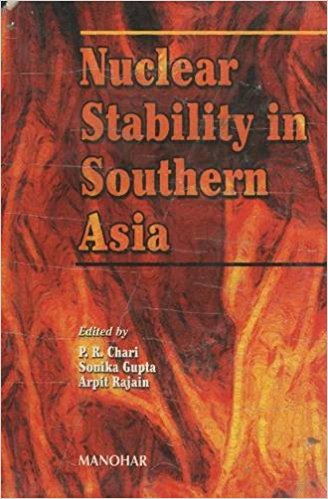
P R Chari
The first fifteen years of a nuclear rivalry can be very rocky. This is when the rules of the competition are still being written, when vulnerabilities are greatest, and when monitoring capabilities are spotty, at best. It therefore comes as no surprise that India and Pakistan are going through a dangerous passage.
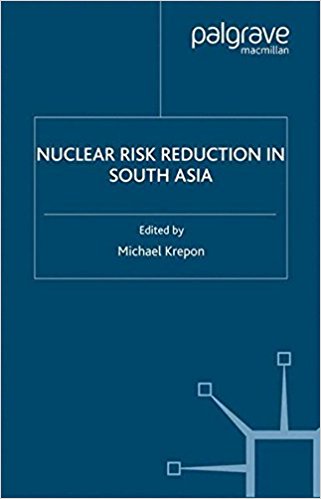
Michael Krepon
The Stimson Center and Vision Books have brought out a well researched paperback on a subject which the Center has pioneered in South Asia – Confidence Building Measures and Risk Reduction. The hopes that motivated the Stimson Center, led by Michael Krepon, on leading India and Pakistan to a “progressive and cumulative set of CBMs between 1991 and 2003, have been belied, owing to ‘geopolitical realities’”.
Pervaiz Iqbal Cheema
Pakistan is a state that appears to be in rapid movement, but has in fact changed very slowly. In the last few years it has become an overt nuclear weapons state, the army seized power for the fourth time in a coup, there was an ill-fated military adventure across the Line of Control at Kargil, the leadership signed up with the American-led (but ill-named) war on terrorism, and most recently Pakistan’s revered “father of the bomb,”
Chander Bhan and M.V. Nadkarni
C. Bhan’s ‘Farm Mechanisation and Social Change’ and Nadkarni’s ‘Farmers’ Movements in India’ are two recent studies which focus on the impact of technological development and moder¬nization of agriculture to explore the different dimensions of social and political changes engendered by, and within, a process of agricultural moder¬nization.
David Hardiman
The Coming of the Devi is a minutely researched and sensitively written history of the transformation of an obscure small¬pox propitiation ceremony into a move¬ment for social reform and tribal self assertion. Hardiman’s empirical investi¬gations into the origins, spread and growth of the Devi movement among the tribals and peasants of South Gujarat also addresses more general issues such as the nature of peasant consciousness and the understanding of those movements for social and political change which remained independent of elite control and initia¬tives.
Nari Rustomji
Those who had known Thondup Namgyal, the late Chogyal of Sikkim, would find Nari Rustomji’s portrayal of his persona¬lity extremely interesting and readable. The personal letters reproduced reflect the conflicting trends which contributed substantially to the course of events in Sikkim. Charming and sensitive, Thondup Namgyal was human to the core.
P R Rajgopal
Social change is associated with realign¬ment of individual and group interests as the economy moves from one stage to another in the course of its development. It is, therefore, axiomatic that those whose position is challenged in this pro¬cess should resist and those who feel deprived of their due entitlements make a bid for fair deal. One of the legitimate functions of the State is to ensure that these changes take place without disturb¬ing the order through the processes which are generally accepted as legitimate.
Raghavan Iyer
About five months before his martyrdom, Mahatma Gandhi gave us in a short sentence a key to an understanding of his complex personality and of his place in human history; he told the Shanti Seva Dal, ‘My life is my message.’ Nothing more needs to be said.
S N Prasad & Dharam Pal
This is the full story of the military operations in Jammu & Kashmir during 9147-48 undertaken to save that princely state, which had acceded to the Union of India, from a brutal invasion by Pakistan. The year-long campaign saw many triumphs and tragedies which are narrated objectively in detail. The Indian Army and Air Force, just emerging from the throes of partition and still in the process of reorganization, emerged from the or¬deal stronger.
Y. Lakshmi
A timely book. Timely, since it synchro¬nized with a vigorous debate in the national press on the justification for present outlays on the armed forces and the limits of defence expenditure. This debate was engendered by the rapid escala¬tion in defence outlays for 1987-88 by as much as 43 per cent over the last financial year to over Rs. 12,000 crores.
P. Ramaswamy
As though to make up for the past neglect of Sri Lanka, there has been lately a spate of writing on the island and the complexities of its politics, particularly in relation to the Sinhalese-Tamil ethnic conflict. As is only to be expected in a highly sensitized situation, much of this writing specially in newspapers, tends to be either consciously or unconsciously tendentious or simplistic in its perception, whether it be of the Sinhalese-Tamil conflict or its implications for India’s Sri Lankan policy.
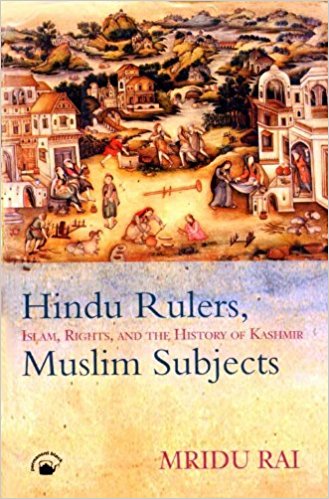
Mridu Rai
History hangs heavy on Kashmir. The state’s complex and contested past resurfaces repeatedly in its present-day dilemmas, and today’s headlines are often coloured by references to disputes of the past. To understand what is going on right now draws one into what is a never-ending debate about events that took place half-a-century ago or more.
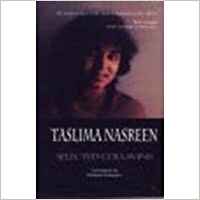
Taslima Nasreen
2004
Taslima Nasreen’s Nirbachito Column first came out in Bengali in 1991and soon thereafter it swept the Kolkata market, creating waves in the psyche of the Bengali bhadralog class; most women were elated, while conventional men and women did not conceal their scepticism and even launched sharp criticism of her contentions.
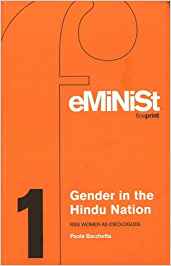
Paola Bacheta
The two books, Paola Bacheta’s Gender in the Hindu Nation and Shahnaz Rouse’s Shifting Body Politics under review are similar in that they both approach the formation of state and nation through the discursive strategies adopted by civil society. Predicated upon a largely unstated Gramscian understanding of the state and civil society the books remark upon how civil society organizations and formations negotiate with and complement the state.
Chandan Mitra
La Martiniere has been a distinguished name in Indian education for more than a century; and yet few know what lies behind that name. Chandan Mitra attempts to chronicle the history of La Martiniere in a book that began as a souvenir of its Sesquicentennial and evolved into a full-fledged history.
Pupul Jayakar
1988
Pupul Jaykar’s Jiddu Krishnamoorthy is a book of great warmth and perception about a man of penetrating insight into the nature of life and the reality that subsumes it. It is a book that requires reading several times over for it contains not only the broad events in this curious man’s life but also the resonance of his life in the spiritual life of those who, as Pupul Jayakar did, knew him personally and at close quarters.
Bernard S. Cohn
At last it is possible to read Bernard Cohn without having to hunt for his articles in obscure journals scattered in various libraries. Here are twenty-three of his essays, written over the period from 1955 to 1983, thus including all but his most recent writings. What a boon for Indian students, who do not have access to the sophisticated biblio¬graphical aids to be found in American libraries and in the British Library System.