
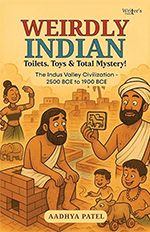
Aadhya Patel is a young writer making a foray into what seems to be an interest she developed through her school studies. She begins the book by dedicating it to her history teacher, who inspired her interest in world events and the historical past. While it is admirable to see an eleven-year-old take a keen interest in writing, it is also fascinating that she chose to write about ancient history. This indicates the important role that education plays in sparking curiosity in young minds. Further, it challenges the idea that Gen Alpha is disconnected and uninformed.
In her book, Patel writes about the Indus Valley Civilization, focusing on both Harappa and Mohenjo-daro. In twelve chapters, she covers details of lifestyle practices, and the undeciphered mysteries of the people’s language and script. Her book covers themes such as city design, toys, animals, religion, food, fashion and education. The book rewrites history to bring it to readers in a way that would interest them rather than making it only about the distant past.
The uniqueness in her writing stems from retaining the language of her generation to make facts about the ancient world engaging and interesting. Her distinctive style of comparing the lifestyle of people in the Indus Valley Civilization to contemporary times makes one revisit contemporary practices and wonder about the knowledge and wisdom that people of the civilization once had.
A strong addition in the book is the creative activities that Patel has presented at the end of each chapter. The activities include designing one’s own city, thinking about developing a terracotta seal, rethinking the use of jewellery, and even ‘theorizing’ about why that civilization vanished! These activities serve as valuable inputs into creative and critical thinking exercises. School teachers for primary and early middle grades can use these to help students to work in groups or individually and showcase their work to their peers or maybe even to a larger audience.
The book does not present uncommon facts, but the writing style is likely to appeal more to young readers than the more academic language of school textbooks and detailed reference books on the same topic. Simple illustrations supplement the text and add value. Through the distinctive writing style and the suggested activities, this book is a useful resource for parents and teachers to encourage pre-teens to develop an interest in history. A book written by Gen Alpha for Gen Alpha holds tremendous promise as probably a first in a series of history books.