

‘In following a story, we follow a story, we follow a storyteller, or, precisely, we follow the trajectory of a storyteller’s attention, what it notices and what it ignores, what it lingers on, what it repeats, what its memory plays in understanding what historical events consider irrelevant, what it hurries towards, what it brings together. It’s like following a dance, not with our feet and bodies, but with our observation and our expectations and our memories of lived life.’ —John Berger, Bento’s Sketchbook.
Before the advent of the written word came the oral world. It was a world in which humans passed on their knowledge and wisdom to future generations through songs, tales, and folklore that moved aurally from one generation to the next. With the advent of the printing press, as beautifully observed by Sukrita Paul, the editor of Indian Literature, in her editorial note, the written word gained currency, while the age-old tradition of passing on knowledge found itself committed to pages.
It is interesting to observe how this shift created boundaries among people, and how knowledge once shared with urgency and immediacy became something one could reach for on a bookshelf at leisure. 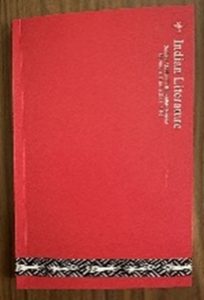 I remember studying the formation of sounds and the varied shapes a single word can create. Why is that? Why focus so intensely on how a word sounds when one can simply read it and understand the connotations it carries? This is a long discussion, and to follow it further would take me away from what I am trying to consider here.
Prostrate to Earth
On the people who own this earth
What is the base of earth?
The base of earth is soil navel
What is the base of soil navel?
The base of soil navel is stone structure
What is the base of this stone structure?
The base of stone structure is pot
What is the base of pot?
The base of pot is clear water
What is the base of water?
The base of water is bamboo stick…
—one of the Mangalamkali songs of the Malavettuva
What the two latest editions of Indian Literature have achieved is remarkable. To gather voices from the length and breadth of this country is not an easy task, and to bring them onto the page is an even more demanding one. The July-August edition includes tales from the Andamans, Irula songs sung by the Irula tribe in Tamil Nadu, songs from the Gonda tribes, the Jatapus, Gorboli, the Malavettuva tribe, songs and stories in the Tulu language, poetry and songs in Marathi, the Bhatiyali songs, and songs from Gujarat (in Kumhari, Bunkari/Chamari, Bhili and Saurashtri). There are stories from the Gadaba tribes, myths from the Kodava, stories in Konkani and Kannada; and alongside these, essays that bring deeper insight into various oral and folk literary traditions.
One essay that struck me deeply was on the songs of the fisherfolk on the Kerala coast, where ‘the words, the thematics of the language are also distinct and carry the connotations of the ocean.’ Sung and shaped by the fishermen themselves, the essay turns a spotlight on the history and emotional landscape of the community. A beautiful introduction to the idea of Barahmasa is also explored through an essay in which Barahmasa songs in Awadhi, Bhojpuri, Bundeli, Gujarati, Kashmiri and Tamil are translated into English for readers.
To preserve the oral is always challenging. How does one hold on to the essence of what someone is trying to say, to sing, or to express? Yet, while going through these editions, what stood out was how the translators have painstakingly assembled songs and oral traditions from specific regions and offered readers a glimpse of what we urgently need to preserve. The Sahitya Akademi has long been doing commendable work in this area, and these volumes continue that effort with clarity and care.
Part Two of the journal, focusing on oral traditions in the September-October edition, drenches the reader in songs in the Pattani language, in Chambiali, in Garhwali, in Pothohari/Punjabi, in Haryanvi; songs from the Apatani tribe, the Galo tribe, the Meitei community; in the Molsom language, in Bhojpuri; songs from the Bastar region; folktales from Jammu and Kashmir, in Dogri, in Awadhi; songs and folktales from the Wancho tribe, the Bodo, in Baiga, in Bhili, Desia, Kondh, Munda, Chhattisgarhi, Kharia; and myth-stories of the Korku tribe.
And riddles in the Kokborok language:
When born she has horn
As she grows she looks like a golden plate
Who has cursed her?
Answer: the different phases of the moon.
The essays in this edition are equally eye-opening: from folk theatre of Himachal Pradesh, to the Bhunda performance of Spail Valley in Rohru Tehsil; to the soulful expressions of Syed Bulleh Shah; to a study of endangered songs of the tribes of Arunachal Pradesh (Tibetan, Ashing, Singpo, Brokpa, and Nah); to essays exploring the oral traditions of Dree Busi and Dree Ayu; an exploration of Kaben, the folksong of the Galo tribe; songs of the Kirar community; the traditions of the Baiga; and the creation myth of the Kutia Kondh people. The depth of study and the breadth of collection leave one breathless.
One cannot help but notice how the dynamics shift when women take centre stage in transmitting oral history. In such moments, history is moulded through a woman’s gaze. A gaze that negotiates but does not surrender entirely to the patriarchal structures surrounding her. She may not be completely free of them, yet her voice enters the continuum of oral storytelling and music, reshaping it and ensuring that her memories, interpretations, and emotions are not lost. A conversation in the July-August edition highlights this beautifully:
KR: Does folk envisage a feminine order?
SS: Yes, women are powerful in folk. It is about women in folk… There are men too, but the dominant aspect is of women. Most folklore around and about women feels like our own. Shah Latif, while writing, presents himself as a woman. So do Bulleh Shah and Khwaja Fareed.
Under the able guidance of Sukrita Paul, these editions form a compendium that will benefit not only scholars but also readers who wish to search for, understand and experience the oral traditions of India. What is especially beautiful is how these traditions have been kept alive. They are not merely accounts of suffering or hope; they are expressions of the human need to look back, to remember, and to speak one’s past aloud. The heart speaks a language that only the heart understands. Oral traditions combine memory with history, weaving together the threads that shape one’s identity and one’s relationship with the place one comes from. Language shifts, as do linguistic affiliations, and these shifts emerge vividly across the collected traditions.
Boundaries begin to collapse as one moves through the landscape of oral tradition. Much has been written about this subject from scholarly perspectives. In her 2022 essay, ‘Oral Traditions in the Aural Public Sphere: Digital Archiving of Vernacular Music in North India’, Aditi Deo observes, ‘In postcolonial imagination, the location of such music was consolidated through All India Radio’s public service broadcasting which, from the 1950s, began to feature vernacular “folk music” in nationwide programming and from the 1970s, Doordarshan continued this trend.’ The philosophy underpinning oral traditions has always been bound to origins: myths of creation, stories of beginnings, and over time, a split emerged between what belonged to the sphere of orality and what found its way into writing.
What these two editions have done is something I have yet to see in any journals in recent times. The effort and the hard work that have gone into creating such a rich compendium are laudable. They bring us back to the places we belong to, and to the realization that languages go far beyond the handful we are familiar with and often assume to be the only ones that represent who we are. They are not. These two editions shake us from the stupor of that false idea, revealing worlds that thrive beyond our imagination.
Semeen Ali has published four poetry collections and contributed to national and international journals and anthologies. She has co-edited anthologies and is the Poetry Editor for Muse India. Additionally, she is part of the editorial team at Red River.