
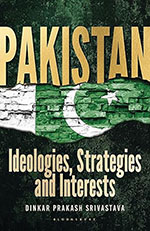
A plethora of books have been published during the recent years on Pakistan, attempting to explain recent developments. While many have been written by scholars from outside the region, a few have been authored by former diplomats and Defence officials who served in Pakistan. Their first-hand experience in Pakistan has helped them to explore new areas beyond narrow security and external relations issues. Dinkar Srivastava’s book Pakistan: Ideologies, Strategies and Interests is a new addition to this literature. He had served in Pakistan and authored another book on POK titled Forgotten Kashmir: The Other Side of the Line of Control.
Srivastava’s book has four parts: ‘The Road to Partition’, ‘Faith, Politics and Interests’, ‘Nationality’ and ‘Ideologies, Strategies and Interests’. Since the contents of the first two parts have been widely discussed in the writings of other scholars, this review focuses mainly on the last two parts looking at the question of nationalities within, and how Pakistan pursued certain strategies towards critical questions such as Afghanistan, J&K, Terrorism and Nuclear Weapons.
An important contribution of the book is its focus on Pakistan’s nationality question. Srivastava states that ‘the nationality issue in Pakistan is older than the creation of the country in Pakistan…Pakistan was to be a new State, but the provinces already existed.’ This was the case in many of the newly independent countries of that time, including India, but it became a bigger issue in Pakistan. Of the six major nationalities within Pakistan during its initial phase—the Pashtun, Punjabi, Baloch, Sindhi, Bengali and Mohajir, all others except one (the Punjabi) have raised questions over the national identity (Pakistani) vis-à-vis their linguistic and ethnic identities during the last seven decades. While the Bengali identity assertion resulted in the partition of Pakistan in 1971, the Sindhis, Baloch and the Pashtuns have continued to grapple with the issue. Why was this the case? Srivastava provides two answers: ‘The 1973 Constitution sought to resurrect a unitary state under a federal guise’ and the use of ‘Islam to suppress national and linguistic identities…’. An equally important argument that the book alludes to is the weakening of regional parties. All the above three propositions need separate inquiries.
Four chapters in Part 3 of the book examine the above questions among the Pashtuns, Sindhis, Baloch and Muhajirs. This is an important contribution of the book, examining subnational questions and providing a brief yet historical overview of the four ethnic groups from Jinnah to General Asim Munir. The four chapters that look at the question explain how the provinces and their political elites saw the idea of Pakistan before Independence, and how the relationship was shaped since 1947 with the federation. The chapters also look at how the ethnic communities looked at the others.
The chapter on Khyber Pakhtunkhwa looks at the decline of the provincial parties—the NAP and the ANP, the rise of fundamentalism and terrorism, and the use of religious political parties (under the Muttahida Majlis-e-Amal banner) with support from the Establishment as three major reasons for the problems of the province. Srivastava makes an important argument on the above in relation to the rise of Imran Khan’s Pakistan Tehreek-e-Insaf (PTI) in the province: ‘The PTI’s rise was engineered by targeted violence against ANP leadership and its rank and file. The party gained the political space vacated by ANP in the elections. This heralded a shift of political balance towards the religious right.’ The book was published in 2025. Recent developments in the province hint that the above transformation in the KP—from secular religious parties to the rise of religious and fundamentalist parties/groups is not over. The Establishment’s experiment with Imran Khan and the PTI stands failed. So, what next for provincial politics and the identity question in KP?
Sindh, despite witnessing a nationalist movement led by GM Syed, remains integrated with the rest of Pakistan, with occasional provocations over water sharing and differences over federal-provincial financial awards. The rise of PPP and its success at provincial and national levels have played an important role in addressing the issue. According to Srivastava, PPP’s success in forming the government in Islamabad ‘may have reduced the appeal of GM Syed Jiye Sindh… as the main channel for the articulation of Sindhi nationalism.’ PPP has played an important role in keeping Sindhi nationalism alive but has also worked towards strengthening the federation.
Balochistan has always been a curious case within Pakistan. The largest province in Pakistan has the smallest legislative assembly for the province and sends the smallest number of members to the National Assembly. Srivastava writes: ‘Despite its vast natural resources, Balochistan remains Pakistan’s most backward region.’ The historic case of forced annexation of Kalat, along with the above reasons, has kept Baloch nationalism alive in the province. According to Srivastava, ‘Pakistan was using religious fundamentalism to suppress Baloch nationalism’, and links it with the rise of Shia killings in the province. Unlike in Sindh, where there is a party (PPP) supporting the cause of nationalism, there are no similar provincial parties in Balochistan. Srivastava concludes: ‘While East Pakistan could break away, given its small population and proximity to larger provinces, Balochistan cannot escape Pakistan’s iron grip. The Chinese presence in Gwadar has increased the strategic importance of the region in the Pakistan Army’s calculus.’
The fourth nationality that the book looks at is that of the Muhajirs. For Srivastava, ‘Muhajir identity has been shaped by state repression and ethnic conflict.’ For him, the MQM’s rise in the 1980s was the result of Mujahirs’ marginalization in the power structure. However, this is now being challenged by the breakup of the Party, after the 2016 speech by Altaf Hussain calling Pakistan a cancer, and later by the rise of Imran Khan and PTI in Karachi’s politics. What next for the Muhajirs in Pakistan?
If Srivastava plans for a second edition, he should add a chapter on Punjab in this part. While many consider Punjab as the most stable province, with least number of issues for Pakistan, recent developments during the last decade indicate a coming storm. Politically, the last two elections witnessed the rise of Imran Khan and the PTI in Punjab, which for decades have been the PML-N fort. The Shariffs were the undisputed leaders of the province; however, the last two election results highlight the inroads that the PTI has made into the Muslim League bastion. A second important factor is the rise of Brelvi politics, spearheaded by the Tehrik-e-Labbaik Pakistan (TLP). The Brelvi political assertion, as was witnessed through the TLP’s rise, has serious questions for the PML-N and also for provincial stability. A third important factor in Punjab’s politics is the role of the Establishment; the rise of PTI in Punjab challenges that preeminent position. A fourth important question is related to South Punjab and the Siraiki question.
Part Four of the books refers to the role of the Army in Pakistan’s politics and its entrenchment, the Afghan challenge, strategies towards J&K, Pakistan’s response to terrorism, the role of nuclear weapons, and the state of the economy.
The chapter on the Army in Part Four is about how the Establishment looked at J&K, Afghanistan, Terrorism, nuclear weapons and doctrines, and the jihad within. It raises a few questions; more are needed to be raised and also possible search for answers. Srivastava starts with an interesting proposition that the Army also defends Pakistan’s ‘ideological frontiers’ and later in the chapter refers to the loss of East Pakistan creating an ‘identity crisis in the country and within the Army’. Later in the chapter, there is a statement that Pakistan Army was ‘also acting as the vanguard of an Islamic civilization.’ The chapter also refers to the Afghan war radicalizing not only the society ‘but also the military’. What are Pakistan’s ideological frontiers, and how has the Pakistan Army been defending them? Is there an ‘identity crisis’ within Pakistan’s Army, post-1971 defeat? What is the nature of radicalization within the military? What are the contours and the implications of these three propositions? They need further research and even trajectory mapping.
The chapter on Afghanistan makes two interesting and interconnected propositions—that Pakistan’s strategic depth policy ‘makes little military sense’ and the policy ‘may have become redundant’ after acquiring nuclear weapons. The chapter also details the tensions between Pakistan and the Afghan Taliban. With the developments during the last two years, Afghanistan has become more of a strategic trap. Srivastava’s two propositions need further examination. How will Pakistan respond to Afghanistan—militarily and politically?
In the chapter on J&K, after explaining the politics in Pakistan-occupied Kashmir and the discrimination faced by the two political entities there, Srivastava raises an important question: ‘Why do Muslims of POK have less freedom than Muslims of Pakistan?’
The chapter on terrorism, towards its conclusion, while repudiating Pakistan as a victim, says: ‘A policy of using terror groups to advance Pakistan’s strategic interests in Afghanistan and Jammu and Kashmir and suppressing national or ethnic identities in Khyber Pakhtunkhwa and Balochistan was bound to produce a domestic fallout.’ During recent years, many within Pakistan, especially from the civil society, have made a similar argument. Why then does the state, especially the Establishment, pursue the same? Especially after the attack on the Army Public School ten years back, where does the above approach stand? What will make the Establishment change their approach?
On nuclear deterrence, the chapter summarizes Pakistan’s approach as achieving the unfinished agenda of Partition (relating to J&K), inviting international mediation on J&K, and keeping the threshold deliberately low, with an objective to deter any Indian response to terrorism by a Pak-based group. This raises questions about nuclear stability between India and Pakistan, especially alarming the international community in the West. But how to explain Pakistan’s response to India’s reactions to the attack on Pulwama and Pahalgam? Is Pakistan’s nuclear threshold really low, or is it rhetoric?
The chapter on the economy makes an important proposition: ‘Pakistan has been very successful in exploiting geopolitics for financial assistance.’ Pakistan’s ability to seek geopolitical rent has been vital in the past. After the US withdrawal from Afghanistan, there was an expectation this would decline. With recent developments in Iran, Trump’s new-found interest in Pakistan’s minerals, Pakistan-Saudi Arabia and Pakistan-Turkey defence agreements and negotiations, where does it stand? Will there be a resumption of Pakistan seeking geopolitical rent?
Finally, the chapter on Imran Khan asks an important question: ‘Will Imran have a second innings?’ Imran Khan’s rise may have been triggered by the Establishment, but he has succeeded in building a political base for himself across the provinces—from Peshawar to Karachi. Will the Deep State succeed in silencing him—politically or otherwise?
Srivastava makes the following interesting conclusions. First, Pakistan’s ideology ‘provides no solution to the existential problems.’ Second, the idea of Pakistan ‘was fundamentally different from the Westphalian system where the nation state was defined in terms of geography, not the king’s religion.’ Third, the conception of ‘a state based on religion was inherently flawed.’
So, what next for Pakistan? There are no easy answers for the questions that Srivastava has raised and referred to.
D Suba Chandran is Professor & Dean, School of Conflict and Security Studies, National Institute of Advanced Studies (NIAS), Indian Institute of Science Campus, Bangalore.