
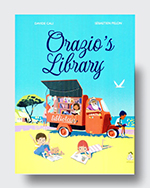
Libraries are a common setting in children’s picture books around the world, and a modest collection of these books also features memorable librarians, both real and fictional. Whether it is a whimsical story about challenging the norms of a quiet library in Library Lion, a tale about the power of a curated home library helping a child overcome anxiety in Thammi’s Gift, the inspiring biography of The Librarian of Basra, or a celebration of a community library in Our Library, these stories possess a timeless appeal for those who value reading. Orazio’s Library/Orazio ki Library is another such picture book. It tells the story of a mobile library bringing books to isolated villages, as well as a teacher-turned-librarian who finds his work deeply rewarding.
In the story, Orazio, a retired schoolteacher, obtains an old motor van and turns it into a bookmobile. Every Friday, he drives up the hills of Sicily to four different villages, delivering the joy of books to young and old alike. His patrons eagerly await his arrival, especially because they live in remote areas and find it difficult to secure a steady supply of new books. Each village has a different audience and welcomes Orazio in its own way. The twist in the story arrives when, as Orazio steps away briefly to refresh himself at a water fountain, his precious library-on-wheels rolls down and crashes into a valley. Will this be the end of Orazio’s library? How will Sicilians get their weekly dose of books? How will Orazio spend Fridays? The rest of the story answers these questions while showing why we can never have enough good stories about libraries and librarians.
Sébastien Pelon’s colour palette works brilliantly to illustrate the dramatic landscape of Sicily and instantly transports us there. Every element—from the rugged coastal cliffs, turquoise waters, and clear sky to sun-drenched rolling hills, fruit-laden trees and prickly cacti—stands out, yet all of it blends into appealing scenery. The artist has also used colours to communicate some of the subtler aspects of the story, such as the time of the day and the characters’ mood, and to guide the viewer’s eye towards specific interactions. I couldn’t help flipping through the pages again and again just to notice the tiny details in the illustrations, like the label indicating the children’s section in the bookmobile and drawings gifted to Orazio by the children.
Picture book lovers, children who already enjoy stories about libraries, and readers who like discovering different cultures through print will especially appreciate this book. It is suitable for anyone aged 8 and older.