
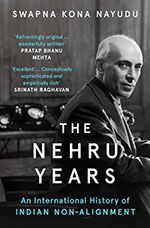
Nayudu’s book is an engaging enquiry into the philosophy underpinning Indian nonalignment, so closely associated with Jawaharlal Nehru. She does this through a rigorous, empirical analysis of India’s response to four major international events: the Korean War (1951), the Suez Canal Crisis (1956), the Hungarian Revolt (1956) and the Congo Crisis (1960). Through these events, her book presents a history of India as an international actor. Although the events analysed are historically unique, a discernible common thread ties India’s nonaligned response to each of them, as articulated by India’s mediation interventions or by their limitations. The lines of her enquiries have untangled the basis of Nehru’s beliefs and the strands of Nehruvian thinking.
Nayudu writes in her Introduction that The Nehru Years is an international history of Indian nonalignment from the founding period following India’s Independence in 1947 until 1964, with Nehru’s passing marking the end of the first phase of India’s international relations. Nehru indeed played a dominant role in the formulation and articulation of foreign policy, although he disclaimed personal ownership of it. In his parliamentary speeches, he attributed the evolution of Indian foreign policy to a slow process preceding Independence. ‘It is a policy,’ he said, ‘inherent in the circumstances of India, inherent in the past thinking of India, inherent in the whole outlook of India, inherent in the conditioning of the Indian mind during our struggle for freedom, and inherent in the circumstances of the world today.’ Nonalignment is the product of India’s colonial experience. By the time India attained Independence in 1947, Indian nationalist leaders had developed a distinct outlook on world affairs, with Nehru’s strong imprint. ‘What does independence consist of?’, Nehru asked rhetorically in the Constituent Assembly. He then said: ‘It consists fundamentally and basically of foreign relations…. Once foreign relations go out of your hands into the charge of somebody else, to that extent and in that measure, you are not independent.’
Nayudu is of the view that it is wrong to view Nehru’s nonaligned policy within the framework of Cold War politics, as Western political scientists do. She is correct that the primary foundation of nonalignment was India’s anticolonial struggle. Nehru believed nonalignment conformed to India’s quest for sovereignty and self-rule, and post-Independence, to freedom of action internationally (what is now generally described as ‘strategic autonomy’). Also, in consonance with India’s struggle for freedom, Nehru wanted to work in favour of the ‘emancipation of colonial and dependent countries and peoples’. Nehru’s statements conform largely to Nayudu’s view that nonalignment is ‘a politics of anticolonial resistance’. She presents nonalignment in the context of anti-colonialism, decolonization, and postcolonial diplomacy (p. 2).
That said, each of the four major international crises that arose during the Nehru years—the Korean War, the Suez Crisis, the Hungarian Revolution, and the Congo Crisis—had Cold War connections. The Cold War conundrum was that its protagonists remained hostile to independent thought and action on the part of the newly emerged countries that had freed themselves from colonialism. Nayudu herself notes that Nehru was ‘unabashedly critical’ of Cold War ideological camps (p. 28). She quotes Nehru cautioning that ‘the slightest deviation’ from the Indian policy of nonalignment would be ‘a disaster without repair’ (p. 71). Although the nonaligned impulse originated from the colonial experience, the movement that emerged was equally a rejection of Cold War-determined, military alliance-based international relations.
A dominant consideration for Nehru’s embrace of nonalignment was his conviction that such a policy would enable India to contribute to maintaining global peace. ‘Destiny has cast a certain role upon this country’, he declared in the Constituent Assembly. Nonalignment was an instrument for India to do so. Nehru believed that ‘the supreme question’ globally was how to ‘avoid a world war’ that would be ‘utterly catastrophic’. He felt that India could play an ‘effective part’ in preventing such a war, and for this, India needed to remain nonaligned, along with like-minded countries. Indeed, on September 7, 1946, as Vice-President of the Indian Interim Government, he said in a broadcast that India had to ‘keep away from the power politics of groups aligned against one another.’ Nehru stated that India ‘aligning itself with a particular group of nations, headed by a superpower’, would have compromised nonalignment.
Nehru’s peaceful outlook, which included a reliance on diplomacy combined with an aversion to a military approach, characterized Nehruvian nonalignment. He also invested, especially in the early years of his Premiership, in an Asian identity (predicated on an India-China entente), which he considered an essential condition for global peace. One of the five chapters of Nayudu’s book is devoted to Tagore, Gandhi, and Nehruvian nonalignment, which, besides anti-colonialism, was informed by cosmopolitanism and internationalism. Nehru transposed Mahatma Gandhi’s idealism and moral leadership, which were the instruments used in the national movement, to the international arena, without fully appreciating the Gandhian strategy of, in Gramsci’s words, ‘the war of position and the war of movement’. Nehru invoked, in his words, the Gandhian ‘doctrine of non-violence’ as an active instrument for ‘the peaceful solution to international differences’. Yet, Nehru’s deep dislike of war did not make him a naïve pacifist. His dedication to peace-making came from an aversion to violent confrontation. To Nehru, the two world wars had demonstrated ‘the futility of warfare’. Faith in nonviolence and an abiding commitment to progressive internationalism were part of Nehru’s mental makeup since his early days in the national movement. Nehru’s acceptance of Gandhian congruence between the ends and means underpinned his non-militarist outlook.
Nehru’s energy, patience, and diplomatic dexterity resulted in successful Indian mediation efforts in most major global crises that arose during his Premiership. He pursued peace against formidable odds, including, as he put it in a private letter, the obdurate leadership of the great powers: ‘It really is amazing how great nations are governed by very small people.’ Despite misgivings on the part of China and the United States, he helped secure peace in Korea. India’s role was also critical in ending the Suez Crisis; he extricated the French and the British from the mess they had created for themselves. He saved the United Nations Operations in Congo (ONUC) and prevented Katanga’s secession. Despite India’s non-condemnatory response to the Soviet Union’s strong arming of the Hungarian uprising, he called out the armed intervention, stating in the Indian parliament that the Soviet armies were in Hungary ‘against the wishes of the Hungarian people’ (p. 121).
Nayudu’s particular contribution to India’s diplomatic history has been to analyse Indian objectives and legacy in resolving the Congo Crisis. India’s disinterested, principled contribution came at a significant cost to India itself. Nehru decided to deploy, in 1961, the best Indian infantry units as part of the two brigades deployed to ONUC, the UN’s first peacekeeping mission with significant military capability, at a time when India-China relations were souring. Nehru’s overriding concern then was saving the UN. Nayudu quotes Nehru as stating that national issues should not come in the way of India’s ‘international commitments’ (p. 167).
Nayudu has done equally well to highlight that Nehru did not envision nonalignment as a ‘third bloc’ (p. 142). All her arguments are well annotated, and her bibliography speaks of the depth of her scholarship. Nayudu’s eminently readable account is an essential guide for anyone interested in the evolution of India’s nonaligned foreign policy and the leading role Nehru played in it, as well as a reminder of the progressive leadership India displayed at the time on the world stage.
Jayant Prasad is former Indian diplomat of the Indian Foreign Service who served as the Director General, Institute for Defence Studies and Analyses, New Delhi.