
In 2006, a public awareness campaign using the slogan ‘Condom bindass bol’ (Say Condom Freely) made waves in India and won the UN Grand Award, an award the United Nations jointly sponsored with the International Public Relations Association (IPRA) to recognize excellence in campaigns that tackle priority issues. This campaign was launched to counteract a decline in condom use and sales in eight States in northern India caused by taboos and shame around contraception. The entrenched social stigma around sex education and birth control measures that exists even today helps us to put the life and work of Professor Raghunath Dondo Karve, India’s first propagator of birth control measures, in perspective. It was about eighty years before this campaign, in 1927, that the first issue of the magazine Samaaj-swaasthya (The Health of Society), the landmark initiative of RD Karve dedicated to the scientific examination of sexual urges and birth control measures, was published.
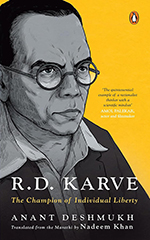
Karve was the flagbearer of conversations on sexual autonomy and sexual health at a time when, let alone public, even private discussions behind closed doors on these concepts were unthinkable. Braving aggressive resistance from the Brahmanical and conservative quarters, Karve laid the foundations of the birth control movement even before it became a subject of discussion in Europe. Anand Deshmukh’s R. D. Karve: The Champion of Individual Liberty is an ode to this visionary, who singlehandedly steered society in the direction of scientific and rational discussions on birth control measures.
The book largely follows a chronological sequence of Karve’s life. His life can be broadly classified into before and after the beginning of Samaaj-swaasthya. The first half of his life is essentially Karve’s journey of discovering his life’s purpose: propagating birth control and sexology. The second half, while branching into various directions due to his wide-ranging interests, largely centres around his efforts to propagate sex education and birth control through his magazine. Finally, the last three chapters of the book discuss miscellaneous details, such as the articles he wrote for other platforms and the people who played significant roles in his life.
Raghunathrao was born on 14 January 1882 in a small village called Murud near Harne in Maharashtra. Nineteenth and early twentieth-century Maharashtra was deeply enmeshed in religiously-sanctioned customs and orthodox social mores. Karve was fortunate to be surrounded by a handful of unique personalities who swam against the tide, especially his father, Dhondo Keshav Karve, the pioneering social reformer who advocated widow remarriage and women’s welfare.
It was at Fergusson College, Pune, that young Raghunathrao first encountered the science of birth control and sexology. Later, while pursuing a diploma in teaching, he also became proficient in French, which opened up a whole new avenue of knowledge on these subjects. Around this time, Karve fell in love with Gangu Gode, also called Maltibai, who later became his wife. After his education, Karve began his teaching career as the assistant to the Professor of Mathematics at Elphinstone College.
However, his teaching career was short-lived due to a series of incidents described in detail in the book. It was during this period that he first suffered the consequences of his heterodox views. From this stage of his life to the very end, Karve continued to pay a heavy price for his defiance.
Karve began his campaign on family planning and birth control in 1921. By the time he launched his magazine in 1927, he had already established himself as a staunch advocate of sex education. As one might expect, his magazine started with a setback. When attempting to publish on these subjects, he quickly realized that his opinions and articles were too radical and therefore unwelcome, not just in orthodox spaces but also in the then progressive magazines such as Kirloskar Khabar. When faced with setbacks, instead of giving up, Karve doubled down on his efforts and launched his own magazine to discuss the physical and mental health of individuals and society. The first issue appeared in 1927, and it survived for twenty-three years and four months, until his demise. The sheer volume and the smorgasbord of contents make this magazine a treasure-trove for people interested in the history of the time in general and in the health debates in particular.
The conservatives argued that under the pretext of sex education, he was promoting and advocating promiscuity, nudity and extramarital sex. The scathing language he used while critiquing his opponents added fuel to the fire. His iconoclastic views invited numerous legal battles, explored in detail in the book. However, this does not mean he was completely alone in his fight. His father, wife, half-brothers and several high-profile intellectuals understood the significance of his endeavour and stood by him.
Even though advocating birth control measures occupied most of Karve’s life, he was a man of varied interests. He had enviable knowledge of music and literature. The book uncovers these lesser-known aspects of his life, including an extensive discussion of articles he wrote for various platforms and reflections on important personalities in his life. The book concludes with an account of Karve’s passing and the subsequent publication of the final issue of Samaaj-swaasthya.
While depicting the story of a visionary’s life in minute detail, the authors have paid careful attention not to reduce the personality to a straitjacket. For instance, even though Karve was a rationalist who led by example, engaging enthusiastically even with the staunchest critiques of his magazine, there were incidents in his life that revealed pettiness, egotism and intolerance to criticism. Rather than sugarcoating such contradictions, the authors state that one way to make sense of them is to remember Karve as a human being with flaws and inconsistencies.
A biographical work can easily become a skewed narrative in the absence of triangulation. The authors, however, draw extensively from various available sources, such as the autobiography of his father, the earlier biography of Karve by YD Phadke, numerous articles written by Karve himself and other historical materials such as interviews of friends and well-wishers. Apart from the occasional overlap of events, the authors have successfully maintained the flow of narration, giving the reader a coherent and comprehensive documentation of Karve’s life.
The book offers a ringside view of Karve’s life and is a valuable contribution to the readers and researchers interested in his life and times. By documenting his extraordinary life in minute detail, the authors have not only created a reference text but also marked pathways of norm-defiance through a life well lived.
Shreya K Sugathan is pursuing her Ph.D. in the Department of Political Science, University of Hyderabad, Hyderabad.