
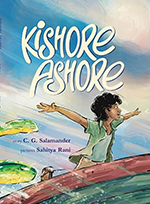
Kishore Ashore is a small graphic novel for young readers aged 8-13. This genre, if well done, is very useful for children this age as they are just getting on to more complex texts with more non-verbal and verbal cues.
The book is about a young boy, Kishore, the son of a fisherman whose training is starting on the fishing boat. Kishore’s first night at sea—the boats usually go out to sea in the evening and return in the morning—a perfect setting for the adventures and fear of the dark that children of this age-group both struggle with and enjoy. The illustrations are evocative.
For me, the book was attractive as being a Goan, I could identify with the fish and the fishing activity. At the same time, I do have a fear of the deep and could also identify with the suspense around that fear.
The suspense and fear begin on the first page itself. Kishore remembers all the dark things and fear that his friends have told him about their first night at sea. This makes Kishore, and with him, the reader, await the adventures that are going to unfold. The main element of style is the complementarity between text and visuals—unlike in picture books, the visuals are not described in the text but aptly used to set the context for each blurb text.
The book also serves as a good introduction to the life of fishermen on a boat at sea. The expanse of dark, the unending water glittering under the stars and its periodic turbulence are well developed and presented throughout the book, as is the sheer collective effort of throwing and drawing the nets! The contrast of the morning is also well drawn and brings out the contrast. A young boy amidst a group of adult men is well handled. The men share their fears of their first trips in order to put Kishore at ease. At the end of the narrative, the women are waiting for the catch. The gender division is clear, but it is good that Kishore is shown to be allowed to sort the fish with his mother and go to the market with her, generally a woman’s job.
The book can be said to be a narrative of a young boy, from his perspective, rather than a story, as there is not much of a plot that would need a resolution. Yet, it gives many opportunities to discuss fishing in deep waters: Why do the fishing boats go to sea at night? How do they find direction? Why do you think women are not allowed on fishing boats?
Even if a little on the expensive side, it’s a good book with good quality paper, good binding, expressive visuals and just the right amount of suspense. An incident or two at sea would have heightened the spirit of adventure.