
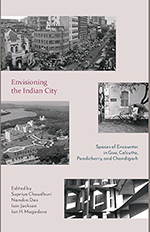
Reading this book reminded me of Italo Calvino’s Invisible Cities; of course, the two are different disciplinary genres, but both engage with the historical narratives of cities to provoke the contemporary urban imagination. Calvino’s stories are philosophically thought experiments, about nostalgia and finding meaning in the memories of one city, Venice; Envisioning the Indian City, on the other hand, is a collaborative academic research project between two institutions, one in the UK and the other in India, that focuses on four Indian cities, three with distinctly different colonial genealogies–Goa, Calcutta and Pondicherry, and one an equally distinctive postcolonial city with modernist European pedigree–Chandigarh, to find meaning in their respective historical evolution.
Calvino’s objective was to explore the personal meanings in the architecture and urbanism of Venice: ‘You take delight not in a city’s seven or seventy wonders, but in the answer it gives to a question of yours,’ while the questions that Envisioning Indian Cities explore emanate from disciplinary concerns–how cross-cultural colonial encounters in the three colonial towns and in the ‘European’ town of Chandigarh evolved to create contemporary urbanism and ‘the space in which today’s capitalistic world economies operate’. Both are conceptual tours-de-force in their respective genres, but its significance is recognized more in literature than urban studies, particularly in India, where the quotidian protocols of urban planning are dominated by dealing with the quantifiable issues of the consequences of massive urbanization and not the intangible ones that this book has focused on: the objective of the research project was to redress this bias.
The project proponents were the Centre of Advanced Study in the Department of English, Jadavpur University, and the University of Liverpool who engaged with it from 2013-2016. The disciplinary backgrounds of the interlocutors ranged from literature and socio-cultural history to geography, topography, architecture and music. They focus on the past and present of three colonial cities in India, each representing an encounter with a different colonial entity–Portuguese Goa, British Calcutta (Kolkata), and French Pondicherry (Puducherry), that together with the postcolonial city of Chandigarh as a signal project of the newly independent Indian Republic. Each city was a significant centre of administration, culture, communication and trade, which made them crucibles of encounter with Europe and European ideas. It contains fifteen independent case studies: four each on Goa, Kolkata and Puducherry, and three on Chandigarh.
The four essays on Goa describe the creation of a multicultural urban landscape where Europeans, Indian Catholics, Hindus, Muslims, and others lived together in an intricate, often fraught ecosystem that was both a product of and contributor to an entangled global history. Today, it is a small State of the Indian Republic that stands out because of its unique cultural and social environment, attracting not only global and local tourism but also change-of-lifestyle migrants from other parts of the country.
Nandini Das, a Professor of Early Modern English Literature and Culture at Oxford University, examines Goa through the lens of cultural and collective memory by reading early modern travel narratives to illustrate how experiences of Goa influenced European views of India, while also being shaped by the city’s cosmopolitan character.
Walter Rossa, a Professor at the Department of Architecture at the University of Coimbra (Portugal), delves into the city’s urban and architectural history to show how Portuguese colonial ambitions were expressed through the morphology of their urban settlements while it was also being reshaped by local practices and resistance. He describes Goa’s genius loci as a ‘mythical capital’, an imaginary that continues to mediate its present-day image.
João Vincente Melo, a Fellow at Universidad Pablo de Olavide, Seville, shifts the focus from the characteristics of the physical space to the socio-political tensions in Goa, both within the colonial institutions and the local population, to throw light on the agency of Goan actors who navigated and frequently disrupted the colonial system to pursue their own interests.
In the final essay of this section, Susana Sardo, an ethnomusicologist and Professor at the University of Aveiro (Portugal) and Visiting Professor at the University of Goa, uses music as the lens for understanding the intricate dynamics of the relationships between the colonizer and the colonized to describe Goa’s colonial experience. She argues that music emerged as a platform for negotiation, allowing Goans to adapt and reinterpret imposed traditions to maintain their cultural identities.
These diverse perspectives highlight three things in particular: ‘Firstly, the role of the intangible–from memory to music–in shaping of urban space that acts as a site of encounter. Secondly, the idea of space as a mediator of identity and cultural transformation, when that space is both (and sometimes simultaneously) physical and symbolic. And thirdly, the ability of such urban spaces to accommodate, albeit not reconcile, binaries.’ Contemporary Goa continues to function through such acts of resistance and reconciliation, both politically and socially.
The next four essays engage with Calcutta (Kolkata). The colonial city of Calcutta was established with the rebuilding of Fort William in 1773, and functioned as the capital of the British Indian Empire until the Durbar of 1911 shifted it to Delhi. In the public imagination, it is the least ‘foreign’ of the four cities in this volume, because of its strong and organic links to the socio-political and cultural construction of modern Indian identity; so close, that as an apocryphal jocular comment puts it, ‘Bengalis think that India is a part of Bengal.’ But as the scholar Kapil Raj has observed, the city ‘ought never to have existed’.
Sukanta Chaudhuri, Professor Emeritus at Jadavpur University, who writes and campaigns on urban issues, gives credence to Raj’s doomsday observation in his essay which highlights the adversarial context of its physical ecology by describing how the development of the city has been constantly battling the unstoppable and changing topography, which has reached ‘a point where ecological degradation is so complete that the city itself might not survive’.
Supriya Chaudhuri, also Professor Emerita at Jadavpur University, in the Department of English, reflects on the characteristics of the ‘grey town’ that invariably emerges between the interstices of the ‘black’ and ‘white’ towns of typical colonial settlements. In Calcutta it was inhabited by a mixed population of Armenian, Portuguese, Jewish and Chinese settlers, as well as native traders and artisans from pre-colonial times, but observes that as ‘a city of movement, crowds, change and exchange’, the city itself is in some ways like a grey town, ‘a meeting place of practices and ways of life’.
Sujaan Mukherjee, currently Senior Curator at the Birla Academy of Art and Culture, Kolkata, focuses on the markets in nineteenth century Calcutta by drawing insights from both social and theatre history. Theatre culture was developing robustly because of the fast-growing, ambitious new bourgeoisie of colonial Calcutta. He emphasizes the need to supplement the historical archives with literary ones by examining two play-texts that describe market wars, or fierce disputes between market owners and administrators, since they provide more clues to public opinions and perceptions.
In the fourth essay, Abhijit Gupta, Professor of English at Jadavpur University, focuses on the social group of Bengali print-house personnel whose work facilitated cultural exchanges not only between European mercantilism and indigenous commerce and quotidian intellectual exchange, but also enabled colonial and nationalist politics, social cosmopolitanism and the culture of intellectual discourse–for which the local society is famous–to take root. In no small measure these developments bolstered and consolidated the significance of the ambiguously situated city of Calcutta.
The third city, the French enclave of Pondicherry, is much smaller, with a core area of just two-and-a-half square kilometers and a population of 877,000 in 2022, but on account of its contested colonial history, it possesses a multiplicity of meanings that makes it an example of ‘lopsided exceptionalism’ that challenges the assumptions of contemporary administrators, policy-makers and urban planners who engage with its civic issues in a routine manner.
The first essay is by Ian H. Magedera; he is associated with the University of Liverpool but also works with an open international team of volunteers who specialize in energizing communities, schools and local government to raise awareness about Indian/European hybrid heritage. His narrative of colonial Pondicherry encompasses a wider and deeper conception of the historic French enclave, the ‘White town’, by referring to the role of communities whose representation is side-lined in the dominant representation of its history. He notes, for instance, that ‘a Tamil-centric history of labour in this region has yet to be written’. These ‘counternarratives’ he suggests, would engage with society, culture, spirituality, nature and the local economy in different ways from the dominant focus on the European grand narrative of the city.
Andrew Davies is a human geographer and Visiting Fellow at the École Français d’Extreme Orient in Pondicherry. His essay focuses on the period between 1908 and 1911, when Pondicherry became an important sanctuary and base for Indian anticolonial revolutionaries like Subramania Bharati and VVS Aiyar, who tied the city into an international network of anticolonialists, anticapitalists and nationalists who operated across the world, thus transforming a provincial backwater to a space for radical cosmopolitanism. Sri Aurobindo Ghose, another fugitive revolutionary Indian nationalist, better known as a yogi, seer and philosopher, also arrived in 1910, but before Mirra Alfassa, the Mother, who established the eponymous Aurobindo Ashram in 1926. The Ashram was instrumental in catalysing the radical confluences of Asian and European spiritualty, which hallmarked the spiritual identity of Pondicherry. It led to the establishment of the visionary satellite city of Auroville that continues to mediate the national and international cultural imagination regarding Pondicherry, but these developments are underplayed in the construction of local social, political and economic narratives of the settlement, thus creating a cognitive duality.
Preeti Chopra is Professor of modern architecture, urban history and visual studies at the University of Wisconsin-Madison. She examines some aspects of this duality through the depiction of Pondicherry in British guidebooks on India from 1859 to 1959, noting ‘their blindness to the emergence of an architectural, cultural and spiritual contact zone in the Sri Aurobindo Ashram, at the heart of colonial Pondicherry’. She points out that ironically, this blindness is mirrored in how the Ashram’s own spiritual history has failed to manifest a spirit of inclusiveness, because ‘its adepts saw themselves as an elite seeking a higher spiritual truth to enfold cultural encounters central to its existence.’
Helle Jørgensen is an honorary research fellow at the Department of History, University of Birmingham. She analyses the urban landscape of Pondicherry as a postcolonial palimpsest by examining its three symbolically significant features: first, the memorial traces of the mid-18th century French Governor-General Joseph François Dupleix; second, the sole Hindu Manakula Vinayagar Temple in the ‘White Town’; and third, the Sri Aurobindo Ashram. In each case, she breaks the simple dichotomy between the colonizer and the colonized to provide the complex context of the ‘memoryscape which condenses historical experience’ that ‘continues to evolve in dialogue with its past’.
The fourth section is on Chandigarh. Much has already been written about this visionary, post-independence city, both in the professional and public domain, and recently it was also inscribed in the UNESCO list of World Heritage Cities. The building of a new city was an attempt by the newly independent Republic of India to somehow ‘start again’ and possibly even reject what had taken place previously, but as a case study it is germane to the objectives of this research project because its urban characteristics, which manifestly reflect its European pedigree has, like the other colonial cites, engaged with the imperatives of Indian urbanism.
In the first essay of this section, Soumyen Bandyopadhyay, who is an urban and architectural historian of the Middle East and India at the University of Liverpool, interrogates Le Corbusier’s modernism by examining it through other historical lenses, including the Indian context. He identifies how it borrowed from the earlier ‘theatrical layout’ of Lutyens’s planning of imperial New Delhi, but also makes the important point that the idea of modernism did not simply arrive in India with Chandigarh but should be viewed as part of a longer trajectory of developments that were already taking place in the country.
He suggests that these include the work, houses and performances of Gaganendranath and Rabindranath Tagore in the 1920s, industrial structures, array of experimental cinemas and urban planning among others. It should also take into account the influence of the Bauhaus exhibition that took place in Calcutta in December 1922 just after the school opened in Germany, the pioneering works of Otto Koenigsberger in Bangalore and Mysore, and the hostel designed and built for the Aurobindo Ashram by Antonin Raymond in Pondicherry.
Iain Jackson, from the Liverpool School of Architecture did his PhD research on Chandigarh and discusses how the economic model of land banking that helped fund the construction of the city also enabled private residential buildings to reflect their identity, status and taste in a variety of architectural expressions that catalysed a counter-narrative to the austere architectural modernism that predominated in the 1950s and 1960s. These developments, he says, create a ‘tension between the vision and reality which makes Chandigarh such an intriguing experimental place to visit and investigate’.
Melissa Smith, an architect and urban designer teaching at the CEPT University in Ahmedabad, tracks these tensions by studying the transformations of the shopping areas of Chandigarh, which were designed into the plan from the beginning but have transformed over time and have been supplemented with several other shopping systems, including the small mobile sellers ‘creating moving markets that trade door-to-door’.
What are the take-aways from this ambitious collective research project and its 15 case studies? Calvino’s 55 narratives were ostensibly addressed to satiate the curiosity of the Kublai Khan, but this book has the scholar in mind. The project has offered many new insights to academics to understand colonial urbanism and ‘rethink urban studies beyond Eurocentric or nation-bound paradigms’. But its objectives to reform disciplinary theory will remain unfulfilled unless the equally important task to rethink the practice of urban planning beyond the same inherited Eurocentric paradigms is undertaken.
This can only happen if its message is absorbed not only by scholars but a more diverse set of urban stakeholders–professionals and the lay public who uncritically extol generic models of ‘modern’ urbanism, and administrators and politicians who hubristically promote visions of ‘world class’ cities. For instance, both have misunderstood the strategic necessity to bulldoze the core of the venerated city of Varanasi to modernize it, and now they are being misled by the rationale of the Delhi Municipality to transform the historic city of Shahjahanabad into a high-rise city centre. Under these circumstances, notwithstanding the enriched understanding of scholars, it will be difficult to impede the inexorable spread of the entropic models of urban transformation that are erasing the diversity of the built heritage of the postcolonial city, a diversity that this book compellingly celebrates.
AG Krishna Menon is Architect, Urban Planner and Academic.