
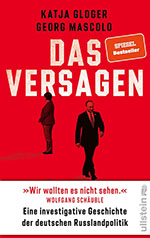
Taken together, Das Versagen (The Failure: An Investigative History of German Policy Towards Russia) by Katja Gloger and Georg Mascolo and Carlo Masala’s Wenn Russland Gewinnt (If Russia Wins: A Scenario) form a remarkably coherent analysis of Germany’s and Europe’s strategic failure in dealing with Russia. Although the two books differ in method, scope, and genre—one an investigative reconstruction of the past, the other a scenario-based projection of the near future—they converge on a central insight: European security has been undermined less by a lack of information than by persistent political self-deception. Read in tandem, the books illuminate how strategic illusions were constructed, stabilized, and ultimately weaponized by a revisionist power.
Das Versagen is, at its core, an anatomy of political misjudgement. Drawing on an impressive body of confidential documents, diplomatic cables, internal memoranda, and interviews, Gloger and Mascolo reconstruct two decades of Germany’s Russia policy with forensic precision. Their analysis is not driven by hindsight alone; rather, it demonstrates that the warning signs were visible, articulated, and repeatedly documented at the time. What failed was not intelligence, but interpretation—and, more decisively, the willingness to draw consequences.
One of the book’s most emblematic episodes is its reappraisal of Vladimir Putin’s 2001 speech to the German Bundestag. Long remembered as a symbol of rapprochement, the speech is reinterpreted here as a calculated act of strategic ambiguity. While many German parliamentarians perceived it as an invitation to partnership, the authors show how Putin simultaneously articulated a vision of Europe centred on Russian primacy and spheres of influence. The political enthusiasm with which the speech was received illustrates a recurring pattern: German policymakers consistently heard what they hoped to hear, filtering Russian signals through the lens of their own expectations.
 The authors make clear that this belief—Wandel durch Handel—was not merely naïve but structurally incompatible with a regime that viewed economic leverage as an instrument of coercion.
What gives Das Versagen its analytical depth is its integration of ideology into policy analysis. The book situates German misperceptions within a broader failure to understand the intellectual foundations of Putin’s system. Neo-imperial and anti-liberal currents within Russian elite discourse, including Eurasianist thought, were consistently underestimated or dismissed as rhetorical excess. In reality, they provided the ideological scaffolding for a foreign policy aimed at revising the post-Cold War order. Germany’s insistence on treating Russia as a ‘normal’ partner thus amounted to a refusal to acknowledge the political nature of power.
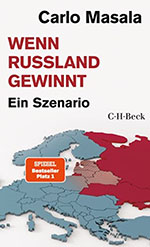
Where Das Versagen looks backward, Carlo Masala’s Wenn Russland Gewinnt looks forward—but without abandoning analytical discipline. Masala does not speculate about distant futures; instead, he constructs a tightly defined scenario in which Russia is widely perceived to have ‘won’ the war against Ukraine by consolidating its territorial gains. From this premise, he explores the consequences for European security, alliance cohesion, and deterrence.
Masala’s central methodological strength lies in his use of fictionalization as an analytical tool. The scenario is not intended as prediction, but as a stress test of assumptions. By introducing a younger, rhetorically polished successor to Putin, Masala illustrates how quickly parts of Europe might declare the crisis over and seek a return to normalcy. This imagined leadership change is less about personalities than about patterns: the recurring Western tendency to interpret tactical moderation as strategic transformation.
The core of the book focuses on NATO’s decision-making under conditions of ambiguity. Masala reconstructs, with striking clarity, how a limited Russian incursion into a Baltic state could expose political hesitation within the alliance. The fictional operation is deliberately calibrated: small enough to invite procedural delay, large enough to undermine credibility. Through this lens, Masala demonstrates that deterrence fails not only through military weakness but through political indecision. Alliance commitments, he shows, are only as credible as the willingness to bear their costs.
Read alongside Das Versagen, Masala’s scenario appears less hypothetical than it initially seems. The structural weaknesses he identifies—the desire for stability, the avoidance of escalation, the search for legalistic loopholes—are precisely those that shaped Germany’s Russia policy for decades. In this sense, Wenn Russland Gewinnt can be read as the logical continuation of the story Gloger and Mascolo tell: a future shaped by the unresolved consequences of past illusions.
Both books share a sober, unsensational tone. Neither relies on moral outrage or rhetorical excess. Instead, they confront readers with the uncomfortable reality that strategic failure often results from reasonable intentions combined with flawed assumptions. Germany’s preference for continuity over confrontation, dialogue over deterrence, and economic comfort over strategic resilience emerges as a central theme in both analyses.
Taken together, the two works offer more than critique; they offer a framework for rethinking European security culture. Das Versagen shows how a political system trained itself to ignore inconvenient realities. Wenn Russland Gewinnt demonstrates what happens when such habits persist under new conditions. The implicit lesson of both books is that peace in Europe cannot be sustained by hope, symbolism, or rhetorical commitment alone. It requires a political culture capable of recognizing power, accepting conflictual realities, and acting accordingly.
As combined reading, these books are essential. They speak to scholars, policymakers, and an informed public alike, offering not only a diagnosis of failure but a warning against its repetition. If Europe wishes to avoid the scenario Masala outlines, it must first internalize the lessons Gloger and Mascolo have so meticulously documented.
Tilmann Kulke is Associate Professor of Islamic & Global History, Ilia State University, Tbilisi, Georgia.