
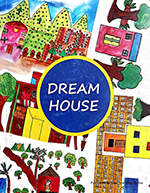
As the Foreword to this book describes, this is a difficult book to credit in the traditional way. There is no one ‘author’ or ‘illustrator’. This lovely book, born of a classroom discussion, has been put out collectively by the students and teachers of the New Learning Centre in Raipur, with support from a number of collaborators and friends: ‘the result of the collective labour—and joy—of children and adults working together’.
The starting point for this experience was the simple question: ‘What would your dream house look like?’ Through the book we see the various answers the members of the group came up with, from smaller houses in the mountains to a house in Savitribai and Jyotiba’s Pune to a house next to a factory in their own industrial town of Birgaon.
The book is all the more interesting because Geography and Environment studies lessons mix into this exercise seamlessly. It points to the possibilities of an education that is integrated and co-constructed, making room for students’ learnings in one ‘subject’ to be welcomed into and expanding the frame of critical and meaningful engagement with each other.
Grappling with the pervasiveness of caste and questioning terms of labour, wages, ownership, class, gender are all alive in the students’ dream houses, and ultimately point to a powerful reimagination of a world where each of us could choose a kinder, friendlier and freer world that we would like to live in. That these alternatives or ‘dreams’ are built on the very real divisions and contradictions of the present is best seen when Kamdev is sharing about his palace-like house in France, moved by what he had learnt of the French Revolution in class, and Tripti asks him, ‘Do they have caste in France?’ The book goes on to show the group of students and their teacher sensitively engage with the hurt and humiliation one of their classmates has faced on account of caste, and it becomes a small but powerful example of how the dreams and hopes we wish to outline for ourselves and our futures can’t be divorced from the despair that the present might bring up.
The lovely illustrations and design by Ubitha Leela Unni match the energy of the classroom discussions and incorporate illustrations of the various dream houses made by the students themselves, adding layers to the narrative. This helps to understand each individual student’s thought process, while also situating the story in its context, a discussion in a classroom.
Both the Hindi as well as the English versions of the book are written in simple, accessible language that readers from roughly grades 3 or 4 onwards could enjoy reading on their own. The Hindi text felt more authentic and representative of the students’ own voices; the English text does on some occasions skew towards the formal.
There are a few small issues with the production of the book which cause some disruption in the reading experience. Sometimes the speech bubbles are organized in a counterintuitive manner, and in at least one place the illustrations are let down by the binding, as the readers cannot immediately make out the action at the centre of the spread. However, these issues are understandable as this is not being put out by an established ‘publisher’ of picture books but is in fact a learning centre that is publishing its own experiences. Some of this will hopefully be addressed in the next publications by the New Learning Centre.
Dream House is a must-read for all of us, not just because it is born out of the aspirations and politics of children from a world that most readers wouldn’t be familiar with, but also because its collaborative and immersive story creation process is one that most children’s literature enthusiasts could learn from.