
Recent academic works have increasingly sought to critically engage with the complex and contested process of tribal identity formation in India. Much of this discourse locates the origins of such identity constructions in colonial epistemological and administrative frameworks. Early colonial representation depicted tribal communities as primitive, uncivilized, and as vestiges of a pre-Aryan, non-Vedic past. This positioned tribes outside the imagined modern Indian polity, casting them as cultural ‘others’ in need of reform. In this context, colonial ethnographic and enumerative practices, particularly the use of anthropometric techniques, contributed to the racialized hierarchical order that placed tribal populations at the bottom. The Criminal Tribes Act of 1871 categorized certain groups often nomadic or semi-nomadic as inherently criminal. This juridical classification reinforced the notion that tribal communities were civilizationally deviant, thus needing correction through surveillance and assimilation.
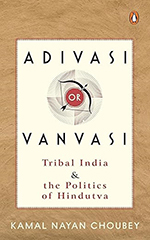
On the other hand, Christian missionaries, largely British, German, French and American, extended into geographically remote and administratively marginalized regions which as late as 1935 were classified as ‘excluded’ (e.g. North East Frontier, Chhota Nagpur, Santhal Parganas, Lushai Hills) and ‘partially excluded’ areas (parts of Assam, Odisha and Central Provinces) under the Government of India Act. These missionary interventions introduced new religious and cultural influences catalysing a significant shift within the tribal lifeworld, particularly in indigenous belief systems. It is against this backdrop that Hindu nationalist organizations such as the RSS and the Vanvasi Kalyan Ashram (VKA) emerged as counter-hegemonic forces, attempting to reclaim tribal subjectivities within a homogenized Hindu civilizational narrative. Kamal Nayan Choubey’s Adivasi or Vanvasi is most compelling in its detailed exposition of the historical evolution, organizational infrastructure and ideological foundations of the VKA. The book meticulously outlines how the organization operates at the grassroot level to reshape tribal consciousness, deploying cultural, educational and welfare-based interventions that are simultaneously social and political in character.
Choubey focuses on the nomenclature of the ‘Adivasi’ (first/original inhabitant) and ‘Vanvasi’ (forest dweller), the latter given by the VKA (p. 4). However, more recently, the term ‘Moolnivasi’ (original resident) has emerged as a broader category, seeking to encompass not only tribal populations but also other structurally excluded communities such as Dalit-Bahujans. Although the author does not discuss Moolnivasis in his book, it is important to understand the contemporary discourse. These terminological shifts are not merely semantic; Choubey states that they embody divergent ideological orientations and reflect competing narratives of indigeneity, national belonging and the pursuit of social justice. The choice between Adivasi and Vanvasi reveals deeper contestations over cultural identity, political representation and historical consciousness. While Adivasi is often associated with claims to autochthony and cultural autonomy, Vanvasi is strategically used in Hindutva ideological framework to emphasize integration within a unified civilizational fold. The politics of naming thus becomes central to understanding broader questions about autonomy versus assimilation in tribal formation according to the book. The preference for one nomenclature over another is often tied to distinct visions of India’s social order, whether to preserve the unique cultural lifeworld of tribal groups or to subsume them within a homogenizing national project.
The book is divided into seven chapters with a comprehensive introduction that lays out central research objectives and methodological orientation. The author adopts a multidisciplinary framework combining historical, empirical, and comparative methods. Multiple sets of primary sources including archival documents, press releases, pamphlets, and interview data are used to examine the activities of the VKA among tribal communities. The analysis is grounded in the premise that the VKA is primarily an organization that indulges in Hindutva politics due to its allegiance to the Rashtriya Swayamsevak Sangh (RSS). While the book traces the gradual presence and influence of the RSS in tribal areas, its primary focus lies in the formal establishment of the VKA in December 1952. Drawing on critical historical evidence, the book argues that the emergence of the VKA must be viewed through the ideological framework promoted by the RSS (p. 26). At the same time, the author nuances this argument by tracing the antecedents of such organizational efforts to earlier debates within the Indian National Congress. Leaders such as Rajendra Prasad and Ravishankar Shukla are shown to have expressed deep concerns over the expanding influence of Christian missionary activity in tribal areas, thereby contributing to—albeit from a different ideological standpoint, a push to the formation of the VKA.
The author traces the early roots of Hindu political assertion to the socio-religious movements of the 1880s, highlighting the role of institutions such as the Arya Samaj and the ‘Sanatana Dharma Sabha’, which were instrumental in initiating campaigns such as ‘Gaurakshini Sabha’ (cow protection society). Concurrently, social reformers like Bankim Chandra Chatterjee and Aurobindo Ghose contributed to the growth of Hindu religious values in the nationalist discourse. These ideological and organizational developments laid the foundational groundwork for leaders like Savarkar, Hedgewar and Golwalkar to construct and concretize Hindutva politics through the RSS and other affiliated organizations like VKA. The author provides three major reasons for the formation of VKA: first, the fear of separatism due to the increase in Christian proselytization among tribals; second, the desire to Hinduize by awakening faith (shradha jagran) among tribals that ‘Tu Mein Ek Rakht’ (You and I have the same blood) (p. 74); third, the care for tribal communities.
The book offers a detailed examination of the life and ideological contributions of RK Deshpande, credited with the establishment of the VKA with active support of the RSS. Particular reference is given to the role of the Princely State of
Crucially, Choubey interrogates the VKA’s categorical rejection of the term Adivasi on the ground that it implicitly designates others, particularly caste-Hindus, as outsiders. This semantic and political position is historically linked to the RSS’s opposition to the Adivasi Mahasabha, an autonomous tribal political organization founded in 1938. The analysis reveals how both the Indian National Congress and the RSS, despite ideological differences, actively undermined the political traction of the Adivasi Mahasabha. This politics eventually succeeded in creating a division among Christian and Hindu tribals. It caused violence surrounding conversions, accelerated the demand to ‘delist’ Christian tribals from affirmative action policies, and also aggressively promoted ‘ghar wapsi’. This illustrates Mamdani’s notion of colonial subjecthood, where Choubey implicates the VKA’s expansion as a subtle continuation of historical patterns of co-option.
Drawing on a series of ethnographic anecdotes, the book offers a nuanced analysis of the VKA’s cultural strategies of ideological incorporation. Ritual practices such as satsang, the celebration of Ram Navami, the formation of Ramayan Mandali, and the regular recitation of Ramcharitmanas are shown as symbolic integration into the Sangh’s hegemonic orbit. These practices are mobilized as tools of cultural pedagogy, transforming the indigenous lifeworld into passive recipients. This is further evidenced by the VKA’s opposition to the formal recognition of the Sarna Code, a proposed legal category intended to affirm the distinctiveness of tribal religious practices.
In addition to the detailed examination of the ideological and cultural programmes of Hinduization, the book devotes critical attention to the welfare initiatives undertaken by the VKA to counter Christian missionaries and foster proximity with tribal communities. It demonstrates that the VKA’s early engagements were rooted in the domain of education but gradually expanded to health services, women’s empowerment, village development and the protection of tribal migrants. The VKA’s 2015 vision document offers a blueprint for engagement with tribal communities. It provides specific areas of intervention designed to integrate tribal populations into the cultural and political imaginary of Hindu nation. These welfare initiatives acted as mechanisms of co-option, what might be termed as a form of pseudo-citizenship where tribal communities are incorporated into the state not through the recognition of their distinct cultural rights but through the assimilation into a hierarchically ordered civilizational narrative.
One of the book’s compelling interventions lies in its exploration of the ideological contradictions within the VKA’s political engagements. In contrast to the broader position of the RSS, the VKA is shown to articulate a more sympathetic stance on certain legal and developmental issues. For instance, its critique of the Uniform Civil Code, its endorsement of the Panchayats Extension to Scheduled Areas Act, the Forest Rights Act, and its advocacy for tribal land rights. A particularly insightful section of the book is an interesting comparative analysis between the VKA and the All India Union for Forest Working People (AIUFWP), a grassroots alliance committed to forest rights, land rights and ecological justice. The book argues that organizations like the AIUFWP compelled the VKA to address the issue of land rights apart from opposing Christian missionaries, spreading Hindutva and doing cosmetic tribal welfare.
Kamal Nayan Choubey’s book is a critical, evidence-rich intervention that highlights the cultural strategies employed by Hindu organizations in tribal India. While the book adequately documents the vision of the VKA and the spread of Hindutva in the interior corners of tribal areas, it is not without limitations. Firstly, it provides insufficient engagement with tribal agency, offering little insights into how tribal communities negotiate, resist and navigate the VKA’s outreach. The absence of direct field interviews with ordinary tribal respondents limits the analysis to a largely top-down perspective. Are they passive recipients or active agents? Secondly, while the documentation of the VKA’s activities in central India is robust, the treatment of its interventions in the North East lacks analytical depth. The claim that Shankardev’s Vaishnavism is instrumentalized by the RSS (p. 67) overlooks theological divergencies, particularly Vaishnavism’s opposition to the aggressive Ram-centric nationalism propagated by the Sangh. Similarly, the limited discussion on Rani Gaidinliu and lack of information regarding the spread of the RSS and its associates in the different States of the North East is apparent. However, this book is a timely and meticulously researched critique of the VKA that provides insights into tribal identity politics, and Hindu nationalist ideology.
L David Lal teaches Political Science at the Department of Humanities and Social Sciences, Indian Institute of Information Technology, Guwahati, Assam.