
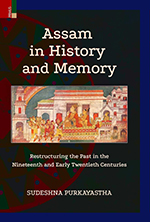
Assam in History and Memory: Restructuring the Past in the Nineteenth and Early Twentieth Century attempts to assess the recorded history of Assam and the Assamese with some refreshing new angles. An analysis of local Buranjis, or written history chronicles, which started with the Ahom reign from the early thirteenth century, forms an important part. From around the sixteenth century, the Buranjis were written in Assamese. Sensitive themes like Assamese nationalism and linguistic identity, the root causes of the Assamese-Bengali language conflicts and the perceived restructuring of history to reinforce the idea of Assamese linguistic nationality have been developed to reach the author’s conclusions.
The primary and secondary sources identified at the important archives listed in the book have been scrutinized, analysed and synthesized to arrive at these conclusions. They have been diligently recorded, and we provide a flavour here by illustratively mentioning a few authors: SK Bhuyan, AJM Mills, Golap Chandra Barua, Kanak Lal Barua, Srinath Duara Barabarua, Prachi Deshpande, Lila Gogoi, Ranajit Guha, Nagen Saikia, Harakanta Sharma, Haliram Dhekial Phukan, Lakshminath Tamuli, HK Borpujari, Benudhar Sharma, Hemchandra Goswami, Padmanath Gohain Barua, Yasmin Saikia, Maniram Dewan, Gunabhiram Barua, Ratneswar Mahanta and Arupjyoti Saikia. Many of these were amateur Assamese historians who contributed significantly to the collection, compilation and editing of Buranjis. Books and documents authored or edited by Surya Kumar Bhuyan have been extensively used. The primary sources include important manuscripts and transcripts accessed from the Department of Historical and Antiquarian Studies (DHAS), Guwahati.
Language-based Assamese nationalism was shaped through modern historiography, which has been derived significantly from the Buranjis. Although the Buranjis present authentic historical farishmancts, they also have mythic contents. Modern Assamese historians like SK Bhuyan compiled, collated and edited the Buranjis to bring out a glorious past to bind the Assamese community into a language-based nation.
The Bengali language was identified by the Assamese elite as a stumbling block to Assamese linguistic identity. Bengali being made the official language in Assam from 1836 to 1872, pushing out the local vernacular, placed the Assamese against the Bengalis. Although the colonial rulers installed Bengali for their own administrative convenience, many Assamese leaders believed that the Bengalis conspired to make that happen. The British exploited this situation to create a serious Assamese-Bengali rift. Assamese was reinstated as the official language in 1872 in view of the Company’s rapidly growing commercial interests in Assam. For that purpose, the colonial bureaucrats and the Christian missionaries took steps to shape the Assamese language into a standard format, which ignored the pre-colonial polyglot practices.
The Assamese generation which grappled with the language challenges of coordination with the new British rulers post-1826 were often closer to the Bengalis. In fact, Haliram Dhekial Phukan published the very first history of Assam in 1829 in Bangla.
Maniram Dewan, hung by the British in 1957, wrote Asam Buranji Bibekratna in 1838 in Assamese, Bangla and Sanskrit. While Maniram was an unbiased historian, the Assam Buranji authored by Haliram presented fragmented cultural dimensions and identified distinct Sanskritized and tribal social domains. It has been argued by his critics that Haliram’s book reflected an attitude of linguistic inferiority and also negativism towards the Ahoms. The lack of knowledge of history and the absence of prose literature in pre-colonial Bengal provided leverage to the Assamese intellectuals to combat the perceived threat of cultural domination.
The Department of Historical and Antiquarian Studies was established in Gauhati in 1929 to promote research and ensure the reliable preservation of historical records. The Vaishnava shastras provided valuable materials for the reconstruction of the Assamese past. From 1930 to 1936, Surya Kumar Bhuyan, assisted by a galaxy of Assamese scholars, collated and edited seven Buranjis: Assam Buranji by Harakanta Sharma Barua (1930); Kamrupor Buranji (1930); Tungkhungiya Buranji (1932); Deodhai Buranji (1932); Assamar Padya Buranji (1932); Padshah Buranji (1935); and Kachari Buranji (1936).
Bhuyan grew into a full-fledged professional historian in the course of his research in the School of Oriental and African Studies, London (where he obtained his Doctorate), the British Museum, the Royal Asiatic Society of Great Britain and Ireland, and the London Institute of Historical Research. He was an active member of the Indian History Congress (IHC) from its inception in 1935. He succeeded in building enduring relationships with historians like Jadunath Sarkar, P Sheshadri, Nihar Ranjan Roy, Kalidas Nag, Srikumar Banerjee, Pratul Chandra Gupta, Surendra Nath Sen, C D Deshmukh and Nilakanta Sastri through perseverant efforts. At the twenty-second session of the IHC held in Guwahati, Bhuyan said: ‘…the facts of Assam history if properly disseminated will convince…the world that the people of Assam are inheritors of great achievements in political, …cultural and spiritual fields.’ He made Herculean efforts to disseminate Assamese history with a missionary zeal.
The author attempts to explore the multiple past processes of documenting the legend of Jaymati. She concludes that the factual and the embellishments are ingrained in this piece of history writing. Surya Kumar Bhuyan, according to the author, reinterpreted the memory of Jaymati’s torture into a celebration of her death as a self-sacrifice to reconstruct the glorious heroic past of Assam.
Similarly, she holds that the memory of Saraighat and its hero Lachit Barphukan is used by Bhuyan and other modern Assamese historians to support a nationalist fervour rooted in a heroic Assamese past. This approach is displayed time and again to reinforce the Assamese identity and aspirations, as done during the language agitations in 1960, the popular movement against illegal immigrants from Bangladesh in the eighties and the subsequent rise of the United Liberation Front of Assam (ULFA).
It is important to supplement the author’s conclusions with other relevant and credible viewpoints to position her themes in a balanced light. One, the impact of the renaissance in Bengali literature and the strident assertion of the Bengali intelligentsia that Assamese was an offshoot of their language were successfully countered by the Assamese. (The Assamese: A Portrait of a Community, Sangeeta Barooah Pisharoty, 2023, p. 94 and p. 98.)
Two, Assamese is described by Mr. Brown, the best scholar in the province as a ‘beautiful…language and differing in more respects…than agreeing with Bengalee…we made a great mistake directing that all business should be transacted in Bengalee’ (AJM Mills in an official report).
Three, by origin an Indo-Aryan vernacular, ‘Assamese…is an island in a sea of diverse non-Aryan languages…Assam lay on the highway for emigrants from…India…and this contact with…the Aryan speaking India…checked the non-Aryan tendencies…making…radical changes in the structure of Assamese…’ (Assamese, its Formation and Development, Calcutta University PhD thesis (1935) of Banikanta Kakati approved by a Committee with Dr. Suniti Kumar Chatterjee, author of The Origin and Development of the Bengali Language, 1926, as a prominent member).
Four, ‘Hema Saraswati…can be considered the earliest (fourteenth century) Assamese writer…Before Sankardev started writing his impressive oeuvre (in Assamese) in the fifteenth-sixteenth centuries, his mentor Madhav Kandali translated…Ramayana into classical Assamese…’ (The Assamese—A Portrait of a Community, Pisharoty, p. 96).
Five, ‘In Chaitra of Saka 1127 the Turushkar met with their destruction. Since then, Assam had to face the onslaught of Pathan and Mughal invasions for more than a dozen times and in all, in spite of occasional discomfitures, Assam had the means and strength to ward off its invaders…’ (authenticated Sanskrit inscription found near Guwahati).
Sudeshna Purkayastha, who teaches history at Assam University, Silchar, grew up and has been living and working in the Bengali-dominant Cachar area of Assam. As a Bengali, she experienced first-hand the impact of the Assamese-Bengali frictions, including the agitation against illegal Bangladeshi immigrants and the ULFA insurgency. Yet her book is remarkably free from prejudices.
In fact, the book stands out due to the blending of the insights and concepts derived from the study of reputed Bengali and international historians and her experiences as a Bengali living in Assam with the results of her extensive, in-depth and painstaking research into the most important primary and secondary sources of Assamese history.
Jayanta Bhuyan, a Petroleum professional with an MBA from IIM Ahmedabad, established and ensured the long term business success of IOT Infrastructure and Energy Services, as its founding CEO and Managing Director for 18 years. Prior to that, during his tenure in IOC, he held Directorships in their Joint Ventures with MNCs: Mobil USA, Nyco France and Oiltanking Germany. As Founding Partner, Bhuyan helped to set up Gateway Business Solutions LLP to actively support foreign investment in India.