
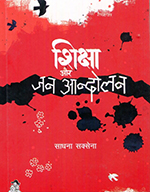
Sadhna Saxena’s book Shiksha Aur Jan Aandolan explores the question of what role education can play in redressing the economic and social inequality in India, and what were the factors in the journey of education which gave rise to people’s movements.
In the introduction to the book, the author posits that since the existing education system is trapped in the nexus of powerful people, for those with limited access to resources and opportunities, education can become possible only by dismantling this nexus. The fundamental question is: what kind of education can contribute to the struggle to bring about this redistribution of power? The book analyses movements that reveal the complex layers of education and politics but are unable to become part of the discourse on education.
In this context, the book discusses the limitations of formal and informal education, as well as the contradictions between them. The author describes how, at the learning centres run by Mahila Samakhya in Mahbubnagar and district and Medak district, girls were learning that they were poor because their families were large and their parents were illiterate. In this way, the education system shifts the responsibility for the marginalization on to the very people who experience it.
Reviewing educational theories in the context of mass education and resistance, the author finds that the debate around school education in India is divided into two factions. One side believes that all children should be included in the formal school system, regardless of the quality of education they receive. The other side believes that making the school system accessible to all is simply not possible under the present economic, political, and social conditions. In a country like India, it is impossible to discuss equal opportunities and outcomes in education without examining the internal processes of schools and the class, caste and gender backgrounds of students.
The book offers a detailed discussion of the work of the Telangana Library Movement (1920-48), Kishore Bharati’s education programme (1972-82), the anti-liquor movement in Nellore (1990-94), and the Women’s Development Programme in Rajasthan (1984-86), with an intention to understand the alternatives and outcomes of mass education. It also examines the consciousness that developed through these initiatives, both directly and indirectly, and how this consciousness eventually gave rise to such movements in different parts of the country and in different periods. The book provides an extensive account of the immediate social, economic and political circumstances in which each movement emerged and developed.
Saxena argues that a measure of good education should be its ability to sharpen social and political consciousness. It also shows how governments have repeatedly used education to pursue vested agendas, dull people’s consciousness, and preserve the status quo.