
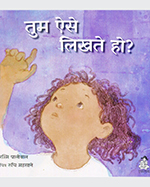
Tum Aise Likhte Ho? narrates the real-life accounts of a child’s early adventures with language, as recollected by her mother. As young Lali grows up from the age of two to nine, she experiments with and discovers the secrets of the world of writing, and this book gives us a peek into Lali’s, or any young child’s marvellous feats into figuring out the world and making space for herself within it through writing.
We are introduced first to two-year-old Lali who talks and sings and scribbles as she is learning more and more about the many things with their many names that exist around her. She plays with language, inventing, scribbling, creating new forms and new names as she goes along. The question ‘Tum Aise Likhte Ho? / Is this how you write?’ comes from Lali’s curiosity to figure out the secrets of writing, which the adults around her seem to be constantly doing. What follows then, is a very realistic account of emergent literacy where make-believe, play, imitation, talking, naming, drawing, and writing become part of a unified process of meaning-making. As Lali grows up, so does her engagement with the world around. She has many stories to tell which Amma scribes for her, and gradually Lali figures out that sounds are related to letters, and letters when read in order can become words with meaning, and she too can make new words and eventually many stories for all that she has to communicate with herself and others.
There are many things I admire about this picture-book; for one, the design of this book seamlessly incorporates real-life examples of Vibhuti’s (or young Lali’s) experiments with expressing herself in writing and Ruchi Mhasane’s illustrations of Lali and her mother’s world. The clever use of actual print materials that the author carefully collected and kept from her daughter’s escapades with language growing up, and the quick change of font-styles when Lali and her mother speak in dialogue versus when the story is being narrated would make this an interesting read for most age-groups of readers. Most of all, I imagine that curious adults living around young children and observant of their evolving worlds of sense-making would greatly enjoy this book! At the same time, the book’s page-size and the thickness of its cover page seem to suggest that early readers too would find it a comfortable read.
I also enjoyed how this book, while being clearly written by a perceptive adult attending to a child’s journey of becoming a writer, doesn’t overly narrate the steps of this journey. The text is minimal and centres Lali’s world and its idiosyncrasies rather than spelling out what made it possible through the adults’ eyes. The illustrations, too, do just that and though it is never explicitly said, the readers will feel the import of what becomes possible when children brimming with questions and information are encouraged to express themselves fully, comfortably and meaningfully. Though it may seem as though the journey from emergent attempts at writing to identifying oneself as a writer is a natural part of meaning-making and that all children everywhere are able to do so with as much ease and initiative as Lali does, what this book silently makes possible for us to notice is the many kinds of scaffolds, supports, attempts at creating relevance and connections that are key to this continuous and non-linear journey.
Priced at ₹ 90, I imagine this book will be an important resource to all those who are working in teaching-learning spaces and pedagogical interventions. Especially at a time when ideas of foundational literacy are buzzing in educational practice and policy circles in India, this book is a must-read for adults interested in how children learn to make sense of writing as part of a network of languages.