
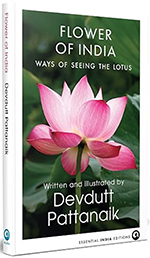
This is a book about the lotus, which many may think is the national flower of India, which, apparently, it is officially not! It is a book for young adults—aged 13 to 18. Devdutt Pattanaik curates very interesting historical and mythological information and puts it in a unique perspective. This slim compendium of information structured into five sections viz. Botany, Resource, Metaphor, Design and Sacred, has diagrammatic drawings to illustrate some of the aspects being talked about.
Each section presents short descriptions and facts about a variety of aspects of the theme and is further divided into topics—for example, the section on Botany gives a fairly good view of the parts of the lotus and also distinguishes it from other lilies. The section on Resource talks about its various parts like the stem and the kernels being used for food—kamal kakdi and kamal gatta, the flowers, leaves, stem, seeds for medicine. The lotus flower garland is called vaijayanti mala —the garland of victory. Particularly interesting is the fine and very delicate textile fabric ‘made from the fine fibres extracted from the stem of the lotus plant’. Since thousands of stalks are needed for even a small bit of fabric, this fabric is one of the most expensive (costing up to ` 10,000 per yard). Traditionally it was used for monastic robes and ritual textiles, also because the lotus signifies purity. Apart from Northeast India, it is produced in Myanmar and Cambodia.
The lotus flower and other parts of the lotus plant have a history of a variety of uses in metaphor and in Hindu and Buddhist traditions. The lotus called Kamal or Padma is used as a metaphor to signify beauty, e.g., Kamal Nayan or eyes like a lotus petal, and Padmaja, born of the lotus. The south Indian version of Chakravyuh is Padmavyuh—drawn from the concentric formation of many petals of the lotus. Metaphors for impermanence as of lust and sexuality (as the lotus wilts quickly) are drawn from it.
The design section is very interesting as the architecture of Hindu and Buddhist temples, masjids and gurudwaras have lotus medallions, bases of pillars and decorations of arches. In addition, idols of deities and goddesses sit on lotus flower designs; lotus petals adorn their arches and domes. The Bahá’í House of Worship is shaped like a lotus. And Indian fabric designs and embroidery often feature the lotus motif.
The lotus finds a place in Indian Christian traditions too, particularly in the south. Statues of Mother Mary sometimes show her standing on a lotus. Some churches of South India also use images of the lotus in their emblems. The lotus and its leaves figure in some tribal and Vedic creation myths too.
The book has a lot of interesting information, in short texts, conducive to attracting a new reader to a non-narrative text. It also takes examples from across communities, very important to create an inclusive culture and dispels some misconceptions like lotus being the national flower. However, its structure and conceptualization do not lend themselves to a very engaging read for a mature reader. It also does not seem to be in line with the author’s natural style, which is usually quite engaging, analytical and thoughtful. Here, the structure, which may have been imposed by the publisher of the series, may have acted as a constraint. It is also rather expensive for its size and paper quality.