
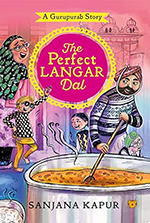
Children love a good adventure, even more so if it involves some delicious food! The Perfect Langar Dal, written by noted children’s writer Sanjana Kapur, with eyeball grabbing illustrations by Kavita Singh Kale, is as delicious an adventure for adults as it is for children.
So many stories for children revolve around Holi, Diwali, Dussehra, Eid and Christmas. This story takes place in the days preceding Gurupurab, the festival celebrating the founder of Sikhism, Shri Guru Nanak Dev Ji. Gurupurab is celebrated all over India and the world, wherever the Sikh community resides. But the festival has a special charm, excitement and flavour when celebrated in Punjab, the birthplace of Nanak. Everyone looks forward to gurdwaras decorated with bright lights, and celebrations with fireworks. The mornings are full of piety and prayers. The most amazing part of the celebration though is the kadha parshad and the langar.
Eight-year-old Amal has been excited too, because his Bebe (grandmother), who has been supervising the langar in the gurdwara for ten years, has a surprise this year. She has invited Maan Singh from Harmandir Sahib, or the Golden Temple, to cook the langar waali dal this year. Maan Singh is famed for his delicious dal, which bubbles gently overnight to become creamy and delicious. Amal and his friends Simran and Angad cannot wait to eat.
Maan Singh puts a damper on everyone’s happiness because he turns out to be surly. He ruins Bebe’s mood by telling her that he will cook the dal all by himself. He asks to be alone in the kitchen, without any help from Bebe or anyone else in the community. Put off by his churlishness, Bebe forbids the children from disturbing him. But Amal, Simran and Angad have other plans.
When the children peep into the kitchen to watch Maan Singh at work, they stumble upon a disaster. The illustrious cook has run out of a crucial ingredient for the dal. The entire langar—for what is a langar without dal—is in jeopardy, as is the festival. The rest of the story follows our protagonists who use their intelligence to save the day.
The Perfect Langar Dal serves up a lovely adventure alongside the aroma of dal but also teaches the reader about the beauty and essence of the Sikh faith. The community meal, or langar, was started by Guru Angad Dev Ji to ensure that gurdwaras are a place of safety where everyone gets a good meal. Guru Amar Das Ji then made it mandatory for every visitor to sit and eat together. Even today, gurdwaras do not turn a hungry soul away, and the simple and earthy langar, with the dal as its centrepiece, is a mark of fostering community and extending hospitality to all. The author has conjured up thrill and mystery and woven it engagingly with a central tenet of the Sikh faith. The illustrations are bright and beautiful, and a brilliant match for the excitement of the story itself. This book is a happy and heartwarming read and so deserves to be read widely.