
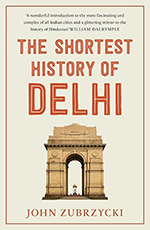
The endless fascination with the lore of Delhi has found yet another home in John Zubrzycki’s The Shortest History of Delhi. Zubrzycki begins by evoking the words of Ahmed Ali from his novel Twilight in Delhi, published in 1940: ‘It is the symbol of Life and Death, and revenge is its nature… But still, it is the jewel of the eye of the world, still it is the centre of attraction.’
Ali’s novel is set in the second decade of the 20th century. The city may not have been in the hands of the Mughals anymore, but even the colonizer understood its imperial significance. Thus, it remained a centre of grandeur even in foreign hands. In 2026, only the first part of the quote above stands true. Delhi looks decrepit now; it is chaotic to the point of stasis. It is polluted and highly unlivable. The ambitious alterations to its built heritage is both a desecration and a lost opportunity. Generic steel and glass buildings rising high over the dusty earth of the city, poor copies of Western metropolises, add all the semblance of functionality with no charm and beauty to speak of. Zubrzycki has provided a compelling account of the city, but somewhat in reverse of the sentiment expressed by Ali—he captures the apogee it reached in the past, and the life and death it is contending with at present.
The author is an Australian journalist, diplomat and scholar who has spent a large part of his career in South Asia. The Shortest History of Delhi is his seventh book on India. The book is part of the Shortest History Series, published in India by Picador Pan Macmillan. As such, it is designed to be a quick and easy read. Organized chronologically, the book starts with the early history of Delhi, when it was a relatively small outpost under Hindu kings. The broad region of what is Delhi today was a smaller part of larger empires centred in present-day Bihar, but it did not begin gaining strategic, political and cultural significance till the establishment of the Slave dynasty.
Qutub-ud-din Aibak, the founder of the Slave dynasty, began a conquest of Delhi that was violent and bloody, but stabilized Delhi after gaining control. His successor Iltutmish expanded the dynasty’s imprint by building the Qutub Minar. The Slave dynasty was beset with conspiracy and intrigue, leading to great instability. But it also managed to produce Delhi’s sole female ruler, Razia Sultan. By this time, Delhi was tempting enough a city to invite the attention of the Tughlaqs, Khaljis, and Lodhis. Each of the dynasts built and rebuilt the city to their own preferences, thus creating five out of the seven cities of Delhi (not counting colonial and postcolonial Delhi). The remnants of these cities can be spotted while traversing the modern metropolis. Zubrzycki’s account breathes life into the historical accounts by privileging information that gives insight not merely into imperial machinations, but also lores about the personal lives and proclivities of rulers.
The next part of the book deals with Mughal Delhi. It is not till Shah Jahan constructs the city of Shahjahanabad, presently known as Old Delhi, that governance from Delhi acquires some permanence. It is noteworthy that Muhammad bin Tughlaq, for better or for worse, attempted to shift his capital to Daulatabad; that Mughal emperors before Shah Jahan either had other capitals, mainly Agra and Lahore, or moved between these three cities. Shah Jahan, an enthusiastic builder, commissioned an eponymous city that was imposing and architecturally sound. This new city fostered an entirely new culture while incorporating aspects of Delhi’s older cultures that had by now become deeply embedded irrespective of whether the city itself flourished or declined periodically. So, we see the continuation of the Sufi order of Delhi, which was iconoclastic for Islam. This moves with a commingling of Hindu and Muslim residents, flowering of literary cultures and arts, and Delhi remaining important for trade. Aurangzeb was busy with other pursuits, both military and puritanical, and when the Mughal Empire declined after him, it became a magnet for invaders such as Nadir Shah. Each time a foreign invader let loose a reign of terror upon the city only to covet its riches, it set the template for contemporary times. Delhi today is not a city where many wish to claim prideful ownership, but one from where we come to benefit in some way while complaining about the cruelties the city heaps upon its residents.
And thus, we come to the most extractive of them all, the British Raj. David Ochterlony, Delhi’s first resident, when asked why he wanted to live in India, quipped: ‘Where else could I live like a king?’ The stream of British functionaries who came to Delhi may have acquired some of the finer aspects of the local customs, but this never became the norm. The British were fully aware that they were rulers, and the segregation of Delhi into native quarters and the area north of Shahjahanabad, where Civil Lines and administrative buildings eventually came up, was proof of the disdainful exercise of power. The sudden announcement of the shift of capital from Calcutta to Delhi was in pursuit of political pomp away from the daily bustle of a trade-centric city, which is what Calcutta was in those days. This imperium translated itself into the construction of New Delhi, this time not to the north but to the south of Shahjahanabad. By the time this part of Delhi, now known as Lutyens’ Delhi, with pride or pejoratively depending upon one’s political inclinations, was fully constructed, India’s Independence was nigh.
Delhi continued to remain Independent India’s capital, but it was reshaped yet again by the horrors of Partition and the forced migrations that occurred. After Nehru’s demise, during which time he sought to design the city with a combination of Modernism and Soviet Brutalism, Delhi under subsequent leaders became a city of brutality and revenge. The city had not recovered from the Mahatma’s assassination when Prime Minister Indira Gandhi and her wayward son, Sanjay Gandhi, unleashed havoc. Delhi continues to remain a city of terrible mental agony, physical discomfort and insecurity. Added to this is the vice-like grip of the threat of climate collapse. We are reading this book at a time when the city is in a cycle of decline.
Zubrzycki’s book has been described as ‘breathless’ in the blurb. On the contrary, it is a tremendously patient work. The author has brought his scholarly understanding to bear upon this book. Intermingling of communities and its dazzling culture was a reality of the story of Delhi, as were bloody campaigns by rulers that were at least partially, if not wholly, in the service of establishing the supremacy of their religious beliefs. The author does a service by juxtaposing these facts without inhibition. He has, most refreshingly, stripped his gaze of the unending romance and nostalgia, replicated across books written on Delhi.
After a point, nostalgic thought stops being a compass and starts becoming a barrier to the future. Writers pining away for a lost time is a sentiment that must be duly acknowledged, but when it starts informing the campaigns to revive a city and its culture, it is at best an elitist project and at worst, an exclusionary tactic. The author mentions the disdain of the old, mostly Muslim, elite towards the predominantly Punjabi refugees and their loud culture and rightly points out that the refugees were also industrious people whose presence led to the revival of Delhi. The lamentations for a lost city and a misplaced sense of pride have resulted in a vacuum that is now being filled by contractor-led reshaping of Delhi. The author’s sly ease of prose compels the reader to reckon with these deep questions.
The Shortest History of Delhi is a superlative introduction to the city. It is a fit read not only for those who may not have the time and inclination for a deep dive into Delhi’s history, but also for those already engaging with the vexing questions about the future of the capital.