
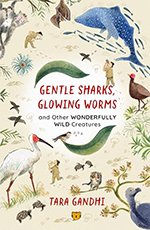
In 2026, it is entirely apposite that a book about creatures in the wild begins with the author receiving a text and video message. The message bears exciting news—there’s a whale shark swimming near Chennai port! Let’s unpack the creature. It’s a shark, not a whale, but as large as the latter; it is, indeed, the world’s largest fish. Unlike most sharks and whales which are happy in very cold waters, this one prefers warmer seas. Unlike its cousins in the shark family which have fearsome reputations, it is a gentle giant! And finally, though a fish, it doesn’t lay eggs but gives birth to live pups which do not, however, suckle the mother. (And we thought that Australia’s marsupials were the only oddities on Planet Earth!) Whale sharks were apparently hunted for their meat as well as liver oil, but after an alarming decline in their numbers, are now protected the world over. The Wildlife Trust of India works alongside fisherfolk to conserve them, and Tara Gandhi recounts being told by fishermen, during a visit to Gujarat, that when a whale shark is accidentally caught in a net, they cut the net (thus incurring a huge loss) so that the creature can swim away to freedom.
The Olive Ridley Turtle lives in the sea, but females come ashore at night to lay their eggs. In Odisha, some mass nesting sites are strictly protected during the nesting season. Gandhi was privileged to witness a nesting very near where she lives, by joining student volunteers who patrol the beaches of Chennai in December and January. On discovering the nests—deep pits in the sand that the females hollow out with their paddle-shaped legs—these students carefully collected all the eggs, 87 in one case, in a bag which they took to a hatchery as stray dogs and even people might otherwise dig them up and make a meal of them. Eight weeks later, when the eggs hatched, the volunteers and the author watched the baby turtles dig themselves out of the sand in the hatchery, and collecting them in open baskets, released them securely into the sea.
Two schoolgirls walking around at dusk in their residential campus spot what turns out to be a pair of slender lorises. Extremely shy and reclusive creatures, they had never before been reported from Chennai. Eventually, a team of naturalists combed the campus at night and counted twenty of this endangered species, in the heart of a bustling city, albeit in a well-wooded campus!
We travel with Gandhi—a nature conservationist trained under Salim Ali—to Great Nicobar across choppy seas to see long-tailed/crab-eating macaques which readily showed themselves but carefully kept out of the range of cameras! Apart from their regular diet of wild figs and fruit and crabs, these monkeys have learnt that coconut and areca plantations make for delicious buffets. Gandhi recalls asking farmers in Himachal Pradesh during an earlier visit about how they protected their crop from monkeys, and being told that even though they did resent the damage to their crops, the monkeys belonged there as much as they themselves did!
In the Andamans, Gandhi and her team went in search of an endangered species—Edible Nest Swiftlets. These birds breed in colonies, where they make their nests with their own saliva, high up the walls of caves. These nests are, however, highly prized for the Chinese delicacy, bird’s nest soup, which means that the swiftlets cannot successfully breed. Conservation efforts are ongoing to train locals and volunteers to protect them from poachers.
Gandhi wakes up one morning to a pathetic squeak—a short-nosed fruit bat was caught in wire netting meant to keep pigeons out. We learn how it was rescued, taken to a shelter for a day, fed, and brought back to the same location to be released at night.
The essays about the Siberian cranes, which last came to India in 2001, and the dramatic disappearance of white-rumped vultures, touched a raw nerve in me too. I had seen that last pair of migrant Siberian cranes during my visit to Bharatpur in the winter of 2001. Much like Gandhi, who details the large gaggle of vultures that used to roost in a large Terminalia arjuna in her house near the Delhi Ridge and leave droppings all over her garden, so much so that her gardener wanted to cut down the majestic tree, I remember that the sight that would meet my eyes every morning when I opened my door in the Jamia Millia Islamia hostel for women was a posse of vultures on the opposite corner of the roof. Despite being a dedicated birdwatcher, I used to hate what looked like a cackle of Macbeth’s witches, multiplied by about six. A few years later, when the population of these scavengers went down suddenly by 99% (yes, that figure is correct), I would have given anything to be able to see those vultures. No, these are not beautiful birds, but these scavengers were the most effective sanitation workers, and in any case, no creature exists to fulfil our aesthetic requirements. Efforts to reintroduce vultures by captive breeding have led to some limited success, but I fear that the world where we could not look up at the sky for a moment without seeing some bird fly past is irrevocably past.
We see Blue Buttons (hydrozoans) on the Marina Beach, glowworms in the Nilgiris, and terns in Lakshadweep. But what stood out for me was the human-faunal interface and the efforts of citizen-naturalists in protecting what remains of the miraculous biodiversity that is our shared inheritance.