
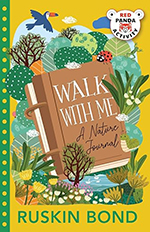
Walk With Me invites young children to explore the natural world around them with all their senses and to express their observations, thoughts and feelings through words and images in multiple ways. Ruskin Bond writes in the foreword: ‘Your nature journal can be anything you want—a diary of all your adventures and observations, a scrapbook of drawings, a collection of poems or even a diary to write stories related to nature.’ The book is designed to arouse curiosity, build awareness and foster delight and wonder in things we often do not even notice.
A wide range of possible activities are given to nudge the imagination such as to look for pictures in the clouds but there are also prompts to pay close attention to colours, shapes, movement and relationships in nature. There are surprise activities like looking at the world from a bug’s eye view, describing the personality of a tree, or noting what happens to the reflection of the sky in the water of a puddle. Children are encouraged not just to name things in conventional ways but to conjure up their own names for smells and scents that they find. In another suggestion readers are asked to write down the sound of the bird as they hear it.
Then there are challenges such as searching for shades of a particular colour and giving them each a name such as ‘fish belly green’ or finding paw prints and thinking about what that particular creature might have been doing and why. Pattern making and creative activities are also encouraged with ideas such as making leaf rubbings, collecting natural materials to make collages or noting the designs used for different animal homes. In one activity children are asked to imagine the adventures of a rock that they have found.
Walk With me is refreshingly different from a textbook and the activities suggested are not prescriptive but welcome honest observation and quiet reflection. Answers are expected to be personal and varied and there is no demand for neatness or perfection; the threat of assessment and comparison is thankfully absent. The book is designed more for the urban, English-speaking child and for individual use rather than as a resource book of ideas, but it might also provide teachers with new ways of thinking about being with nature with larger groups of children in other languages.
The book has more than sixty almost blank pages and at least twenty pages with identical text! It would have been preferable and more economical to encourage children to make their own nature journals and not to be restricted to a given size and format. The cover is immediately appealing but I could not help wishing that the book had included some handmade drawings instead of the impersonal, digitized images that are given.
In many of his books Ruskin Bond expresses his own delight in the natural world so vividly—whether in describing the movement of a hungry snail or the ‘friendly presence’ of a firefly in his room—that I had expected to find some such gems in this book about nature journaling. His poetic voice and particular gift of close observation and humour would have enriched the book and would have been an inspiration to young readers. To give an example, he writes in an evocative poem entitled ‘Listen!’
Listen to the moon as it climbs the sky
Listen to the pebbles humming,
Listen to the mist in the trembling leaves,
And the silence calling.
The book is ‘curated’ by Ruskin Bond and perhaps it would have been a different kind of book if he had written it himself. Nevertheless, Ruskin Bond’s invitation ‘to take a walk with me’ and to discover ‘a whole world of wonder waiting for you to explore, observe and record the magic of the natural world’ is irresistible.