
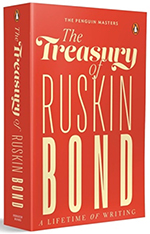
Here is a wonderful mosaic of episodes, recollections, memories, stories and poems by India’s beloved writer, Ruskin Bond. The contents are not new. The book is a compilation of previous works by the author, selected for this collection.
The magic is intact. From the first story, Ruskin Bond’s gentle, unhurried narration and tongue-in-cheek humour take us to vivid memories of a bygone era–down alleys, through fields sprinkled with clover and daisies, train journeys past obscure stations in the middle of nowhere, grassy knolls that lead to streams and blue ponds, small town bazaars, and bigger cities with glitz and glamour. The charming episodes in this thick collection have been written over a lifetime. The book is divided into 11 sections, each dealing with a different phase of the author’s life.
‘Dreams of Childhood’, ‘Rusty and Friends’, ‘Life with my Father’, ‘Dehra in my Teens’, ‘Jersey and London’, ‘Return to India’, ‘To the Hills’, ‘The Ripley-Bean Mysteries’, ‘Envoi’, ‘Love and Friendship Short Stories’, and finally, ‘Songs and Love Poems’. The collection documents Bond’s growth as a person and writer. I read it at an unhurried pace, just as it was probably written, savouring every episode and memory along the way.
There are recollections of old friends mostly all gone, reminiscences of school—some funny, some sad—of happy times with his father, an RAF officer who died too early. Their visits to Regal cinema in Connaught Place at a time when one could walk through the city were among his happiest childhood memories. The separation of his parents was a painful period followed by boarding school fun, pillow fights and all. The memories include scandals and skeletons tumbling out of cupboards. There’s even murder, and what’s more, a serial killer who becomes a friend, and he locks up a sinister murderer in the outhouse! These entertaining memories take up the first four sections of the book, before we come up to Jersey and London.
Ruskin Bond spent three years in the UK, being sent to his aunt in Jersey in the Channel Islands, where it was hoped he would make a living. It was here that he began writing his first novel, Room on the Roof, based on the diaries he had kept during his last year in Dehra Dun. But his heart was always in India. He writes, ‘The affection, the camaraderie, the easy-going pleasures of my Dehra friendships; the colour and atmosphere of India; the feeling of belonging—these things I missed…’
Even though I had grown up with a love for the English language and its literature, even though my forefathers were British, Britain was not really my place. I did not belong to the bright lights of Piccadilly and Leicester Square, or, for that matter, to the apple orchards of Kent or the strawberry fields of Berkshire. I belonged, very firmly, to peepul trees and mango groves; to sleepy little towns all over India; to hot sunshine, muddy canals, the pungent scent of marigolds; the hills of home; spicy odours, wet earth after summer rain, neem pods bursting; laughing brown faces; and the intimacy of human contact.
Human contact! That was what I missed the most. It was not to be found in the office where I worked, or in my landlady’s house, or in any of the learned societies which I had joined, or even in the pubs into which I sometimes wandered…The freedom to touch someone without being misunderstood. To take someone by the hand as a mark of affection rather than desire…To be among strangers without feeling like an outsider. For, in India there are no strangers…
And so, inevitably, it was the return of the native back to India!
The next sections dwell on ghosts galore, even a guardian spirit in the form of a dog, stories of Anglo-Indian spinsters with cats, grotesque tales with macabre figures, rash truck drivers, mysteries with startling disclosures, brief infatuations… The human condition is reflected on and narrated with great humour, along with a thorough knowledge of Indian traditions, beliefs and superstitions.
The Treasury includes poignant short stories like ‘A Guardian Angel’, his classic story ‘The Kite Maker’ (found in several English textbooks) and ‘Would Astley Return?’–a heartwarming story of friendship beyond death. Some of the titles have been changed. The last section has songs and love poems—all between the covers. One just wishes these covers could have been a little sturdier, for this voluminous paperback of 600 pages, with a rather flimsy cover is bound to look dog-eared after a couple of readings. However, the font is well-spaced and easy on the eye.
The Treasury of Ruskin Bond is indeed a timeless collection to treasure and go back to for young adults and indeed all lovers of the quiet magic of Ruskin Bond’s world, away from the cacophony of modern life.