
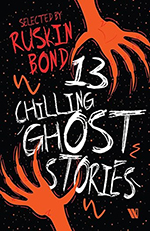
Ghosts will be ghosts. Their origins may be unknown, and their abilities may lie beyond the comprehension of a rational human mind. Defying popular imagination, however, they are not always malignant. Like us, they can be good, bad, or somewhere in between. 13 Chilling Ghost Stories, selected by Ruskin Bond, and Suresh Eriyat’s P.N.K. Panicker’s Ghost Stories, illustrated by Adithi Krishnadas, (Based on the National Award-Winning animated film in Malayalam, Kandittund), offer an interesting take on the genre, introducing readers to a striking variety of ghosts across their pages.
13 Chilling Ghost Stories is an anthology of ghost stories handpicked by Ruskin Bond featuring noteworthy authors like Nathaniel Hawthorne, HP Lovecraft, Rudyard Kipling, Edith Nesbit and many more. Bond’s selections lean toward atmospheric, psychological unease rather than graphic terror, favouring lingering dread over explicit gore.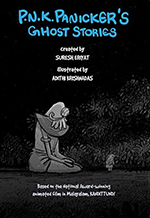 and ‘John Charrington’s Wedding’ by Edith Nesbit, love transcends the boundaries of the ordinary and slips into the realm of the preternatural. Love for one’s passion becomes surreal as shown in Paul Ernst’s ‘Concert to Death’ and Erckmann-Chatrian’s ‘The Murderer’s Violin’ where the music of certain artists continues to be heard long after they have left this world; the spirits keep performing. The anthology ends with perhaps its most compelling story, ‘The Monkey’s Paw’ by WW Jacobs. This tale makes you think twice before making a wish as a talisman from India violently grants a family’s wish and scars them forever.
As with any ghost story, the tales in this anthology let the reader’s imagination run free and far. Each story is paired with a single, rough illustration offering only a faint visual anchor while leaving the rest to the reader’s imagination. The subtle horror of these stories makes this collection well-suited for children who are just beginning to explore their interest in this genre of literature. However, for connoisseurs of ghost stories, this anthology might seem too subdued, as the tales tend to build slowly and resolve gently, favouring a lingering chill over terror.
While the former anthology brings you ghost stories from across the world, Suresh Eriyat’s P.N.K. Panicker’s Ghost Stories, illustrated by Adithi Krishnadas, situates itself firmly in a village in Kerala. It is a marvellous artistic piece, combining beautiful storytelling with brilliant illustrations. The book is based on the acclaimed Malayalam animated film Kandittund! (Seen It!), which in turn was inspired by PNK Panicker’s vivid, larger-than-life tales.
The 93-year-old, introverted and witty PNK Panicker is infamous for his ghost stories in his village. Putting his storytelling skills to use, he combines bits of movies he watches, local folklore and his own imagination to whip up the most incredible ghost stories. While people may think that these are ‘unbelievable exaggerations’, Panicker insists he knows all about the creatures that lurk in the dark in his village at night and claims to have seen a few of them. All of these ‘ghosts’ are distinct in nature and purpose, and Panicker knows all the right ways to ward them off. Some lure you using mangoes; some will do your dirty work for you if you pay them right; some are evil, while others bless you; some simply mind their own business. If you are familiar with the folktales about Kuttichatans, Enampechi or Thendan, these tales will make you question your understanding of them.
The descriptions of their eccentric forms come alive through the vivid and detailed illustrations provided in the book. While the illustrations of these creatures are eye-catching, one cannot help but notice the mundane elements of a Kerala village in the background: the coconut trees, the mundus, the huts and the temples, all create a sense of nostalgia. What makes this book especially unforgettable is the way it retains the oral tone of these spooky stories as if Panicker himself were recounting them by lamplight. This book is a perfect read for children, being both visually engaging and whimsical in its writing.
However, this graphic book is not strictly for children; it can be enjoyed by anyone looking for a read that gives a spooky twist to folklore. For a richer reading experience, it’s definitely worth watching the animated film that inspired this book.
Taken together, these two books offer complementary entry points into the world of ghosts. Ruskin Bond’s 13 Chilling Ghost Stories gathers classic tales from across cultures and periods, presenting ghosts as ambiguous figures whose power lies in suggestion, atmosphere, and the slow creep of unease. Suresh Eriyat’s P.N.K. Panicker’s Ghost Stories, rooted in a single Kerala village, does something different: it localizes the supernatural, turning ghosts into neighbours, tricksters, and guardians: figures you might bump into near the coconut trees or the local temple, not just in far-away haunted houses. Bond’s anthology lets your imagination wander through global legends and cursed objects. Panicker’s stories, brought to life by Adithi Krishnadas’s vivid illustrations and the oral texture of the telling, invite readers to see the uncanny woven into everyday rural life. For younger readers or those new to ghost fiction, either book works well; for those already steeped in the genre, reading them side by side is especially rewarding, as the contrast between restrained, universal horror and colourful, culturally specific folklore enriches what a ghost story can be and reminds us that ghosts, like people, are rarely just one thing.