
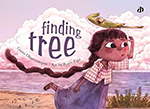
Finding Tree set in the Irula community of Tamil Nadu is about a young girl named Nachiketki and her relationship with a huge tree in the mangrove forest. The tree stands near the sea and is very tall and wide. Nachiketki lovingly calls it her ‘magical tree’ and often says, ‘my tree’. The tree is shown as a world in itself. It is home to many birds and animals such as parrots, mynas, bulbuls, crows, squirrels, bats, snakes, insects, fish, frogs, prawns, and crabs. Nachiketki often shares stories about the tree with her grandmother and Pattikutti. Her relationship with the tree shows her strong sense of connection with nature. One day, the magical tree suddenly disappears. Nachiketki becomes very sad and begins searching for it. Her journey takes her across mountains, rivers, and a silk bridge, where she eventually meets Emmeraja. Through this imaginative journey, the story explores death, loss, love, relationships, separation, and memories.
The story introduces children to the idea of death in a sensitive way. It does not give a simple explanation or try to remove the pain of loss. Instead, it allows us to experience Nachiketki’s confusion, sadness, and loneliness. It suggests that when someone or something we love leaves us, the relationship does not completely disappear. Memories and shared experiences remain with us, changing the way we experience that relationship.
The story moves between reality and imagination. Characters like Emmeraja, the silk bridge, and other magical elements create an imaginary world, while the illustrations make it feel believable. The colourful and detailed pictures made me feel as if I were watching a film, with Nachiketki climbing trees, flying through the sky, and moving across rivers, mountains, and bridges. In the story, Nachiketki searches for her tree, while the parrot searches for its children. Both are experiencing loss and searching for answers. Their journeys can be understood as journeys through grief.
The story can also create meaningful conversations with children and adults. Before reading, we can ask: What are some people or things that you love? What is very special or important to you? How would you feel if that person or thing suddenly went away? Have you ever lost someone or something important to you? How did you feel? As an educator, I feel that this story can reach readers of different age groups because loss is an experience that everyone encounters in some form. Stories like this can provide a space to talk about emotions that are often difficult to express.
For me, the strength of this story lies in holding both pain and hope together. It acknowledges the difficulty of loss while reminding us that memories, relationships, new experiences, and possibilities can continue to exist. Rather than giving an easy answer to grief, the story gently invites us to understand it and find our own way forward.