
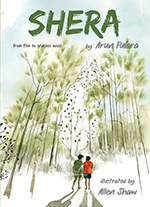
This is a graphic novel that depicts the lives of two children from a village in the Himalayan foothills and their love for wildlife. The fabric of friendship and emotions is woven very beautifully into the story. Arun is from a village in Kumaon, and the stories he heard from his elders about leopards during his childhood deeply resonated with him. These are leopards that do not attack humans and reside in forests adjacent to human habitation. In a way, they live in their own home, a notion accepted by the residents of the Himalayas. This idea holds significant relevance in today’s context, as space for others is gradually shrinking. Arun has incorporated this aspect into his story, along with the theme of the people of the Himalayas migrating toward cities.
Monu and Raju share a deep friendship, and both are eager to see Shera. They are well acquainted with the forest trails, and in their search for Shera, they even involve the reader. One can feel the chill of the wind brushing against the pine trees. The absence of other children in the village compels one to ponder. What is not written in the story invites contemplation, and then many truths come to light. Spending a few days as a tourist in the Himalayas seems so delightful, yet the struggles of the local people’s lives often go unnoticed. This scene is also depicted in the story. Leaving one’s land forever is not easy, and leaving a place where friends and loved ones reside is certainly not simple.
The Shera that Monu and Raju think about all the time, the adult and elderly villagers who tell stories about, the way this Shera takes shape amidst grass and pine trees in the illustrations is truly remarkable. Allen Shaw has created such watercolour illustrations that you can see the Himalayan mountains and the grassy fields in the distance, and among them, Shera is sometimes peeking from behind bushes, sometimes running, and sometimes looking back. Throughout the book, you encounter different shades of green. When I read this graphic novel for the first time, I first read the text and then tried to closely observe the illustrations two to three times. Wherever Shera appears, its expressions, movement, and stillness are visible in the illustrations, along with the rustling of bushes, the swaying of tree branches in the wind, and the roar of the Shera. While reading the story solely through the illustrations, the beauty of the forest in the morning, afternoon, and night captivated my mind.
The collaboration between Arun and Allen Shaw is wonderful. Before writing this story, Arun wrote a short story. After that, he made a short film called Shera and then wrote this graphic novel based on the same story. The language of the story is simple, and the curiosity to know about Shera continues. At the same time, the process of understanding the lives of Monu and Raju also unfolds. I enjoyed reading it and discussed some parts of it with children as well. Libraries for children should have graphic novels of this kind.