
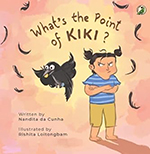
Emotions are very fundamental to being human. They allow us to perceive the world around us; through them, we come to know ourselves and forge connections with others. Yet, these very emotions can sometimes drive us apart from people. Nandita da Cunha’s picture book, What’s the Point of KIKI?, offers an opportunity to experience these emotions. The arrival of a crow into a family changes many things within the household.
Kiki, an injured crow, enters the family’s life. Although it recovers quickly, it does not fly away. Instead, it becomes a part of the family. The most significant change brought about by a new family member is the need to care for them and dedicate time to them. A young girl in the family, one of the central figures in the story, feels that the affection she once received is now being shared. She resents her mother cooking for the bird and tending to him all day long. She feels that Kiki is monopolizing her mother’s time, and resentment towards the bird begins to grow within her. Neighbours, too, find it unusual to see a crow living in the house like a pet. In the afternoons, Kiki is visited by a flock of friends, and the house fills with the cawing of crows. This book sensitively portrays the emotional turmoil experienced by the young girl.
However, over time, initial feelings of dislike or resentment can gradually transform into a bond of affection. There comes a turning point in the story when the little girl begins to feel a growing bond with Kiki. This happens when Kiki gets into trouble; he becomes entangled in a kite string, and she cannot bear to see him suffer. With her mother’s help, she tries to free him.
Kiki escapes the danger, but even after recovering, he is unable to fly. He has now become her good friend; she places delicious treats in his tiffin and often even fetches items for him from the neighbourhood.
The story does not end simply by exploring themes of love and attachment. It also raises several significant questions. For instance, Kiki’s natural instinct is to fly; he ought to be living his life among other birds of his kind. Yet, he is living with a human family. How does this affect his innate nature? Is the family’s love and care leading him toward a different kind of dependency? And could this dependency actually be a form of imprisonment?
Thus, alongside human emotions like love, affection, and even hatred, the book compels us to reflect on the nature of a living being’s innate instincts and its freedom to live authentically. This is a key strength of the story.
Another highlight of the book is the illustrations by Rishita Loitongbam. The illustrations do not merely advance the narrative; they expand upon it. In many places, the visuals seem to tell a story of their own. This way of telling a parallel story through visuals is essential in a picture book.