
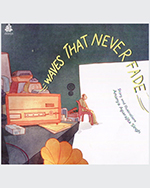
 Waves That Never Fade is the story of the Moinuddin Radio Service shop in in the historic Chatta Bazaar near Charminar, Hyderabad. The author explores themes of history, memory, craft, curiosity and intergenerational legacy, as well as the everyday presence of radio and sound, the tactile world of radio repair, and the understated dignity of those who choose to preserve rather than restore. The story raises an important issue through small details linked to the changing history of technology.
The story begins when a boy visits Moinuddin-ji’s shop and becomes fascinated by the old gramophone and radio displayed there; he asks Moinuddin-ji what they are. In response, Moinuddin-ji shares stories ranging from the history of the radio shop and the gramophone to his own childhood memories, and the author has crafted this conversation into a story.
This is not merely Moinuddin-ji’s story but the saga of three generations. The author chronicles how the radio shop opened and gradually became an integral part of the city and the community. But the book highlights this difference in an interesting way. The author goes beyond viewing the radio merely as a device for broadcasting; she links it to livelihoods, community bonds, and social prestige, illustrating the significant role the radio played in people’s lives.
The story captures the memories and experiences surrounding the radio, experiences that fostered community connection. It depicts scenes such as people gathering outside ‘Mahboob Radio Service’ to listen to news during the Indo-Pak war. Whether it was cricket matches or film songs, the crowds that gathered around the shop demonstrate that the radio was never just a means of personal entertainment; it was a shared community experience.
The title connects the story to the idea of radio waves that never cease to exist. This is illustrated when, at the end of the story, a person asks to have his grandfather’s radio repaired and is told it is a 1935 model; this signifies that, much like memories, radio waves remain with people and never truly fade away.
Typically, a city’s heritage is connected with monuments, landmarks, museums, and historic buildings, but this story offers a different perspective. Through this narrative, the author reminds us that a city’s memories can also reside in the small shops we pass by every day. A city’s cultural heritage is not defined solely by its architecture or structures; it also encompasses professions, sounds, markets, everyday relationships, and craftsmanship passed down through generations.
The book explores various dimensions, but what resonated with me most was the theme of ‘preservation versus restoration’. The author conveys that restoration is not merely about making an old object look new; rather, preserving an object’s inherent age and character is what truly safeguards its significance. The scratches on an old radio, its wooden cabinet, its vintage components, and its unique sound, all these elements are integral to its history. Throughout the story, Moinuddin-ji advocates keeping these objects alive with their original identity intact, rather than erasing their past to modernize them.
The illustrations lend strength to the narrative, providing an animated visualization of the old radio repair shop with Moinuddin-ji sitting outside his shop and watching the hustle and bustle of the city and the passing crowd. The book will appeal to the young and fuel their imagination through the illustrations as they read.
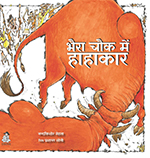
Bhaira Chowk Mein Hahakaar, set in a village square, is about a sudden commotion that erupts at a village square. The book captures the excitement of a bullfight, depicting how people get drawn into the fray and make frantic attempts to stop the clash. The illustrations accompanying the story are beautifully crafted and bring the narrative to life.
The story begins with the everyday life of the village: villagers returning from work, family members chatting outside their homes in the evening, and farming tools and water tanks placed outdoors simply because there is no space to keep them inside.
When the villagers see two bulls fighting in the village square, among the people who try unsuccessfully to stop them are the schoolmaster with the help of his pet dog and Abu Chacha using his tiny goat, Vooly. The fight drags on. Finally, the children devise a way to end the conflict using their own ingenuity and resourcefulness. In this story, the children emerge as the true heroes, resolving a chaotic situation through their wisdom and quick thinking, where the adults had failed. In the end, with a little tact and good sense, the entire mess and commotion is turned into a light-hearted, humorous situation. The author has transformed real-life moments into a narrative, one that sparks the imagination and stays with readers long after the final page.
The book is designed well, with the illustrations working alongside the narrative to transport the reader to a particular place and time. The images convey emotions, hidden jokes, and additional details that complement the text. Furthermore, Soni has beautifully captured the atmosphere of a village at dusk. The colour palette, featuring dark orange (saffron), brown, and light yellow, effectively conveys the mood. Warm colours like yellow and orange express happiness or excitement. These colours highlight facial expressions, posture, and the eyes; details such as a wagging tail are also clearly depicted. Larger images capture grand, thrilling, or expansive moments, while smaller images draw attention to intimate, quiet, or playful details. Mehta writes in very simple language that children can read easily.