
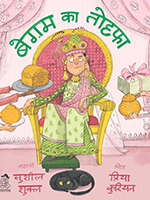
Some stories are not written to begin with. They are told. They travel from one person to another, gather little details along the way, and eventually become part of a city’s memory. Begum ka Tohfa feels like one such story. The tale of Sultan Jahan Begum and the gift meant for Queen Victoria has long been heard and retold among people in Bhopal. Sushil Shukla has woven this oral memory into a written story, while Priya Kurian’s illustrations give it a visual life of their own.
The premise is simple. The Begum wants to send Queen Victoria a gift that is not just an expensive one but truly unusual. The question travels from the palace into the city. People begin to think, suggest, argue and imagine. And then comes the wonderfully improbable idea: a baya, should be persuaded to weave a nest with threads of gold and silver.
The baya, of course, has other plans. He does not understand the value of gold and silver. He understands the need for a nest, for shelter, for raising his young. He builds it in his own way, brings up his chicks and eventually leaves it behind. Only then can the empty nest become the Begum’s gift.
The story is charming, but what stays with the reader is the visual world created by Priya Kurian.
Two spreads, in particular, deserve to be lingered over. They are crowded with people—men, women, children, shopkeepers, passers-by, animals, faces and gestures, all caught in the middle of their own small activities. At first, the eye sees a crowd. Then, slowly, individual stories begin to emerge. Someone is looking at someone else; someone seems to be talking; someone is busy with his own work; someone has stopped simply to watch.
This is where the illustrations become more than illustrations. They do not merely show the story; they create stories around it. A child can return to these spreads several times and discover something new each time. The visual narrative keeps moving even when the written narrative pauses.
More importantly, these crowded scenes make Bhopal itself a character. The market, the people, the roadside conversations, the little gestures and the density of everyday life create a sense of a city that is lived in rather than reconstructed for a historical setting. The story may concern a Begum and a queen, but the illustrations keep bringing us back to ordinary people.
There is also a lovely contrast between these bustling spreads and the quieter images of the baya and his nest. The noise of the marketplace gradually gives way to the stillness of a tree, a nest and a family of birds. The shift is almost like moving from the human world into another rhythm of life.
The language carries the same quality of oral storytelling. Phrases such as ‘Toh janaab…’ and ‘Ab idea suno!’ make the book sound as though someone is sitting nearby and telling us the tale. This matters because the book’s strength lies not in presenting history as a lesson, but in preserving the warmth and informality of a story that has lived in people’s memories.