
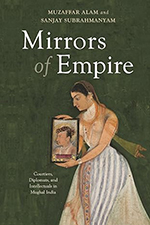
For four decades, the collaborative scholarship of Muzaffar Alam and Sanjay Subrahmanyam has transformed the study of Mughal India, challenging conventional geographical and historiographical boundaries through works such as The Mughal State (1998), Indo-Persian Travels (2007), and Writing the Mughal World (2012). Mirrors of Empire, the latest product of this long intellectual partnership, is an ambitious and learned work. Rather than offering another institutional history, it seeks to reconstruct the intellectual universe of the Mughal Empire through what the authors term ‘self-narratives’. Organized into six substantial chapters, the volume explores the lives and writings of courtiers, diplomats and scholars, arguing that autobiographical and first-person writings provide a privileged window into Mughal political and intellectual culture.
The theoretical foundation is laid in a wide-ranging Introduction. Alam and Subrahmanyam challenge the long-held assumption that autobiography and individual self-consciousness were uniquely European phenomena. They engage critically with the formulations of Burckhardt, Gusdorf, and Lejeune, before bringing into conversation Arabic, Ottoman, Persian, Japanese, and South Asian traditions of self-writing. Their aim is to demonstrate that first-person narratives flourished across the Persianate and Islamicate worlds long before the emergence of modern European autobiography. This intervention is persuasive and important. The introduction alone will become required reading for historians interested in life writing and the history of the self. Few historians possess the linguistic range required to move with equal confidence between Ottoman memoirs, Arabic autobiographies, Timurid embassy accounts, and Mughal chronicles.
Yet it is precisely because the book is so ambitious that its silences become equally significant.
Although the authors seek to depart from older political and administrative histories, the social world reconstructed here remains overwhelmingly that of the elite. The principal figures examined include Faizi, imperial courtiers, ambassadors, celebrated intellectuals, Timurid princes, and renowned Persian scholars. Even the comparative material from the Ottoman and Arabic worlds centres exclusively upon scholars, bureaucrats and eminent men of letters. The protagonists remain members of the highest educated strata of Persianate society. One encounters an interesting paradox: the authors present their work as a departure from histories centred upon imperial institutions and ruling classes, yet the social universe they reconstruct remains entirely confined to these very classes. The elite have not disappeared; they have merely changed their costume. The mansabdar has become the munshi; the noble has become the intellectual. This shift produces fresh insights, but it does not fundamentally democratize the archive.
What is more surprising is the relative absence of lesser figures whose writings survive from the Mughal period. The correspondence of Balkrishan Brahman opens an extraordinarily rich window into the life of a middling munshi, illuminating patronage, financial anxieties, family concerns, and bureaucratic routines. Likewise, the diary of a late seventeenth-century petty bureaucrat provides a rare glimpse into subordinate administration, while Bhimsen’s ‘Nuskha-i Dilkusha’ is valuable as the reflective account of a middling official who experienced the Deccan campaigns from well below the highest echelons of command. These are precisely the kinds of ‘self-narratives’ that might have complicated the overwhelmingly court-centred perspective of the present volume. Their omission is striking because they have not remained unnoticed. Scholars associated with Aligarh, including M Athar Ali and Majida Khan, drew attention to such figures decades ago. Such studies may not have achieved the international visibility of recent cultural histories, but they anticipated many of the concerns now gathered under the fashionable labels of micro-history and ego-documents.
Running quietly beneath this volume is an implicit historiographical contrast with what is often called the ‘Aligarh School’. Although the book does not engage in extended polemics, its methodological orientation clearly distances itself from institutional, administrative and socio-economic history in favour of cultural and intellectual history. This raises an important question: what exactly distinguished the historians associated with Aligarh? Contrary to popular caricature, they were not simply historians of emperors and institutions. Mohammad Habib, Irfan Habib, M Athar Ali, Satish Chandra and others devoted immense attention to the Mughal state, but their central concern was to understand how those institutions functioned.
Their questions were structural: how was revenue assessed? How did the mansabdari system operate? What determined the composition of the nobility? To answer these questions, they employed an extraordinarily diverse archive comprising revenue manuals, farmans, chronicles, legal documents, inscriptions and statistical materials. Far from ignoring narrative sources, they used them extensively. The difference lay less in the sources than in the questions posed to them.
Alam and Subrahmanyam’s intervention is nevertheless distinctive. Where the earlier generation asked how institutions functioned, they ask how individuals fashioned themselves; where the earlier generation sought structures, they seek subjectivities. These are legitimate and productive shifts. The difficulty arises only when such approaches are presented as superseding structural history. The two are inseparable. Faizi’s self-fashioning cannot be understood without imperial patronage, and Anand Ram Mukhlis cannot be understood apart from the fiscal and political fragmentation of eighteenth-century Mughal India. Diplomats existed because states existed. Munshis emerged because bureaucracies required them. The self is never autonomous from the structures within which it is produced. Here the historiographical opposition between cultural history and institutional history becomes unnecessarily exaggerated.
There is another irony. The authors rightly criticize earlier Eurocentric assumptions that autobiography was uniquely Western. Yet once they arrive in Mughal India, the archive they privilege becomes remarkably exclusive. Their protagonists are almost invariably individuals whose writings survived because they already occupied positions of cultural prestige. One is left with what might be termed an aristocracy of texts. The ordinary bureaucrat, the provincial scribe, the merchant, and the lower-ranking official once again recede into the background. The empire thus appears primarily through exceptionally articulate Persian-writing elites. A more explicit reflection on the politics of archival survival would have strengthened the book’s claim to be recovering marginalized forms of selfhood.
Perhaps the greatest weakness lies in the dichotomy it implicitly establishes between structural history and cultural history.
Fine historical writing rarely requires such choices. The Mughal Empire needs both. Without understanding revenue administration, patronage, military organization and class formation, the lives reconstructed here cannot be adequately explained. Equally, without attention to self-fashioning and textual strategies, institutional histories risk becoming impersonal. These approaches should complement rather than replace one another. One might suggest that the finest synthesis remains to be written: a history capable of integrating the insights of the Aligarh historians with the cultural sensitivity exemplified by Alam and Subrahmanyam. Such a synthesis would recognize that structures and selves are mutually constitutive. One might also ask whether the focus on self-narratives has led the authors to neglect other forms of evidence. Administrative records and revenue documents can reveal aspects of Mughal society that even the most reflective memoirs cannot capture.
These criticisms should not obscure the remarkable achievement represented by Mirrors of Empire. It is a work of extraordinary learning, impressive philological command, and immense comparative ambition. The book will undoubtedly become essential reading for scholars of Mughal India and Persianate studies. Yet it also raises important historiographical questions about whose voices deserve to be heard. In seeking to recover the ‘self’, it privileges those selves already endowed with education and literary distinction. The voices of middling officials and less celebrated writers remain outside its field of vision.
Ironically, the real contrast with the Aligarh historiography is not that one studies elites while the other studies institutions. Both are deeply engaged with elite society. The difference lies in emphasis. One analyses the structures that sustained imperial power; the other examines the intellectual lives of those who inhabited those structures. A more generous acknowledgement of that intellectual inheritance would have made this important and stimulating book even stronger. The challenge for future scholarship will be to widen the field of vision while retaining the theoretical sophistication that this volume so admirably exemplifies.
Syed Ali Nadeem Rezavi is retired Professor of History (former Chairman & Coordinator), Centre of Advanced Study, Department of History, AMU, Aligarh, Uttar Pradesh. He is also former Coordinator, Musa Dakri Museum, AMU, Aligarh.