
In his history of the Leadenhall Street headquarters of the East India Company (EIC) in London, The East India House, William Foster refers to James Mill and John Stuart Mill together walking ‘daily to the office’ from their home, ‘probably with many a discussion on the way’. As is well known, the two worked in the Company’s headquarters, James joining in 1819 and John four years later. Both were employed in the Examiner’s Office, the key department which handled the voluminous correspondence between the EIC’s Court of Directors in London, and the authorities in Calcutta. James headed the department from 1830 till his death in 1836; the son held the same position for two years between 1856 and 1858, when the Crown took over the government of the Indian Empire.
During John Mill’s entire career of thirty-five years as an employee of the EIC, he drafted a vast number of despatches, mainly on the subject of relations with Princely States. There are at least two lists of despatches he drafted, or those to which he contributed substantially (or for which he prepared the initial draft), and they amount to nearly 1,700 items.
Without going into the complicated issue of alterations at several stages of the preliminary drafts he prepared, it would not be wrong to say that throughout his working life, Mill would have spent a great deal of time familiarizing himself with conditions in India. What has puzzled scholars is that India does not figure very prominently in John Stuart Mill’s major writings. Besides, he tells us almost nothing about his views on specific aspects of the Company’s policies in his Autobiography, or his possible involvement in formulating these policies, except mentioning that his father’s History of British India had a profound impact on him, contributing ‘largely to my education, in the best sense of the term’.
Many of Mill’s admirers did not attach much importance to his involvement in Indian affairs as an EIC clerk. In a lengthy tribute published on Mill’s death in 1873, John Morley, who would later become Secretary of State for India, does not mention either India or the EIC. At the same time, Mill thought it worthwhile to maintain a detailed record of the despatches he had helped to prepare, indicating that he was not entirely indifferent to his formulations on Indian questions.
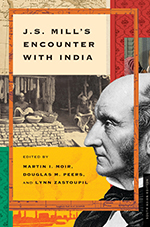
The ten essays brought together in J.S. Mill’s Encounter with India consider, from different perspectives, the place that India occupied in Mill’s thought. The volume was first published by the University of Toronto Press in 1999 and contains papers initially presented at a conference held in Calgary in 1990. It seems that quite a few papers have not been updated or revised since. However, they remain relevant for an understanding of Mill’s thinking on India.
Alan Ryan’s introduction provides an outline of the history of the establishment of British rule in India, and touches on some of Mill’s assumptions about the empire. Mill considered European despotism as the ideal form of government for India. His career at Leadenhall Street coincided with the three decades in which the EIC’s empire attained its greatest territorial extent. By the time he was promoted to the position of Chief Examiner, the entire subcontinent (and southern Burma) had been conquered by the Company—and the revolt was just a year away. The EIC ceased to govern the empire in 1858, immediately after the revolt had been brutally suppressed. Mill advocated the continuation of Company rule.
Douglas Peers in his essay on Mill’s campaign in favour of the continuation of Company rule notes that ‘the fullness of his relationship with India continues to elude us’ (p. 201). Transition to Crown rule was one issue on which Mill took a stand publicly on a matter relating to India. He was particularly critical of Lord Palmerston for his role in the abolition of Company rule. For Mill, specialized knowledge of India was essential for governing the empire well. This was knowledge that Parliament clearly did not possess and therefore had no business to take over the government of India. Crown rule would mean more interference by Parliament in Indian affairs. India could not be ruled through institutions or conceptions that were products of British historical experience. These were not appropriate for conditions in India. Rather, a system of government that was relevant for India would have to be based on very different principles. The peculiar form of governance which had evolved in India, i.e., Company rule, had to be shielded from excessive parliamentary scrutiny and control. This could be achieved by distancing the British Indian Government from the Crown.
We should bear in mind that the Company had continuously obfuscated the issue of sovereignty. The Charter Act of 1813 had proclaimed sovereignty of the British Crown over the Company’s territorial possessions, and this had been recognized by the European powers in 1814 (Treaty of Paris). Yet, the EIC had also accepted the sovereign status of the Mughal Emperor. The matter was still unresolved in 1858 when Bahadur Shah Zafar was put on ‘trial’, just around the time that Mill was putting together his defence of Company rule. These are problems that Peers does not address, rather focusing on Mill’s argument that the continuation of Company rule was essential for reasons of security—a major concern for colonial ideologues due to the experience of the revolt. Ultimately, to Mill, an autocratic form of government was the most suitable for India. India could only progress under an enlightened despotism; not under Indian despots, but ‘civilized’ western despots.
The essays of F Rosen, Allison Dube and Javed Majeed do not directly deal with Mill’s ideas but are useful for placing Mill’s understanding of India in the context of intellectual trends of the early nineteenth century, especially Utilitarianism and James Mill’s principles. Rosen offers a critique of Eric Stokes’s 1959 classic, English Utilitarians and India. Rosen argues that Stokes went along with Élie Halévy’s interpretation of Utilitarianism, mistakenly assuming that James Mill, as a follower of Jeremy Bentham, uncritically endorsed autocracy. Dube’s essay reassesses the relationship between Bentham’s Utilitarianism and the ideas of the Mills. In the case of James Mill, Bentham’s opinion was that ‘His creed of politics results less from love of the many, than from the hatred of the few’ (p. 47). Majeed suggests that we need to take into account the linguistic and aesthetic dimensions that had a bearing on James Mill’s views about Britain’s empire in India. He was critical of William Jones’s romanticization of Indian culture, which created difficulties for undertaking reform. Majeed has earlier, in his Ungoverned Imaginings (1992), underlined that James Mill’s project of writing the History of British India was closely intertwined with ideological conflicts in Britain between Utilitarianism and a rejuvenated conservatism aggressively hostile to the principles of the French Revolution, resulting in a complex set of ideas about governing empire.
Lynn Zastoupil, whose authoritative John Stuart Mill and India (1994) explored at length the evolution of Mill’s ideas about India, looks at the influence of European thinkers on his position on the question of education. By late 1820s, John had distanced himself from his father’s position on the programme for education in the Indian empire, and aligned with the Orientalists in the debate.
Martin Moir’s valuable contribution sheds light on the inner workings of the EIC establishment. Even when we can be certain that Mill was associated with drafting a particular despatch, it is difficult to ascertain the extent to which the final document sent out to Calcutta incorporated his views. Drafts had to be prepared in accordance with instructions given by Company directors, though this was preceded by informal consultations between the relevant director and the Examiner’s Office (in which Mill might have participated). Once the preliminary draft was approved it was sent to the Board of Control for further consideration. Comments and suggestions communicated by the Board would have to be incorporated in the preliminary draft sent to it (referred to as ‘Previous Communication’ or ‘PC’). It is only then that the PC became an official draft. The Court of Directors deliberated upon the draft at this stage. The official draft might undergo further modification before being finalized and transmitted to India. Given this complicated procedure, it is not easy to determine the authorship of despatches.
Nevertheless, some of the despatches do reveal his approach to aspects of colonial policy. Robin Moore’s essay examines his thinking on policies relating to Princely States, the department with which he was most closely connected. For instance, whereas he had been in favour of keeping the status of taluqdars intact before the revolt, he was critical of their restoration by Canning after the revolt. On the other hand, he also supported peasant proprietorship as a general principle.
The concluding essay by S Ambirajan discusses the impact of the writings of Mill on political economy on nationalists and colonial officials in India. Mill was widely read in India. Nationalists were well-acquainted with his political and economic theories, and his philosophical ideas. So were colonial policymakers. His arguments about strengthening peasant proprietorship for preventing famines (though made in the context of Ireland) generated considerable interest in India, particularly in debates about land tenure and food scarcity. It is in this impact that we should seek the relevance of Mill’s ‘encounter’ with India, rather than in his work at Leadenhall Street.
Amar Farooqui is former Professor, Department of History, University of Delhi, Delhi.