
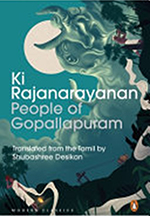
Leaving aside the politics of translation from Indian languages to English and what it says about the implied hierarchy of languages in our context, the problem of translating regional variations of a language into a monolithic ‘standard’ English is a real one. How does one translocate unique turns of phrase and idioms typical to certain geographical regions, which are different from the standard Tamil into English without flattening out the nuances or destroying the texture and flavour? The regional variations have a relationship of synchronicity, difference, deviations, departures, and at times rupture with the mythical ‘mother ship’ language. A Tamil reader would notice and appreciate these variations, leading to a layered understanding of the text instantly, whereas all that is lost to an English reader.
The problem becomes acute when the writer in question is Ki Rajanarayanan (popularly known as Ki Ra), who wrote in a different register of Tamil which belongs to the Karisal (black soil) landscape in the south of Tamil Nadu and is called vattara vazhakku (literally, local language). Although he is a folklorist too, he is primarily known for the novels Gopalla Gramam (Gopalla Village, first published in 1976) and its sequel Gopallapurathu Makkal (People of Gopallapuram, first published in 1990 and the recipient of the Sahitya Akademi award in 1991, the English translation of which is the subject of this review). Gopalla Gramam has been translated twice: first as Gopallapuram, translated by Pritam K Chakravarthy and published by Penguin Random House in 2011; and as Gopalla Gramam, translated by M Vijayalakshmi and published by Sahitya Akademi in 2012. The book under review is the first translation of Gopallapurathu Makkal.
Fortunately for translators and reviewers, Ki Ra himself has written a dictionary of vattara vazhakku. In his Sahitya Akademi acceptance speech in February 1992, he gives the reasons which impelled him to compile such a dictionary:
There is a prevalent opinion that there are difficulties in translating this novel [Gopallapurathu Makkal; People of Gopallapuram] into other languages. I feel it is only appropriate that I say a few words about that. Generally speaking, I accept that literature written in regional dialects can be hard to translate into other languages….
…It is a major drawback that we don’t have a broad-based dictionary that would enable us to understand words from vattara vazhakku. I have published, for the first time, in Tamil a small dictionary containing such words from my karisal region. Still, I am not satisfied with the effort.
(From Ki Ra’s Sahitya Akademi prize acceptance speech, published as an appendix to Gopallapurathu Makkal, pp. 271-272; translation mine).
Curiously and inexplicably, this acceptance speech, which is added on as an appendix with every edition of the Tamil original, has been omitted from the translation under review. And it is not particularly long either.
Strictly speaking, there is no linear plot or narrative in Gopallapurathu Makkal, maybe because it was serialized in Ananda Vikatan over 34 weeks. Just vignettes of the various characters and incidents, stitched together from the pre-Independence period up to 1947, when India got its Independence. The love story of Kittappan and Achintalu is the underlying thread weaving through the incidents in Section 1. How this closed world confronts change and modernity, introduced through ‘English education’, the Independence movement itself and how it impacts their way of life, and the villagers’ views of the various strands of the Independence movement—the Congress, the INA and the Dravidian parties—are portrayed in Section 2.
Coming to the translation itself, I feel it is flawed in many important respects and could have benefitted from rigorous editorial supervision. One doesn’t embark on a translation lightly. It involves hours of poring over a text, weighing over alternative words, choosing an appropriate word for the context and ensuring that it gels as a whole, and, after everything is done, it is mostly appreciated in niche circles. So, negative criticism should not be made lightly, and I certainly don’t make mine lightly.
For me, one of the lesser problems in this translation is the tendency to annotate, to present words in the original language and give an endnote or explaining them in parenthesis inline. And I think it is perfectly alright if employed judiciously. But in the book, most often, such words from Tamil are not only explained within parenthesis in-line in the text, but also explained away in endnotes, and when it is done repeatedly on almost every page, unlike in the original, it impedes the narrative, acting as roadblocks as it were. Especially when Ki Ra himself doesn’t do it, and he was writing in a register of Tamil which is very different from the ‘standard’, ‘literary’ Tamil and he had every excuse to do so.
Another problem, a major one, with the translation is that too often Tamil idioms have been translated rather literally. Again, there are too many of them, and there isn’t enough space to list them all. A couple of examples will do for the purposes of this review.
Kittappan, one of the protagonists in Section 1, hurts himself grievously after a hard and unnecessary feat to show off his strength. Ki Ra uses this phrase to describe his condition: ‘’
(p. 36). This idiom, which translates to ‘Kittappan was bed-ridden’ has been translated literally as ‘Kittappan fell to his bed, ill’ (p. 40).
The word ‘’ means oilcake, but in speech, it is a mild swear word to refer to something worthless or nonsensical. One of the characters exclaims, ‘Nonsense, this has nothing to do with magic’ (translation mine). It has been translated rather literally as ‘What magic is there in this? He would say swearing, “No magic! No oilcake!”’ (p. 170).
We haven’t come to the mistranslations yet, of which there are plenty. Sometimes, a translator has to deliberately dislocate the structure and grammar of English to accommodate and give a sense of the cadence and rhythm of the original language. It works when it does. But here, it is not that kind of dislocation, just ‘bad’ translation.
The sentence ‘’, meaning ‘Kali yugam has indeed peaked’ has been translated as: ‘The Kali had matured’ (p. 112).
I am aware that there is no ‘correct’ way to translate a passage. But felicity of expression and fidelity matter. Sadly, there are numerous such examples: ‘When he said the last, a small wave of laughs came and went in the crowd’ (p. 134) and the charkha gets translated as ‘hand-operated spinning machine’ (p. 225).
It looks as if the manuscript went straight to print without editorial intervention of any sort from the publisher. Just to take two examples of simple mistakes: ‘It seemed that “the world” were not satisfied with separating Kittappan and Achintalu’ (p. 90); ‘…the tufts was gone’ (p. 110). Simple but glaring mistakes such as these subject-verb agreement, and the use of ‘Indianisms’ such as ‘…he ran like anything…’ (p. 70) and ‘…he laughed like anything…’ (p. 125) could have been avoided with editorial input. Personally, I look forward to another translation of Gopallapurathu Makkal, as it happened with the prequel Gopalla Gramam. Surely, Ki Ra deserves it?
Subash Jeyan was an editor/writer with The Hindu Literary Review, Sunday Magazine and Frontline for over two decades. A translator, birder, and biker, he lives in Palakkad, Kerala.