
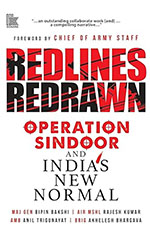
The April 2025 Pahalgam attacks claimed 26 lives, with the assailants specifically targeting men to convey a political and psychological message to both civilians and the Government of India. In response, India launched Operation Sindoor, a calibrated military response lasting 88 hours, the name paying homage to the women who were widowed by the terrorist attacks. Sindoor is considered a symbol of strength, commitment and auspiciousness in Indian culture and was portrayed as an embodiment of our collective national spirit that united the Government, the Army, and the citizenry in giving a definite response (p. 65). Redlines Redrawn: Operation Sindoor and India’s New Normal chronicles India’s decision of redefining its rules of engagement in the face of terrorism. As Maj Gen Bipin Bakshi emphasizes, Operation Sindoor needs to be explored in order to examine and dissect the emerging trends in a rapidly evolving global security order: ranging from the conduct of operations on the battlefield, to the nature of armed conflicts that a state needs to prepare for (p. 261).
The book presents a comprehensive account of the political situation in Kashmir, what allusions it holds for Pakistan’s domestic politics, and how Pakistan has used terrorism as a low-cost tactic and strategic tool against India to pursue its cause (p. 15). The book begins by tracing the history of terror in the Valley, which began with the Soviet Union’s withdrawal from Afghanistan and the consequent redirection of the armed and battle-hardened Jihad to Kashmir (p. 2). Its first chapter authored by Bakshi, ‘State-Sponsored Terror: A Prelude’, documents major terror incidents in Jammu and Kashmir from 2000 to 2024 and the Indian response to them. The author informs us that though the level of infiltration has gone down, every dip in terrorist activities in the Valley is followed by a spike in high-profile attacks (p. 16). Post-Pahalgam attacks, India has sought to engage in non-contact battles within the domain of conventional warfare, while keeping the conflict within the nuclear threshold. Prime Minister Narendra Modi (in the context of the Pahalgam attacks and Operation Sindoor) issued a clear warning against the use of terrorism under cover of nuclear blackmail; signalling that India’s posture is one grounded in resolve, precision and deterrence by punishment (p. 21). The main objective then is to balance punishment with preventing uncontrolled escalation and watch for how Pakistan will recalibrate its proxy war strategy vis-à-vis the evolving Indian doctrine (p. 21).
The next chapter focuses on Pahalgam: after a detailed description of its geographical features and location, the authors note that the region had no history of terrorism and was outside the scope of routine security envelope (p. 32). Due to the mountainous terrain and no motorable road leading up to the meadow, the terrorists were able to easily escape up the hilly region. The chapter recounts the ordeal of eleven families through eleven harrowing survivor testimonies, reflecting the multidimensional scope of Redlines Redrawn. By foregrounding the human dimension of the conflict, it acknowledges both the lives lost and the enduring trauma borne by those left behind. Thus, began Operation Mahadev—a joint venture of the 4 PARA, the CRPF, the Indian Army, and the Jammu and Kashmir police force—who neutralized militants hiding in the Mahadev Peak, Zabarwan range. An important finding of the chapter was grounded in how the Pakistani state actors attempted to create a new module with minimal involvement of the overground workers (OGWs). The chapter explains that the OGWs facilitate logistics, lead the attackers about the terrain, and assist in the provision of arms and ammunition (p. 50). Intelligence revealed that the module had recently been shifted from their training bases in Pakistan, indicating a degree of external coordination and preparation prior to its deployment.
Additionally, Bakshi has given a day-by-day account of the actions taken on both sides—from the time of the terrorist attack to 10 May 2025, marking the commencement of Operation Sindoor. His account narrates India’s multidomain responses and the emphasis on explaining the process of initiation of diplomatic and military responses while documenting the sequence of the Government’s action projects India as a responsible state with a transparent, accountable, and a well-oiled governmental machinery. The section covering the naval dimension of the conflict and how the Indian Navy was employed as a means of exerting strategic pressure is a notable feature of the study. Operation Sindoor, primarily viewed as a joint effort of the Indian Army and the IAF, offered a global stage for India to display its naval supremacy. For instance, the BrahMos supersonic cruise missile naval test signalled India’s dominance in the Arabian Sea (p. 85). The forward deployment of the Indian Navy in the Northern Arabian Sea created a de facto blockade serving multiple purposes. It confined the Pakistani Navy to its harbours thereby adversely affecting its operational agility. Further, the Navy’s Carrier Battle Group ensured surveillance and real-time identification of threats across the maritime domain (p. 86), contributing to the air defence shield of India, especially at the Makran coast. The key takeaways from this section include reference to the Indian Navy’s control over the seas; in turn, validate its anti-missile and anti-aircraft defence capabilities in a complex threat environment; and reflect the non-escalatory intent of India by not letting the conflict expand into the maritime dimension (p. 89).
‘The Air Campaign: Space Surveillance and Nuclear Dimension’, a chapter authored by Air Marshal Rajesh Kumar offers significant insights into the lessons learnt from past incursions and discusses how the Government of India planned its response to the terrorist attack. Battle Damage Response (p. 105) thus became an imperative to increase the efficacy of the Indian retaliation. Additionally, Information, Surveillance, and Reconnaissance (ISR) played a significant role in facilitating pre-strike planning, BDA, real-time situational awareness, aided mid-course correction, and enabled secondary target engagement (p. 127). Kumar has encouraged the fusion of airborne ISR (such as the Netra, AEW&C, and Heron drones among others) with space and Human Intelligence (HUMINT) to protect the ISR assets against cyber-attacks (p. 130). For instance, HUMINT and signal interceptors were employed to identify the increased militant activities and validate the choice of targets. This intelligence enabled precision strikes that minimized collateral damage, thereby helping to control escalation. Redlines Redrawn underscores at multiple points that escalation management was a built-in mechanism at every stage of the plan.
The text is replete with extensive discussions on the weapon systems of both conflict parties, with Brigadier Akhelesh Bhargava even presenting a comparative analysis of the army air defence systems of both India and Pakistan. Redlines Redrawn is thus, a must-read for both, defence enthusiasts as well as beginners in the field. Cyber attacks, drone warfare systems, and the importance of military space infrastructure are some of the running themes through the book that focus on the dynamic nature of contemporary conflicts, especially in the context of South Asia. Bakshi reiterates in his chapter ‘Implications on India’s Security Calculus’ the importance of these aspects in the changing nature of conflict where these dimensions provide for the horizontal escalation of conflict through domain expansion (p. 266).
US President Bill Clinton had once termed South Asia as the most dangerous place in the world (BBC News, 2000). The efficacy of multilateral mechanisms to control the rogue elements continues to decline, and the practice of using focused kinetic force without declaration of war in case of border violations is becoming a norm; however, none of these scenarios have seen two nuclear weapon states in a direct military conflict (p. 262). Nuclear signalling has been evident in any period of tension between the two conflict parties. While the Indian nuclear doctrine rests on the pillars of credible minimum deterrence, no first use, and massive retaliation in case of a nuclear weapon attack, Pakistan’s nuclear posture rests on Full Spectrum Deterrence that allows the state to indulge in nuclear sabre-rattling. This complicates the geostrategic nuances of escalations in the region. On multiple occasions, India has questioned the safety of Pakistan’s nuclear weapons and the ability of the latter’s political leadership to manage them. Through Operation Sindoor, however, India has demonstrated the limitation of Pakistan’s nuclear deterrent as a shield for the prosecution of terrorism.
Ambassador Anil Trigunayat in his commentary as a domain expert in diplomacy has noted the need to understand and re-evaluate the dynamics of strategic partnerships and calibrate its expectations of them accordingly. Through the years, global reaction to India’s plight has oscillated from sheer indifference to verbose condemnation (p. 228), as was observed during the 22 April attacks. Pakistan’s allies, Turkiye and China, provided it with diplomatic, military, and logistic support during its standoff with India; whereas India’s oldest strategic partners and closest allies offered no overt help. For instance, multilateral forums like the Quad and the BRICS did not mention Pakistan by name in their statement condemning the Pahalgam attacks. Trigunayat has also referred to the strategic gaps in communication on the Indian end during the lead-up to the operation, which otherwise would have helped counter Pakistan’s fake narratives.
Redlines Redrawn is a book written from different perspectives and has provided a multi-domain coverage of Operation Sindoor and its consequences: it situates the operation within broader discussions on security, diplomacy, intelligence, media narratives, and civilian experiences. By incorporating contributions from different authors and practitioners, the book succeeds in presenting a layered understanding of the events and their implications. However, this also introduces a notable weakness: the text occasionally becomes repetitive as different authors recount the same events and operational details from their respective vantage points. One may argue, these repetitions serve to reinforce the significance of events across different domains; however, a more streamlined approach would have preserved the multi-perspective value of the text and strengthened its overall coherence and readability. However, Redlines Redrawn has provided the way forward for Indian foreign policy. The text has advocated investing in defence modernization, increasing the defence spending to dominate the escalation ladder in such conflicts; and concluded with maintaining a strong military force and a demonstrated willingness to use it in order to maintain credibility in one’s policy of punitive deterrence (p. 262).
Reshmi Kazi is Professor, Department of Political Science, Jamia Millia Islamia, New Delhi.