
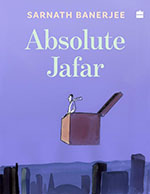
Sarnath Banerjee’s Absolute Jafar is a welcome addition to the graphic novel genre, particularly given Banerjee’s reputation for innovation and experimentation with the form, creating in the process a distinctly Indian graphic novel aesthetic. Some of his earlier works that have been well received include Corridor (2004), The Barn Owl’s Wondrous Capers (2007), The Harappa Files (2011), All Quiet in Vikaspuri (2015), and Doab Dil (2019).
Absolute Jafar is a story about many things, but mostly about the modern-day experience of migration. The novel follows the life of its central protagonist, Banerjee’s alter ego, Brighu, and his experiences of love, marriage, and parenthood in different cities around the world. Through an intimate recounting of Brighu’s life, the novel also tells the stories of the many cities he inhabits—Delhi, Karachi, and Berlin—and the many individuals, such as taxi drivers, government clerks, lawyers, and landlords, who shape his life with their own endearing idiosyncrasies.
Brighu’s story begins in the 1990s in Delhi. Delhi is described by Banerjee as an ‘upstairs-downstairs city’ co-inhabited by the wealthy, the poor, and a large population of migrants who, like Brighu himself, had moved to the city in search of employment, education, and new opportunities. It is here in Delhi that Brighu’s romance with Mahrukh, a Pakistani woman, begins, and this evolving relationship subsequently takes centre stage in the novel. Brighu and Mahrukh’s cross-border relationship, for all its syncretic and romantic possibilities, is realistically depicted, finding itself entangled in the Indo-Pakistani tensions and border politics of the period. The bureaucratic quagmires that they must patiently—and at times despairingly—endure are brilliantly depicted by Banerjee with much sympathy, powerful irony, and occasional witticism. Brighu and Mahrukh’s relationship becomes a lens through which the impact of modern-day geopolitics on the lives of ordinary individuals is powerfully critiqued.
This critique is paralleled by a defining characteristic of Brighu: his habit of walking. The reader is told at the outset of the novel that Brighu walks around every city he inhabits, learning about and understanding urban spaces through these wanderings. In this sense, Brighu resembles the figure of the flâneur described by Charles Baudelaire, an urban observer who maps the city through meanderings, curiosity, and detached reflection. Banerjee’s storytelling in Absolute Jafar can similarly be understood as a metaphorical act of walking, whereby urban spaces are represented not as mere locations but as lived environments that are experienced and remembered by their inhabitants. The illustrations and panels of Absolute Jafar seem attuned to the narrative’s preoccupation with memory. Banerjee employs a largely monochromatic aesthetic created through what appears to be black-ink line work, with only the occasional use of colour.
The unmistakable historical sensibility that runs throughout the work becomes particularly apparent in sections that deal with the city of Delhi, where one encounters a careful interweaving of Mughal histories and the conspicuous presence of South Asian visual motifs. It is also interesting to observe the ways in which Brighu’s story bears the influence of Indian popular culture. Films such as Indian filmmaker Saeed Mirza’s Ajeeb Dastaan (1978) and Yash Chopra’s Noorie (1979), among others, are seamlessly woven into the fabric of the narrative. All of these engagements render the work distinctly Indian in its preoccupations, despite the eventual migration of its narrator to a different country.
An important theme in the latter part of the novel is the sense of nostalgia and dislocation attendant upon the migrant experience. The loss of belonging and home, accessible only through the recesses of memory and imagination, is poignantly represented through the German word Heimat. The anxiety surrounding the transmission of one’s memories and history to the next generation is also palpable in this work. Perhaps what sets it apart, despite its intimate and weighty themes, is its abstinence from excessive emotionalism and solipsism. The narrative’s reflexive awareness of itself as only one story among the many experiences of modern-day migration—including those driven by environmental, economic, and social factors—is worth appreciating.
Absolute Jafar is a seemingly simple yet beautifully illustrated and thoughtfully layered narrative that takes the reader through the affective textures and everyday complexities of lives lived beyond familiar borders in the modern world.
Ann Susan Aleyas is Assistant Professor, Department of English, Jesus and Mary College, University of Delhi, Delhi.