
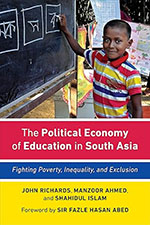
The book under review is one of the more recent contributions to the field of political economy of education that takes the South Asian context as its central object. The book examines, at a narrow level, the relationship between investment in education and learning outcomes and, at a broader level, the relation between educational planning, governance, and human development across South Asia. Its central concern is to ground national educational goals, especially those articulated in terms of measurable learning outcomes, within a language of political economy so that differences in educational performance may be correlated with institutional and policy arrangements. The authors, each with a long-standing engagement in educational research and policy, begin from the premise that the capacity of a nation to provide a decent quality of life to the largest sections of its population is closely tied to the investment it has made in education. From this standpoint, the book asks what counts as investment, what counts as outcome, and why educational investments across national systems yield such divergent results.
Educational outcomes in the book are defined largely through learning outcomes, especially literacy and numeracy, and the authors review different models of assessment across India, Pakistan, Sri Lanka, Nepal, and Bangladesh. Their comparative analysis points to the lack of common standards across these contexts and to the difficulty of arriving at any stable consensus on what ‘quality education’ might mean in such diverse national settings. This absence of standards is treated not merely as a technical problem of measurement but as a symptom of a deeper crisis within education itself. The ‘learning crisis’ (p. xi) is such that ‘expansion in access [to education] has not kept pace with learning outcome’ (p. xiii) and ‘large segments of the population in the developing world…are not benefitting in terms of well-being and prosperity, from strong learning outcomes’ (p. xiii), as Sir Abed notes in his Foreword to the book. Across its chapters, the book returns repeatedly to the argument that educational systems in South Asia have failed to achieve the single most important measure of attaining the goal of education: learning outcome. While the reasons for this failure are multiple, the book identifies weak teacher professionalization, centralization in educational governance, and broader governance-quality issues as among the central obstacles to reform.
The book is divided into three parts. The first is dedicated to defining the quality crisis in education. The second identifies teachers as the key agents through whom this crisis may be addressed. The third proposes a political-economic approach to educational reform that seeks to bring together the teacher-question and the wider problem of educational quality. In the first part, the reader is introduced to the world of actually-existing educational evaluation frameworks across South Asian contexts, including reading and arithmetic matrices associated with ASER and related assessment initiatives. The overall picture that emerges is one of poor performance in almost all the national contexts under discussion, with Sri Lanka appearing as the main exception. Most students who enroll in school do not acquire age-appropriate literacy and numeracy skills, and for the authors, this has implications that exceed schooling narrowly conceived. Foundational education is linked to economic growth, poverty reduction, health outcomes, and social development more generally (p. 9). At the same time, better performance in learning outcomes does not erase internal inequality, social division, or exclusion, as the Sri Lankan case demonstrates.
The second part of the book turns to teachers: their quantitative and qualitative status, their training and recruitment, and the institutional conditions under which their work is managed. Here the comparative detail is one of the stronger features of the book. Across the various national systems, the authors argue that any meaningful improvement in educational quality depends upon a professionally oriented teaching workforce equipped with autonomy, social recognition, and continuous support. The third part gathers these strands together by asking what forms of intervention in the political economy of education might help reorient educational systems toward better learning outcomes. The overall thrust of the book is therefore not only concerned with diagnosing failure but with identifying pathways through which educational systems can be made more responsive, professional, and effective.
The richness of the book lies in this comparative ambition and in its attempt to bring the South Asian context, as both a meaningful and internally differentiated unit, to the forefront of the literature on educational reform. There are historically shared features across the region: hierarchical social organization, forms of exclusion sedimented through caste and class, a shared if uneven colonial inheritance, and developmental trajectories marked by poverty and democratic contradiction. Yet each national context has also evolved along distinct lines over the past several decades. For comparative educators, the challenge has always been to hold together this tension between commonality and difference without allowing one to cancel the other out. In many ways, Richards, Ahmed and Islam attempt to do justice to that problem. By using learning outcomes as a common comparative ground, they try to register national specificities without abandoning the possibility of regional comparison. In that sense, the book also makes a methodological intervention at a moment when the comparative impulse in educational research often appears to have receded in favor of ethnographic and case study approaches.
At the same time, the book can be understood not only through what it engages, but also through what it leaves out. Read symptomatically, these omissions become especially revealing. The book does not seriously engage with the COVID-19 pandemic, except in passing, as though it were an event external to the education field that merely illuminated already existing inequities. It does not meaningfully address EdTech or AI, nor does it treat war, violence, migration, or climate catastrophe as central categories for thinking either political economy or education. While teachers’ professional development is rightly identified as a key driver of reform, the political economy of the teaching profession itself, amidst automation, deskilling, functional simplification of labour, and technological mediation, remains largely outside the frame. Likewise, while active citizenship and civic participation appear as values attached to educational reform, the weaponization of citizenship by states across South Asia, and the educational consequences of forced migration and displacement, do not become part of the analysis. One may sympathetically concede that a book on educational reform cannot deal with every dimension of contemporary crisis. Even so, these silences are too striking to be dismissed as incidental. They raise a larger question: are such omissions simply the result of limits of scope, or do they reveal something about the framework of reform the book itself adopts?
One possible answer lies in the way the book understands ‘political economy’. Curiously, the category is never defined with conceptual precision. Rather, political economy appears in a broad and somewhat policy-centered sense as the study of how public policy shapes the economic and social welfare of a political unit. In turn, the political economy of education comes to mean the field concerned with political decisions about educational governance and their consequences for human development. While this may be a dominant approach in the academic settings where the authors are based, it is clearly a limited one. Here the political, the economic, and the educational appear as relatively discrete domains that interact externally. Education possesses its own technical foundations, politics has its own logic of power and administration, and economics names the domain of welfare, allocation, and productivity. But recent history has shown with increasing force that these categories are not externally related so much as structurally co-constituted. COVID-19, AI, digital infrastructures, ecological catastrophe, and new regimes of migration did not simply affect education from the outside. They transformed what education is, how it is governed, how it is experienced, and what forms of exclusion it now produces. One can no longer neatly separate where education ends and where technology begins, or where educational crisis ends, and the wider crisis of socio-economic formation begins.
From this standpoint, one may approach the book through partisan reading. Despite its explicit emphasis on teachers as the pivots of change, the deeper vector of the argument appears directed less toward educators or educational researchers than toward political and administrative centers of power. The book seeks to persuade those who regulate educational systems to organize the field in such a way that educational quality and teacher autonomy may be secured. Yet this is also a paradoxical position. For teachers to have autonomy in the sense that the book desires, they must first submit to an abstract notion of profession. That abstract professional mastery is then measured through learning outcomes. At present, those outcomes are defined primarily through literacy and numeracy, but one must assume that these measures are historically specific and not transhistorical ones passed on to us from generations. They may shift as the socio-economic order demands something different from education. This is the contradiction at the heart of centring learning outcomes as the organizing principle of education: it promises reform through improvement while simultaneously deepening the logic of measurement whose substance is historically specific and contingent.
It is precisely for this reason that contemporary education policy–India’s National Education Policy 2020 being an example–including the broad policy climate in which outcome-based reform has become common, has so easily organized itself around metrics, accountability, and measurable performance. Once learning outcomes become the master category of reform, education tends to increasingly reorganize through comparison, audit, and performative accountability. Reform then risks becoming less a transformation of the conditions that generate crisis than a way of managing crisis while preserving its deeper structure. In this sense, the book is both valuable and limited. It is valuable because it offers a comparative account of the learning crisis, teacher professionalization, and governance across South Asia. It is limited because its understanding of political economy remains too narrow to apprehend the wider forces that now shape educational life. The book is therefore best read not as a definitive account of the political economy of education, but as an important document addressed to those who continue to believe that educational crisis can be solved through better governance, stronger professionalism, and more coherent institutional design. Whether that belief remains adequate to the present is the larger question the book leaves behind.
Manu V Mathew teaches at the School of Liberal Studies, BML Munjal University, Haryana.