
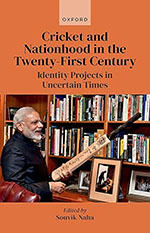
The book critically explores how nationalism has been manifested in cricket. As the game has been played by erstwhile colonizer, settler colonies and erstwhile colonies, the politics of nation-building through cricket assumes greater relevance. With the endeavour of making it reader-friendly, the review forges the missing link between the nature of society and dynamics of cricket nationalism. Such an approach will facilitate to conceptualize the major tenets of nationalism–ethnic and civic; liberal and conservative. Cricketing nationalism offers scope to validate certain key political concepts such as democracy, social inclusion and exclusion. In its introductory section, the editor has eloquently carved out the essence of identity formation pivoting around cricket. Alongside projecting the game as a part of popular culture in the postcolonial societies, this edited volume has unravelled the manner in which the franchise-based cricket leagues depict the ethos of nation branding. Thus, national as well as post-national identity in cricket resemble themselves in simultaneity.
Prior to the Second World War, cricket primarily showcased the ethno-racial basis of identity formation in England. However, the post-1945 scenario revealed a changing dynamics of visualizing national identity due to the politics of immigration which paved the way for cultural diversification. Rather than unravelling nationhood from the point of view of shared ethnicity, the civic notion of identity has become increasingly visible. Players such as Jason Roy, Jofra Archer and Moeen Ali illustrate this proposition. Importantly, cricketers hailing from the British-Asian community have become a permanent feature of English cricket. Hence, cricket nationalism in England reveals substantial degree of ethno-cultural heterogeneity as well as inclusiveness. The passion and enthusiasm for the game among the BAME (Black, Asians and Minority Ethnic) community is worth appreciating. Therefore, the cultural puritanism of Victorian ethics otherwise associated with the Marylebone Cricket Club (MCC) and English cricket deserves to be revisited. Cultural connotations such as Britishness, Englishness and identifying England as the ‘home’ of cricket is barely compatible with the growing ascendency of multiculturalism in the English national cricket team.
In New Zealand, rugby has always given a tough competition to cricket in terms of its popularity. Put differently, rugby has emerged a potent sport for conceptualizing sporting nationalism. However, the success of national cricket in the 1992 Cricket World Cup not only heightened cricket’s popularity in the country but also stimulated the cricket governing authorities to strengthen the domestic cricketing structure of New Zealand. Taken together, it paved the way for diverse socio-ethnic groups to be incorporated into the ambit of national cricketing culture. Hence, players from the Maori community such as Ross Taylor became eminent members of the national side. Likewise, the process of immigration also enriched the cultural diversity of the national team. Players such as Ish Sodhi and Jeetan Patel have Asian descent whereas Neil Wagner and BJ Watling hail from South Africa. Considering the cricketing success of New Zealand, the cricket administering authorities have encouraged their participation in recent times thereby embarking upon the civic sense of national belongingness through cricket.
The social polarization along the lines of race and ethnicity in South Africa provoked its political leadership towards formulating a ‘rainbow nation’ in the post-apartheid context. The politicization of cricket had far-reaching implications for the representation of the Blacks—the Africans, Indians and coloured contingent of the populous on the cricket pitch. As a measure of undertaking affirmative action, the quota system came into existence for selection of players in the national cricket team. It projected a link between national identity and equality of opportunity in South African cricket. Moreover, the sporting success of players such as Hashim Amla, Makhaya Ntini, Vernon Philander, JP Duminy and Kagiso Rabada in international cricket made a strong case to revisit the existing stereotypes pertaining to the incompetency of the non-white cricketers. Despite the success of the Black cricketers, the generalized assumptions of viewing cricket as a means of social mobility needs to be avoided as numerous Black South African cricketers were being raised in elite schools during their formative years. Additionally, the quota system has infused apprehension regarding the future of White cricketers in the post-apartheid era. Hence, the flip side of nation-building has to be accounted for.
India and Pakistan have created a sense of aggressive nationalism in both countries. Whenever the two teams face one another on the cricket field, the long-shadows of Partition and memories of the 1965 war automatically infuse a feeling of ‘self’ and the ‘other’ among the fans on either side of the border. Both teams exhibited a unified stance by playing alongside one another in Sri Lanka prior to the 1996 Cricket World Cup as a mark of ‘South Asian’ solidarity, thereby encouraging foreign teams to play their matches in the island country without having any security concerns; nevertheless, the statesmen have viewed the game as a tool to muster political mileage. Indo-Pak cricket diplomacy was no exception. If Shiv Sena’s act of digging-up the cricket pitch of the Feroz Shah Kotla stadium in New Delhi during the 1999 Pakistan tour of India resembled the spirit of conservatism, the then Indian Prime Minister AB Vajpayee’s iconic appeal to the Indian cricketers to win over the hearts of the people alongside the matches during their the 2004 Friendship Series in Pakistan depicted the virtues of mutual trust and compassion. However, the 26/11 Mumbai terror attacks falsified the potential of cricket to foster peace in Indo-Pak bilateral relations. Alongside barring Pakistani cricketers to participate in the Indian Premier League (IPL), Pakistan was denied the right to host any matches of the 2011 Cricket World Cup. The growing stature of the Board of Control for Cricket in India (BCCI) in the second half of the new millennium manifested the intensification of political interference in cricket. Also, it marked the marginalization of Pakistan especially from the corridors of South Asian cricket.
In Sri Lanka, cricket has been perceived as a hyphen that joins the rhetoric and reality of sporting nationalism. The game has always possessed a considerable degree of social connotation for this island country. Amidst the persisting Tamil-Sinhala ethnic conflict, cricket in Sri Lanka has interestingly showcased the binary of ethnic coexistence and the politics of cooption by the dominant ethno-social group. Muttiah Muralitharan, Sri Lanka’s premier bowler, became a national cricketing icon despite hailing from the ethnic Tamil minority community. In contrast, Angelo Matthews–a Tamil Catholic, had to face social-media backlashes for not complying with Pirith ceremonies before departing for a foreign tour. Hence, the idea of ‘One Team One Nation’ portrays the faultlines between cultural homogenization and heterogeneity. In Sri Lanka, cricket has been viewed as a forum through which people strive for fairness and equality in a society punctuated by ethic turmoil. Towards this end, non-governmental organizations and civil society actors have utilized the popular value of cricket to promote social harmony.
Perhaps, the most fascinating aspect of this volume are the chapters on Australian and West Indies’ cricket as they have projected how global cricket has accorded a commodified value of cricketing nationalism wherein the demarcating lines between the global and national domain become blurred. The Australian Big-Bash League (BBL) was initiated to rejuvenate the domestic structure of Aussie cricket. Moreover, the Women Big-bash League (WBBL) has added a gender dimension to cricket nationalism and postnationalism. Likewise, the Caribbean Premier League (CPL) symbolizes cultural capital embedded in cricket. Even while acknowledging the commercializing trends of the CPL, the chapter has argued the triumph of national identity over competing local and regional identities.
Overall, the book deserves praise for bringing together the multifaceted perspectives of cricket nationalism. However, a dedicated discussion of the IPL would have certainly enriched the glocalization of national and transnational identities. Additionally, the idea of substantive and procedural justice may have also added rigour to the chapter on South African cricket. Nevertheless, the book can be useful for students, researchers and journalists interested in sports studies, postcolonial political studies and sport diplomacy. It is equally enthralling as a popular read.
Avipsu Halder currently works at the Department of Political Science, University of Calcutta, Kolkata.