
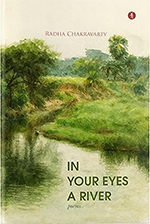
Writer, critic and translator Radha Chakravarty’s In Your Eyes a River is her second poetry collection after the debut Subliminal (2023). Some of the poems in this book have been published earlier in journals and anthologies, nationally and internationally. Radha Chakravarty’s poise in writing is striking; well chiselled words are imbued with feeling to create a rich emotional tapestry. Each of the sixty-one poems in this collection is an invitation by the poet for a curatorial walk, through personal memory archives—forests, mountains and the verdure of the ecosystem. Poems on myth and legend, and musings on life are also a part of this book.
Coursing through this collection is an intense experience for the emotional range infused in each poem. In Your Eyes a River has several poems on members of the poet’s family. Poems on her father, mother and maternal grandparents strike a personal chord with the reader. In the eponymous poem on her father’s village Shyamsiddhi in East Bengal, now Bangladesh, Radha Chakravarty captures the trauma of the Bengal partition. The painful experience of leaving home behind as her father moved from Shyamsiddhi to Calcutta, is poignantly felt: ‘You never left Shyamsiddhi. / In your heart you carried a home, / in your eyes a river, in the soles your feet, / the swing and shift of a bamboo sanko…’ In confronting her father’s story, she traces her own beginnings. ‘Red Hibiscus’, a poem written for her mother, Anita Barari who died of Alzheimer’s, brings home the suffering experienced by both the patient and the caregiver. The red hibiscus offered by the mother each day to her god transforms into a motif signifying both her pain and presence: ‘until one day, / that day you went away, / a red hibiscus bloomed in the garden/ in blood red glory/ and we knew, then, where to find you still, / we knew then where the lost trail led.’ In the poem ‘Grandmother’s Gramophone’, as the ‘rusty pin’ of the turntable spins, the poet meets her grandmother in spirit through a ‘mist of tears’ and asks, ‘Nani. Are you back here with me, now? / Are you listening to the gramophone too?/ These tears. Are they yours or mine?’
Radha Chakravarty recreates not only figures from her personal life, but also the period to which they belonged. The poem ‘The Old House Remembers’ describes the house of her maternal grandparents in Shyambazar Street, Calcutta. Here, we are reminded of a period when women were mostly confined to the domestic space and looked with longing at the world outside: ‘The cavernous kitchen, a space of grandma’s own…And that row of lonely desperate windows/ with bars through which sequestered women/ once watched wistfully as the world outside/ passed them by, in the bustling streets below.’ The trope of memory has been used effectively by the poet through the lens of both the young girl and the mature woman. In ‘Wild’ she reminisces with tender emotion about the relationship with her mother. When she was a young girl, mother ‘struggled’ to ‘tame’ her curls, even as the ‘rebellious tresses refused to obey’. Now, in her sunset years, the poet nurtures the spark within and longs to be with her mother: ‘And I yearn for your calming presence still/ as I battle my way through a tangled world, / alone in the wilds now you are gone.’
The poet’s sojourns to different places in the country and abroad are the focus of some of the poems. In these, the reader is given an insight into the poet’s deeply introspective observations on nature and life. ‘Kanchenjunga’ the ‘fabled golden peak’ inspires her: ‘your mystic glory lifts the soul/ in the blinding light my spirit/ grows wings and soars/ my feet walk the air.’ In Naples, Mount Vesuvius is ‘crouching over Campania/ like an ancient humpbacked camel—/ crescent caldera cradling the cone.’ Note the use of alliteration (a device used in other poems as well) that underscores the beauty of Vesuvius. Poems such as ‘Where Have All the Bulbuls Gone’, ‘Paper Plant’, ‘House Plant’, ‘Hum’ foreground natural history and remind us of our organic connection with nature. ‘Living Fossil’ charts the evolutionary journey of the red panda who has been around for 25 million years, a symbol of the ‘ultimate survival story’ but now reduced to ‘the mock habitat of public zoos, / imperilled by vanishing woods, / predatory poachers, curious crowds/ and a climate gone awry.’
In Your Eyes a River combines myth and legend with the harsh reality of the modern world. Where Subliminal brought forth the legend of Khona, the Bengali female astrologer and poet of the medieval period, in this collection the poem ‘Mouth of Truth’ recounts a medieval legend from Rome. Located at the portico of the Santa Maria in Cosmedin Church, it is believed that the ‘Mouth of Truth’ will bite off the hand of any liar who puts their hand in it. Radha Chakravarty refers to it as the ancient version of the ‘lie detector test’ and in an ironic twist she asks if the usual suspects are— ‘thief, adulteress, fraudster, cheat,/ politician, hypocrite, salesman—/ and always of course in every age/ those tricksters who presume/ to describe themselves as poets?’ In a very different flavour, tickling our palate is the poem ‘Chutney’. In the making of the amsotto, the poem brings together the ‘sticky sweetness of dates’, ‘balance of salt and sugar’, ‘sharpness of red chilli’; all coexist to create a delectable dish. But beneath this lies the telling thought that life is a complex of diverse experiences. The collection also carries a contrapuntal poem, a Fibonacci poem and two poems written as a response to a picture prompt, a photograph by Robert Maddox Harle.
In Your Eyes a River is a poetry collection one will go back to for its opulent emotional texture. The poems in this book are to be savoured in quietude for the tranquil mood evoked as they beckon contemplative engagement with the poet’s observations.
Payal Nagpal is Professor, Department of English, Janki Devi Memorial College, University of Delhi, Delhi.