
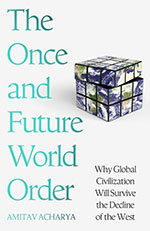
Amitav Acharya has done both history and the study of international relations a service by writing a comprehensive history of the idea and practice of world order. Using a broad definition of world order, namely, as the political architecture that enables cooperation and peace among nations, Acharya shows how the idea existed long before the rise of the West. He traces the elements of world order to Sumer, Egypt, India, Persia, China, and other classical civilizations, and shows that the rules of interstate relations and conduct, economic interdependence, and humanitarian values existed and developed over millennia. He then goes on to suggest that the end of Western dominance that we witness today offers an opportunity to build a better, more egalitarian and representative world order, and makes a powerful argument for cooperation between the West and the Rest in doing so.
Taken together, this book makes a strong case for de-centering the study of international relations. Few scholars have done more than Acharya to move the discipline of international relations from its pale, male, stale, mid-Atlantic origins. In this volume he takes his body of work further, starting with a fascinating and educative romp through the history of the idea of world order and its diverse origins and forms over time. His basic argument is that many mechanisms of building a stable world order, whether in their foundational or advanced forms, came from non-Western civilizations. These include the independence of states, inter-state cooperation, diplomacy, peace treaties, protection of people against cruel and unjust punishment, religious and cultural tolerance, freedom of the seas, mutually beneficial trade, and environmental protection. To this list he adds the provision of security and trade benefits by a leading nation without it colonizing others—which makes China’s tributary system a distant cousin of the post-WWII American world order. Indeed, the first, and possibly the only, civilization with a non-divine origin myth was the Chinese.
Acharya shows that it is in the third to second millennium BC, from the rise of the Sumerian city states to Egypt’s New Kingdom, that five of the most enduring elements of world order were first seen joined together: divine monarchy, the independent state system, empire, the narrative of chaos versus order, and great power cooperation.
The book is thus a frontal attack on the Western conceit that the world order we live in today is a purely Western creation, emerging from the Allied victory in World War II. He rightly points out that most major civilizations borrowed political, cultural and technological ideas from others, especially their predecessors. The creation of a world order has never been the monopoly of a single civilization. For him it was Egypt, Anatolia, Persia, China, and India in antiquity that contributed substantially and durably to the core aspects of contemporary world order.
In effect, Acharya differs fundamentally from the standard linear narrative of Western progress and benevolence that Henry Kissinger, Niall Ferguson, Francis Fukuyama, Tom Friedman, and popularizers like Fareed Zakaria write about, attributing the most profound ideas of world order almost entirely to the West, and asserting that only the West can provide a peaceful, prosperous and just world order, and that others will take us back to barbarism or chaos. Instead, Acharya argues that the benefits of the contemporary world order have gone disproportionately to the West, thanks to predatory colonialism, violence, racism and injustice. What made the contributions of other civilizations invisible was the founding of the modern idea of the West on Europe’s imperialism, cultural arrogance, and racial exclusion. The decline of Western dominance now permits change.
Acharya then goes on to look to the future. He is an optimist and believes that since the values and foundations of world order are not the West’s exclusive property, they will endure even as Western power shrinks. He suggests that with the decline of the West, other non-Western nations will be more important in the future world order, and that it will be marked by cultural and political diversity. His preferred description of the coming world order is that it will be akin to a multiplex, with multiple shows on offer, giving the audience a choice of plots, actors, directors and so on. Acharya does not think the world is increasingly multipolar, for three reasons. In a multipolar world, conflict and cooperation are shaped by a handful of major powers using their superior military and economic strength. But today an increasing number of players, not all of them states, have agency. Secondly, in a multipolar world, economic and military instruments of power matter most. A multiplex world, on the other hand, takes into account the role of culture and ideas. Thirdly, in a multiplex world new forms of leadership and cooperation emerge, and the great powers cannot and do not lead in every area. And that is what we are witnessing today, a multiplex world rather than a multipolar world.
The part dealing with the future is perhaps the bravest portion of the book for prediction is a high-risk calling. Acharya sees postcolonial nations like Brazil, South Africa, Nigeria, Mexico and others joining or displacing Western middle powers like Australia, Canada and Norway in providing global leadership. Postcolonial nations have been rule makers, not rule breakers in reality, and Acharya sees this growing. Today some 35% of global merchandise trade is among the countries of the Global South (from which he excludes China), while that among the rich Western nations has fallen to 25%. Only time will tell whether he is right, but alternative futures are also possible and envisionable including a version of the current order with Chinese characteristics, or a reversion to the historical norm of an absence of a world order and multiple regional orders or multiverses.
India figures often in Acharya’s telling, both as a source of ideas, from Kautilya through Ashoka to the recent past, and as a factor in the emerging world order. His chapter on the ‘Indianization’ of Southeast Asia stresses the peaceful nature of the diffusion of ideas and culture. He also recognizes the creativity of Indian approaches to world order in the early years of the Republic during the fifties and sixties. He is also confident of the greater role that India will play in the emerging world order.
There are, however, some aspects of the book on which further debate is possible and necessary. Both history and the future could be read differently. Acharya defines world order as ‘the political architecture enabling cooperation and peace among nations’. This is a very broad and loose definition which encompasses most of politics and political science. Its breadth is useful in enabling Acharya to range widely in his tracing of the origins of world order, most of them non-European and pre-Western. But its very breadth raises questions about its analytical utility. By this standard, there has always been a world order, even in times of war. There are other sharper ways of defining and looking at the history of world order. This reviewer has argued elsewhere that for most of history there has been no world order, defined as a successful attempt to order the known world. But that is a much less inclusive definition of world order. The false binary between the order imposed by the hegemon and the supposed alternative of chaos is really not borne out by history. Disorder is not necessarily to be feared, except by the state and its leaders rather than by peoples or the people. Some of mankind’s most productive and innovative times have been in the absence of a world order in the Axial Age, the 10th-12th centuries AD, and in war-torn early modern Europe and the industrial revolution.
Secondly, Acharya deals with the building blocks of international order and contemporary Western ideas of order and their origins. For Acharya, the core aspects of contemporary world order include interstate cooperation, humanitarian principles in war and governance, economic interdependence, and cultural diversity. What is less clear is how and why they work, and how they form a coherent world order, except on the basis of Western power and dominance.
All in all, this is a profound and cogently argued book which helps to restore balance in our understanding of the idea of world order and restores the role of non-Western actors in international relations. Its wealth of detail and willingness to look at things afresh do not prevent it from being eminently readable.
One strength of the book lies in avoiding the trap of using classical history to feed today’s hyper-nationalist politics. It concludes rightly that history is not a single, continuous thread of progress leading to the victory of a particular civilization or world order, whether created by the West or others. And it argues strongly for the West and the Rest to work together for a better world order. Whether they have the good sense to do so, is, of course, still to be established.
Shivshankar Menon is currently Visiting Professor, Ashoka University, India, and Chair of the Ashoka Centre for China Studies. He was previously National Security Advisor to the Prime Minister of India, January 2010-May 2014; Foreign Secretary of India, October 2006-July 2009; and has served as the Indian Ambassador or High Commissioner to China, Pakistan, Sri Lanka and Israel.