
Few figures in modern Indian art combine tradition and modernity as eloquently as Sayed Haider Raza (1922–2016). Born in Babaria, a small village in Madhya Pradesh, Raza’s early fascination with landscape, light, and the rhythms of nature shaped his lifelong passion for form and colour. After training at the Nagpur School of Art and the Sir J. J. School in Mumbai, he was one of the founders of the Progressive Artists’ Group in 1947, alongside FN Souza, MF Husain, KA Ara, SK Bakre, and HA Gade, seeking to forge an art that was modern yet rooted in India.
In 1950, Raza went to France on a government scholarship to study at the École des Beaux-Arts. The artist ended up staying for the next six decades. In the late 1970s, he set up a studio in Gorbio, in southern France. It was in France that Raza absorbed post-war modernism and abstraction, moving from landscapes to a geometry infused with Indian metaphysics. The bindu, the black dot or cosmic seed, was his leitmotif, emerging in his works in the 1970s—symbolizing both the source of creation and the point of return.
An interesting aside: when my father, TCA Rangachari went to Paris as the Ambassador of India in the mid 2000s, he made it a point to call on Raza. The practice till then was to invite artists to ‘meet’ the Ambassador. My father thought otherwise—after all, such artists were themselves ambassadors of India, though of a different kind. Raza told Ashok Vajpeyi, who later recounted the incident to my father: ‘Pehli baar koyi tehzeeb wala safir aaya hai.’ When Raza decided to return to India, at the age of 90, he decided to hand over his Gorbio studio and all its contents to the local municipal administration for maintenance. He invited my father to be the guest of honour during the handover proceedings. My father went, and gave a speech—in French!
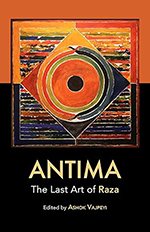
A new book, Antima: The Last Art of Raza, edited by poet, critic and curator Ashok Vajpeyi, focuses on the artist’s final years. The book accompanies the 2025 exhibition Antima at Shridharani Art Gallery, Delhi, which brought together more than sixty works from the artist’s latter phase. It also gathers a diverse group of writers—critics, scholars, poets, and friends—whose essays, memories, and analyses form a composite portrait of Raza’s later vision. The essays in the book explore his desire to reconcile modernist abstraction with the philosophical and aesthetic traditions that were at the core of his practice. Indeed, the artist’s return to India could be viewed as a spiritual re-centring of sorts.
For example, the book reveals how the bindu continued to generate new meanings in Raza’s later canvases. The bindu, as several contributors note, was no longer a motif and had become instead a field of consciousness: a site where stillness, colour, and energy converge. In these late works the bindu seems less diagrammatic and more meditative, suspended in expanses of magical pigment.
Colour, long Raza’s chosen medium of expression, retains its intensity but also acquires a quiet modulation. His late palette oscillates between reds, orange, yellows. As the art historian and curator Yashodara Dalmia writes in her essay titled ‘Raza, The Master Colourist’: ‘The colours are ablaze as in Bindu (2014) where the darkness itself seems to melt into nuanced reds and oranges, creating luminous, diaphanous areas. In “Vriksha-Tribhuj” (2015), the circle is a radiating orange globe emanating red, orange and yellow geometrical shapes and is forever transformative.’1 Some paintings appear to meld between structure and non-structure—evidence, as one essay suggests of an artist who had achieved freedom through form.
Ashok Vajpeyi’s editorial approach is affectionate and heartfelt. Having known Raza closely and written extensively on him, Vajpeyi brings an insider’s access but avoids turning the book into hagiography. His introduction situates the ‘last art’ not as an epilogue but as a summation—a return to sources where the artist’s vision and passion come together. The selection of contributors underscores this balance: writers like Uma Nair, Yashodhara Dalmia, Udayan Vajpeyi, Vandana Kalra, and Aruna Khare-Ghosh approach the work from distinct angles—critical, philosophical, and personal.
The essays together illuminate several key aspects of Raza’s late period. There is, first, the deepening of his engagement with Indian philosophical thought: the recurrent invocation of prakriti-purusha, shunya, and bindu reflects a turn toward concepts that articulate the unity of form and void. There is also a linguistic shift: the use of Devanagari in titles and inscriptions signals a conscious cultural reclamation. Finally, there is the subtle inflection of an end approaching. Many bear the serenity of having come full circle.
For anyone looking to understand Raza’s oeuvre, Antima is a wonderful volume. It combines critical distance with lived experience. The contributors do not merely interpret the works; they recall the artist—the man of gentle humour, solitude, and unrelenting faith in painting as a moral act. Raza worked till the very end, totally dedicated to his art. The book is an important addition in documenting one of India’s most important artists’ practices and adds to our knowledge of modern art history.
The volume’s strengths notwithstanding, its drawbacks include that the contributors’ relationships with the artist sometimes minimize a more critical viewing. Few essays question whether his final experiments risked repetition or whether the freer forms of his last decade matched the structural tension of his earlier work. The book, however, remains invaluable as documentation and reflection. The reproductions—well printed and carefully sequenced—allow the reader to follow Raza’s evolving dialogue with geometry and colour. The writing is accessible and readable. Vajpeyi’s curation of voices ensures that Raza’s art is seen not only through formalist analysis but through the lenses of philosophy, and personal relationships.
Antima: The Last Art of Raza serves as both tribute and study. It affirms that Raza’s late work was not a decline into repetition but a final distillation of lifelong concerns—space, light, and the metaphysical pulse of colour. If the early Raza was the traveller and the experimenter, the late Raza, as these essays suggest, was the sage: painting, yet at peace with the unresolvable mysteries of form. The great artist painted till the end—a true devotee who worshipped at the altar of his canvas in service of art. India is richer for it.
1Antima: The Last Art of Raza, edited by Ashok Vajpeyi, p. 76.
Gayatri Rangachari Shah is a Mumbai-based journalist, columnist, author and podcast host. She is co-author of Changemakers: 20 Women Transforming Bollywood Behind the Scenes (Penguin Random House). She is deeply immersed in India’s contemporary arts scene and is a trustee of the Mumbai Art Room, a hub for young curatorial talent as well as a patron of the Foundation of Indian Contemporary Art.